On our last trip, we had two very different encounters with baby mammals. The first happened when we were searching for nests in some rather strange habitat: the area had been previously logged, then—like all of my sites, rather unfortunately—used for cattle pasture. The cattle presence here had been so intense that the area not only was covered in cow pies, but smelled distinctly like cow. (Ah, nature!) The corn lilies there, usually lush tall green plants, were ragged and brown.
And the whole place was hopping with tiny tree frogs.
Tag Archives: biology
The fledgling problem
EDIT 5/26/2016: If you found this post because you have a baby bird and are wondering what to do with it, please see this post instead; it will be more useful.
———————————————
Being a fledgling—a chick that has left the nest—is awkward.
Fledglings are at one of the most dangerous time in their lives, facing an average mortality rate of 42% over just a week or two. Most of that mortality happens early, just after the little guys have left the nest. New fledglings have almost no skills: they can’t feed themselves, can’t fly well (or, in many cases, at all) and can’t do anything to defend themselves if something terrifying like a weasel, snake, crow, or even chipmunk decides to eat them.
What would happen to you if you shrank to 1 inch high? And more
How can ants lift such huge things? How did T. rex move? Why do we find squirrels cute? Could the alien from Alien really exist? What should you do if you are faced with an ant radioactively blown up to elephant size?
If you’re intrigued, check out It’s Alive! by Michael LaBarbera on Amazon, part of the Chicago Shorts series (it’s just 52 pages) from the University of Chicago Press. I normally never advertise things, but this merits an exception because it’s cool science in small bites, a lot like this blog. Well, except that the author is a respected professor at a prestigious university, so you have to pay $3 for that extra 40 years of knowledge.
And yes, the author is also my father: this is the guy who gave me my love of science. If you’re at all interested in the physics of biology and behavior, or in what really killed the rampaging giant octopus in It Came from Beneath the Sea (it’s not what you think!), it’s definitely worth a look.
What bird colors can tell you
Birds need to know a lot about each other. They need to know things like who will be the best parent; who will pass on the best genes; who could defeat them in a fight; and which offspring is worth investing in the most. One of the ways that birds can perceive such information about each other is by observing each other’s color signals—and the more researchers study these, the more it becomes clear that birds can tell a lot from color alone.
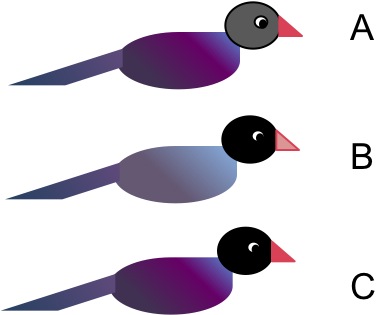
Let’s make up a bird species – the Superb Junco. This imaginary species has a black hood and pink bill like the Oregon Junco, but its body and tail are iridescent blue-violet. Here is an illustration of three individuals of this species:
These individuals are clearly different: A has a paler head, B has a paler bill and is less brightly shiny, and C is brightly colored in all aspects. But what does that tell us?
First juncos of the 2013 field season!
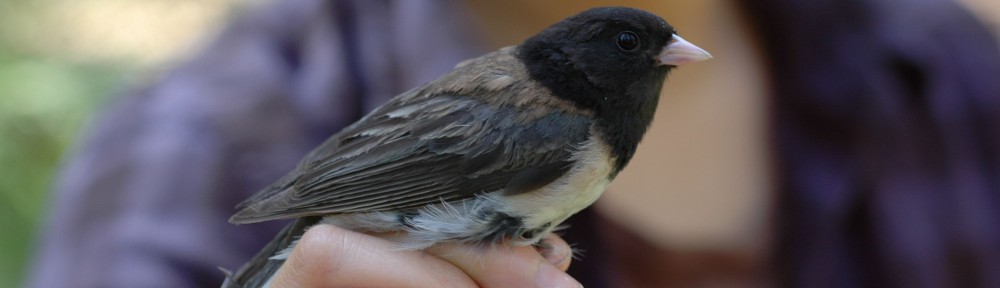
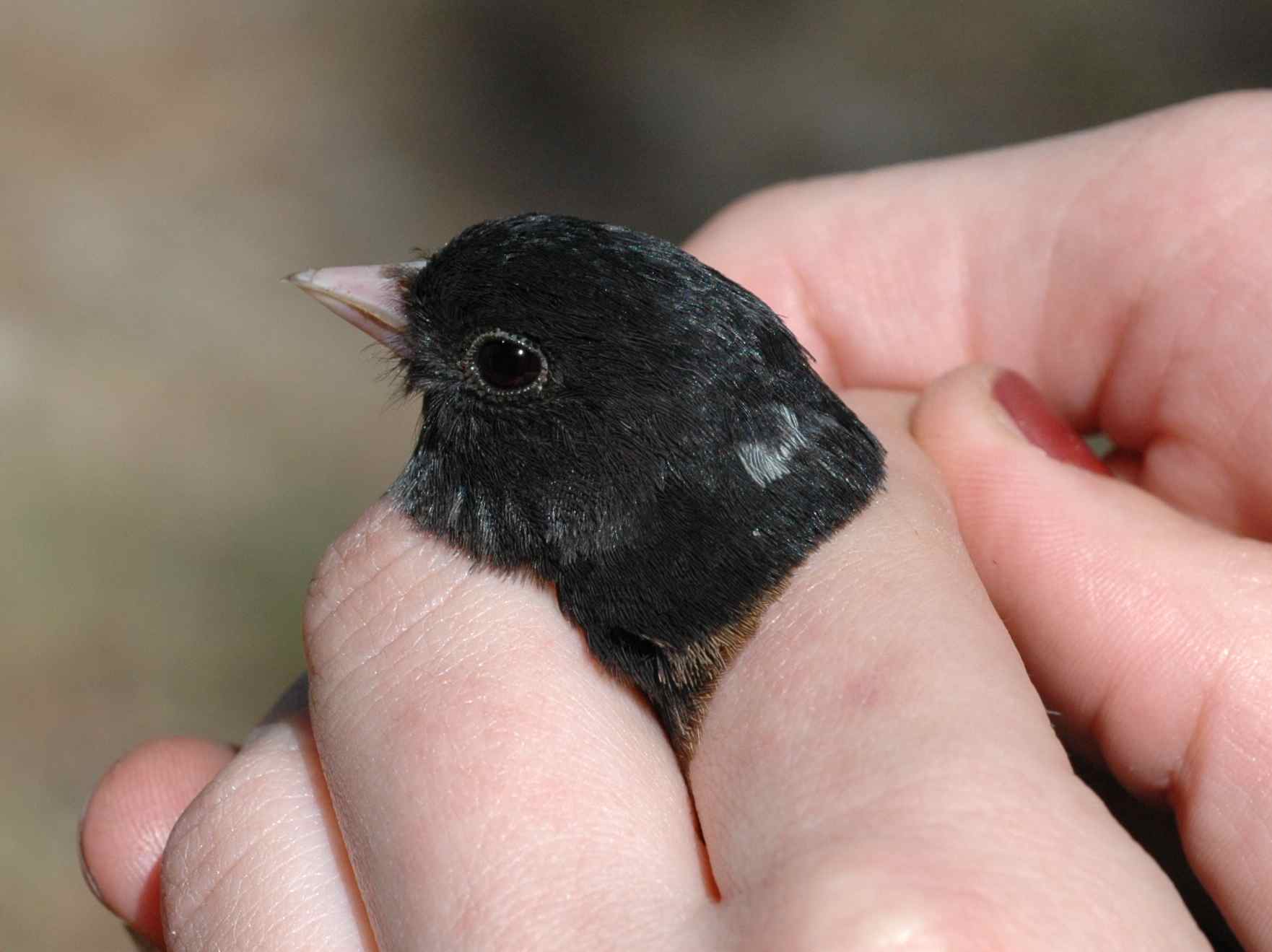
I got back from our first bout of field work yesterday, and I can say that if things keep going the way they did, we’re going to be banding a lot of juncos this year. That is excellent: the more we band, the more we can identify individually by sight, allowing us to observe the behavior of each. It’s much more informative to be able to say “KARL chased RRAY” than “one junco chased another junco”. Too, when we band them we also take measurements and pictures, so we can relate their behavior to things like condition and size.
A heartwarming story, sort of
A few weeks ago, one of my officemates and I were discussing how dangerous it is to be a baby bird when he mentioned that among the creatures that will eat young birds—rodents, deer, ants, slugs—are Western Scrub Jays. “I’ve seen them hunt down and eat young fledglings,” he said. So when, this weekend, I saw a scrub jay pecking at something small and cheeping, I dropped my grocery bags and ran.
The victim was a young fledgling, probably no more than a day or two out of the nest. He cowered on the ground when I reached him. I looked around for his parents, but although there were many spectators peering down from the branches—European Starlings, Chestnut-backed Chickadees, Bushtits—none of them seemed upset. They were there to watch a show, not defend a baby. And although I wasn’t sure what species the fledgling was, I could tell he was too big to be a chickadee or a Bushtit, and he lacked the long-faced look of young starlings.
Scrub jays are smart birds, and I knew if I left the fledgling there, he would go right back on the menu. Too, from the way he huddled and didn’t move, I worried that he was injured. I took him home.
Featured paper: cuttlefish are lying cheaters
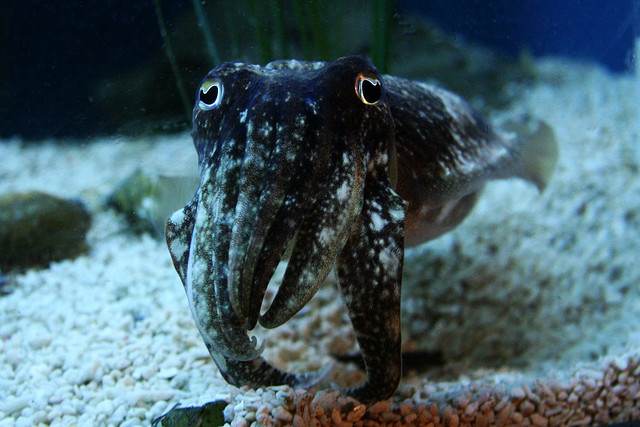
Although the cuttlefish may be best known for making those flat cuttlefish bones that your pet bird nibbles to get calcium, this paper shows that it should be known for being a lying cheater.
Cuttlefish, like their relatives the squids and the octopuses, are masters of visual communication. They can change their appearance almost instantaneously (video here), and they use color and pattern to say things like “Back off, I’m angry!” and “Pretty lady, I would like to do some romance with you now,” and “Please don’t do romance with me, I am male.”
Birds who can see what we can’t
Seeing in the ultraviolet
Even in the visible spectrum, birds can discriminate more subtle color distinctions than we can, thanks to their at-least-five functional cone photoreceptor types (we only have three). But it’s in the ultraviolet (UV) part of the spectrum where they literally can see what we can’t.
Somewhat disappointingly, birds don’t generally have secret UV patterns the way that, for example, some flowers do (Andersson 1996). Instead, they seem to use UV to augment signals we can already see: bluebirds turn out to reflect UV, as do the spots on some thrushes, and so on. But the UV can still contain information invisible to our eyes. In the Alpine Swift and the European Starling, better-fed chicks reflect more UV from their skin; their parents can use this information to give more food to scrawny chicks in good times, or to cut their losses and favor the healthiest chicks in lean times (Bize et al. 2006).
Genetics is complicated: mouse edition
Genetics is complicated. I have taken courses to this effect; I have taught the concept in Introductory Biology. Mendel’s peas with their neat logical Punnett squares were a lucky rarity—each trait governed by just one gene, each of those genes on a separate chromosome. The genetic basis of the vast majority of traits is far more complex. If the genes involved aren’t physically linked (called “linkage disequilibrium”) then they are pleiotropic (influencing many different traits at once), or epistatic (modified by other genes), or simply so subtle that their effects disappear in the noise of environmentally-caused trait variation. Relating traits to genes is hard.
I know this; I understand it; but until recently, I had never actually seen it. Then my pet mice decided to give me an object lesson in genetics.
What happens when you think you have all female mice, but you actually have mostly females and one male?
Avian flight II: albatross flight
Albatross spend most of their lives in flight. They forage in the open ocean, where food may be separated by many miles, and they head for islands only to breed. They have been documented making around-the-world trips in just 46 days (take that, Jules Verne!) and flying for weeks at an average speed of 950 km per day (Croxall et al. 2005). That’s 40 km per hour, so you could beat them in a car (if you could stay awake that long), but still!
How can an animal spend so much time in such fast flight? How do albatross not waste away and die from the sheer energetic effort?