Today I submitted the Big Grant Proposal that I’ve been working on for a while. To celebrate this, because I am a normal person, I dissected some owl pellets.
Now that’s what I call a party.
These particular owl pellets were from Great Horned Owls—these ones, in fact:
When an owl eats something, it doesn’t digest the whole thing. The hard-to-digest parts—bones, fur, exoskeleton—get smooshed into a pellet in the gizzard and then regurgitated. These pellets are a record of what the bird has eaten.
This is my “How is it your business what I’ve eaten?” look.
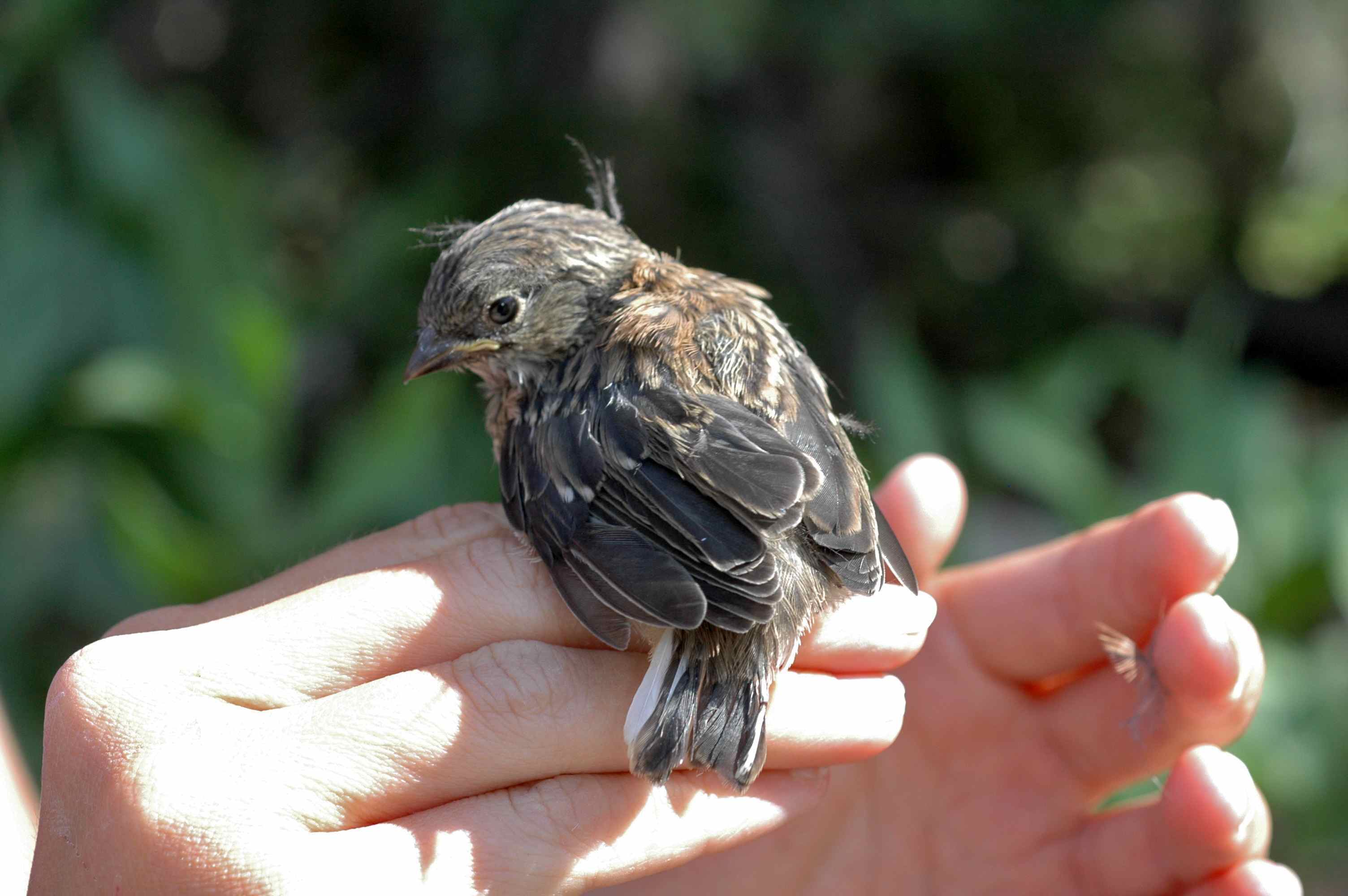
Mammals—including us—use facial muscles to communicate, by, say, smiling or frowning. Reptiles and birds don’t do that: they don’t have the right muscles for it. If you think a bird looks grumpy, or angry, or has any similar human-type facial expression, you’re projecting your human perceptions onto an animal that really doesn’t work like that. (Now, whether the bird actually is grumpy is a different matter; I’m just saying that you can’t tell if it is by looking at its face.)
So the appearance that all these junco chicks have of possessing some serious attitude is merely an entertaining illusion.
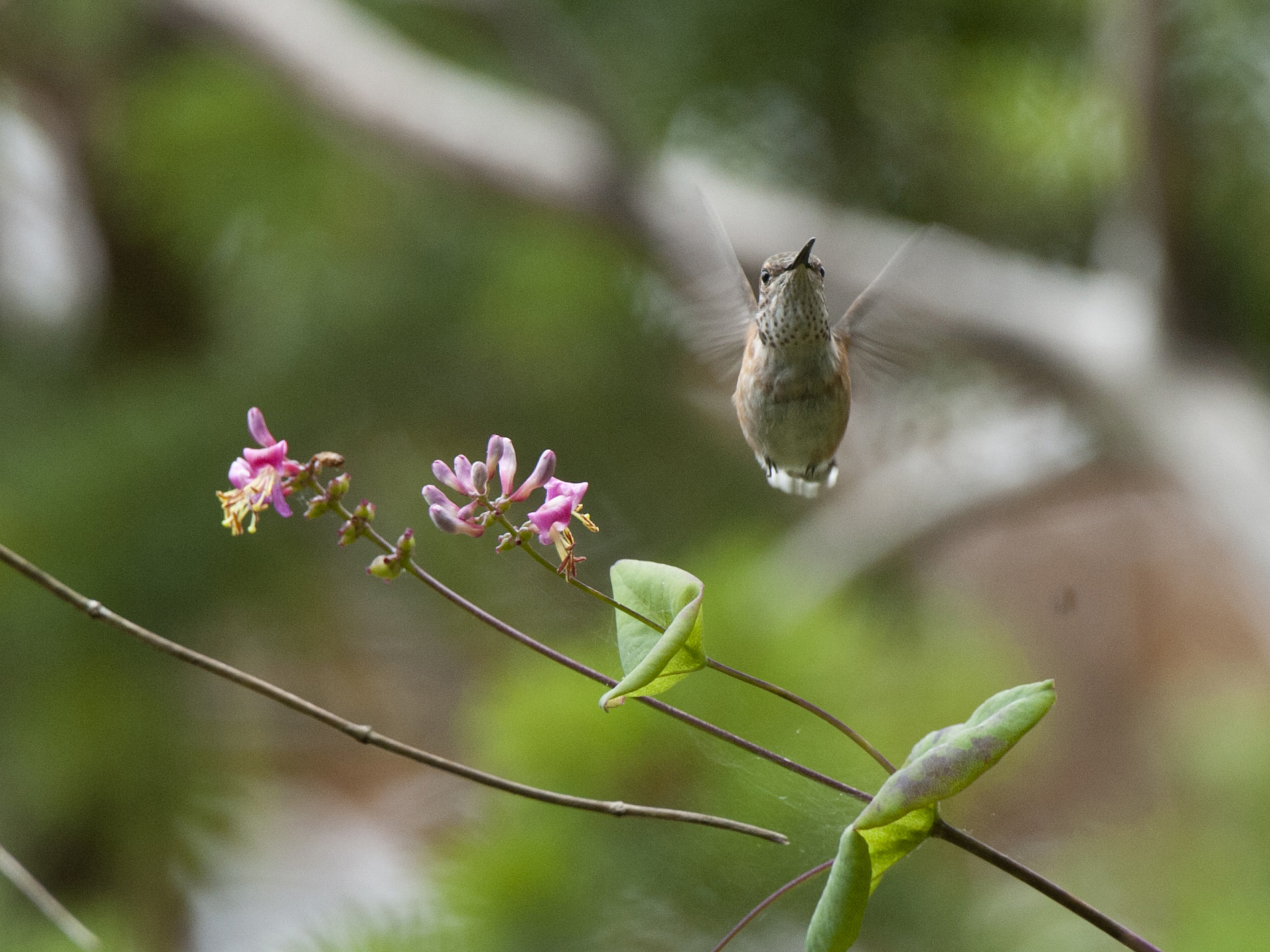
Hummingbirds are amazing fliers. They fly forward at up to 26 miles per hour; they fly backward; they hover. They beat their wings 50 times a second, so all you see is a blur, with that enameled little body floating serenely in the middle. They are flight acrobats. They are flight artistes. How do they do that?
Rufous Hummingbird. Photo by M. LaBarbera
It helps that they are quite small. The amount of power that you can get out of your muscles increases as muscle mass (size) increases—bigger muscles, more power—but the amount of power increases less quickly than mass does. That is, if you double the size of the muscle, you get less than twice the amount of power out of it. This means that as an animal gets bigger, its ratio of muscle power to muscle mass decreases. An ant can carry enormous things for its size. A small bird can generate enough power with its muscles to hold its own body aloft and still in the air—to hover. A California Condor? Not so much. Hummingbirds’ small size means that they are, relative to their own body mass, very strong.
Small size is a Rufous Hummingbird’s secret weapon. Photo by M. LaBarbera
The chickarees have gone crazy. They spent the summer curious but shy, often fleeing us and then scolding from the safety of a tree. Now they seem to have no fear. They run under our table as we eat breakfast. They jump on top of our tents while we are inside. Sometimes they sneak in under the tent fly and look right at us, giant mammals separated from them only by some tent mesh, then saunter off unimpressed. As I was sitting with my back against a tree, one of them went up the other side of the trunk and then crept around to my side, at eye-level, until our faces were a bare few inches apart.
I have somewhat mixed feelings about this new friendliness. On the one hand, they’re cute.
Photo by M. LaBarbera
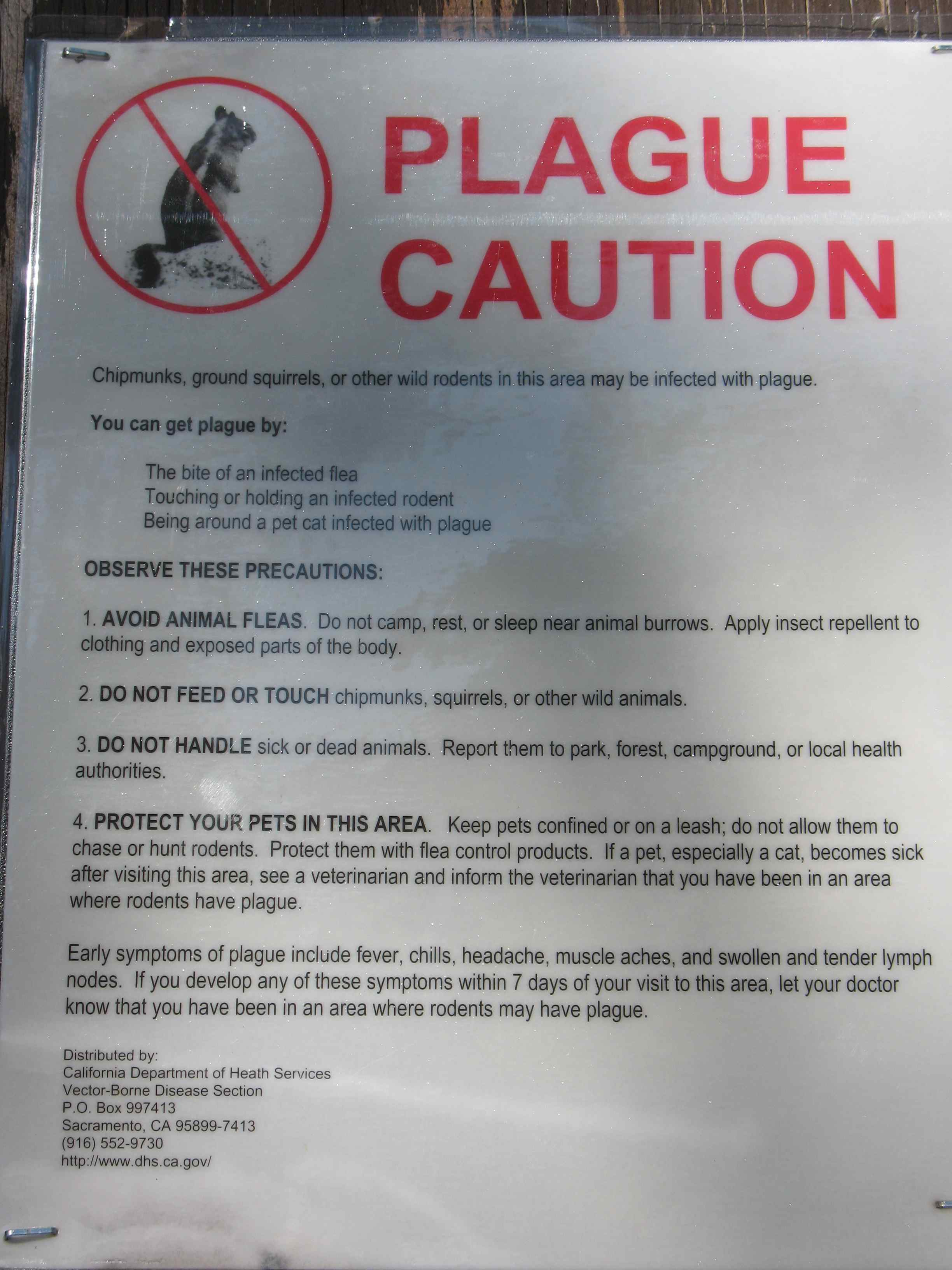
On the other hand, when we call them “plague squirrels,” it’s not just a term of endearment.
And then there’s the fact that they seem to be planning to steal my car.
It was well past dark when I first heard it: around 2 in the morning, it woke me in my tent. I lay awake for what felt like a long time, listening, trying—and failing—to classify the noise definitively as not a danger so I could go back to sleep. At the same time, I tried to think of what it sounded like, so that I could describe it the next morning. A large animal roar. A metal chair scraping across the floor. A death-metal chord. A train whistle.
Whatever it was, it neglected to devour me that night, and in the morning I was relieved to find that one of my field assistants had also been woken by the noise and shared my bewilderment. We agreed that it was primarily a cross between the bellow of some large mammal and the scrape of something mechanical, and so it was dubbed “the robot bear.”
The robot bear
The robot bear called most nights after that. Sometimes I thought it must be a noise of pain, or maybe rage—the tearing roughness in it sounded like strong emotion. Sometimes I was sure it was distant machinery; but we were surrounded by forest, and why would anyone be running machinery in the middle of the night?
Despite pop culture’s image of the scientist as solitary genius, hidden away in his office surrounded by old coffee cups and rat mazes, with escaped fruit flies whirring around his head while theories fizz in his lonely brain, scientists can be quite social. Networking is important in science: it’s how you get jobs, find collaborators, and see new ways to think about your data. (Of course, the networking you’re doing is with other scientists, so escaped fruit flies may still be involved.) This week I’m attending the conference of the International Society for Behavioral Ecology in order to do just that, and the prospect of networking myself has made me think of other animals who network and the benefits they get from it.
The higgledy piggledy poems return… (The first higgledy piggledy post is here.) Once again I have not quite followed all the rules.
————————————–
Parental care
Tentacled vermiform
mother caecilian
what simple kindness your
offspring must lack:
Un-altruistically
cannibalistically
eating their mama’s own
skin for a snack!
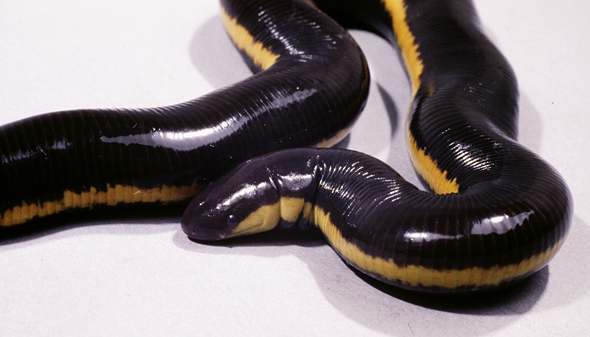
Yellow-striped caecilian. Photo by Kerry Matz*
Caecilians are a kind of amphibian. Some caecilians feed their babies by growing a special layer of skin that the babies then eat. (Hey, is it really any weirder than what we mammals do to feed our babies?) All caecilians have little tentacles on their faces. See, goofy poetry is so educational!
Growing up, I used to watch the Mallards breeding in the local pond every summer. The female would start out with many tiny, adorable ducklings; then, day by day, their number would shrink. I remember not understanding why I couldn’t take a few of the little fluffballs home and have them for myself. (Well, aside from the fact that a city apartment is perhaps not the optimal environment in which to keep ducks.) When so many died anyway, would they be missed? And wouldn’t I really be saving them by taking them?
I’ve been seeing similar sentiments on the internet lately: people who have found out how dangerous it is to be a baby bird asking whether it wouldn’t be best to preemptively “save” the chicks from their probable fate. They are babies in danger, after all—shouldn’t any good person help babies in danger?
Shouldn’t I just keep little YAMM for myself?
The simplest answer is that one should not steal away baby birds because it is illegal under the Migratory Bird Treaty Act—but that isn’t an answer likely to ease the consciences of animal lovers. So I’d like to talk about what it means to help wild animals, and when “helping” can be a really, really bad thing.
One of the biggest changes for me in being in the field, aside from the living-in-a-tent-and-smacking-mosquitos aspects, is becoming intensely aware, all the time, of sound. I’m listening for singing juncos, to know where the territories are; for quietly cheeping juncos, who are usually foraging, to read their band combinations; for angry chipping juncos, whose nests are nearby; for juncos giving what I think of as the ba-boo boo boo call, affectionately greeting their mates. We live in the midst of the juncos, so I’m always listening. And so I hear all the other birds too.
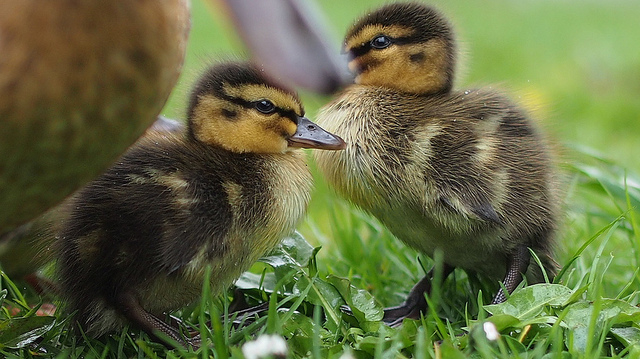
Everyone knows ducklings: yellow fuzz, big flat bills, big flat feet, cute little waddles all in a line after Momma, and superpowers.
Photo by Farrukh*
What, didn’t you know that last part?
Death-defying leaps!
Several duck species nest high above the ground in tree cavities. This is safer than nesting on the ground, predator-wise, but it also means that the ducklings hatch very, very high up. And then they have to get down.
When they hatch, the ducklings weight very little, which helps: the less you weigh, the less you are hurt by falling. Terminal velocity—the fastest that gravity will make you fall—depends on weight, so small creatures are essentially safe from falling no matter how far they fall. The cushiony leaf litter on the ground helps the ducklings too. And notice how they flatten out, spreading their little legs out behind and their wing stubs out front, their bodies as spread out as possible: they are gliding—albeit not as well as a true glider like a flying squirrel, but nevertheless slowing their descent so that they can land safely.