The other day, I thought I’d try out a new camera lens by taking some photos of ducks. It turned out that the ducks were all having the duck version of a bad hair day. If the ducks were on facebook, they would immediately demand that I untag them from these pictures.
A few more ways birds keep warm
Happy New Year! In honor of brand-shiny-new 2013, I have… a continuation of the last post. I left a few things out of that post, since it was starting to get quite long; and then in the course of researching to answer some comments, I found some more things; so here are a few more ways that birds keep warm.
How do birds keep warm?
I’m currently visiting Chicago, relishing the finger-stiffening, face-numbing cold and wind that make up a proper midwest winter. Whenever I look out from the warmth of my big puffy coat and see a bird, I feel a little bad for enjoying the weather so much. I can go home and make myself hot tea; they can’t.
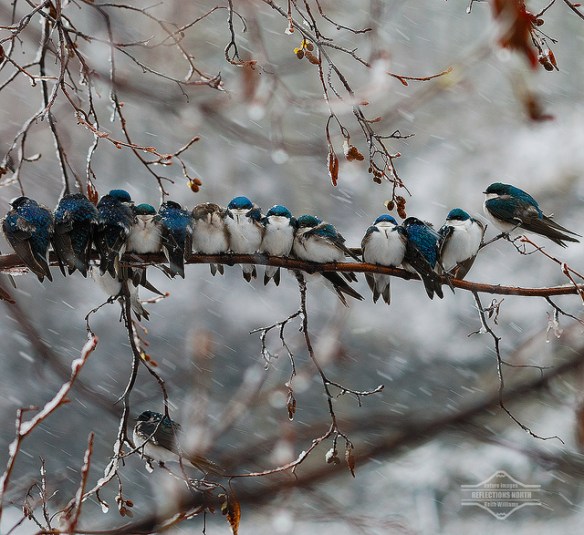
Like mammals, birds are endothermic (“warm-blooded”), meaning that they maintain their body temperature independent of the outside environment. This almost always means keeping themselves warmer than the outside air. Birds have quite high natural body temperatures, even higher than ours, so any given outside temperature seems even colder to them than it does to us.
Birds are also smaller than we are (well, omitting the ostrich), which means that they have a higher surface-area-to-volume ratio than we do. This is a problem because the volume (inside) of an animal is where heat is produced and stored, while the surface (skin) of the animal is where heat is lost to the environment. Imagine holding your hand in a bitter wind: how would you keep it warm? By making a fist. Making a fist reduces the surface-area-to-volume ratio of your hand, and lets it keep warm longer. In contrast, if you hold your hand out flat with all the fingers spread, your surface-area-to-volume ratio is larger, and your hand will get cold very quickly. Because birds have higher surface-area-to-volume ratios than we do, keeping warm is harder for them. How do they do it?
Happy holidays!
Edit: I have added identifications to each photo in the caption.
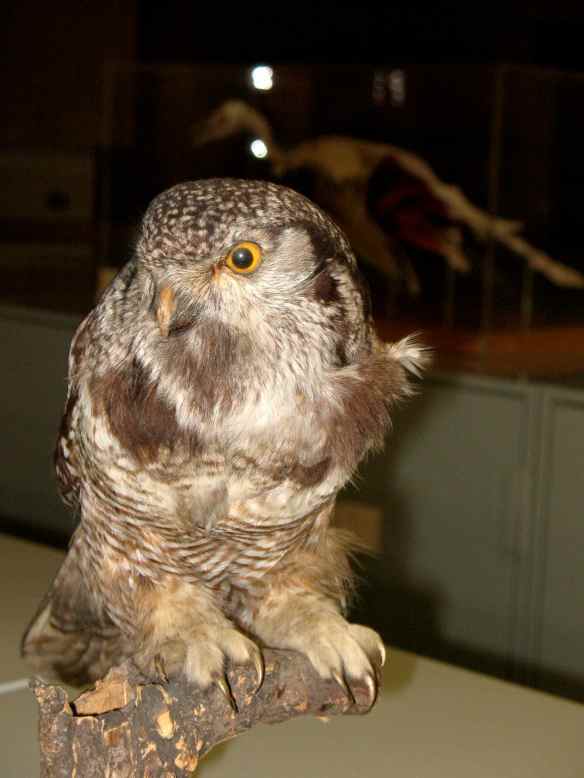
The curators at the museum decorate for the holidays by changing around the mounted specimens on display. (These are all pretty old, usually gifted to us – we almost never mount specimens in a lifelike way.) For Thanksgiving, all the specimens on display were edible animals.
For the winter holiday season… quiz! What connects all of the specimens in these pictures?
(And if you’re not into the quiz, here is your holiday/day-before-the-end-of-the-world gift: a video of a sledding crow.)
Featured paper: the heartbeats of fighting penguins
Viblanc VA, Valette V, Kauffmann M, Malosse N, Groscolas R. 2012. Coping with social stress: heart rate responses to agonistic interactions in king penguins. Behavioral Ecology 23(6):1178-1185.
Most animals live solitary lives, interacting with their own kind only to mate, raise young, or fight. In contrast are group-living animals, from meerkats to humans to Greylag Geese. Their sociality means an easier time locating mates and spotting predators, but it can also mean more disease and competition for resources. This competition can lead to injury and stress.
Breeding King Penguins crowd onto shores in huge numbers and claim tiny territories – about one-half of a square meter – where they incubate their egg and then brood the resulting chick. They have to defend these territories constantly, on average 100 times per hour. This occurs over a tiny space, since the penguins have an egg or chick on their feet and so can’t move much; most aggressive interactions are with neighbors no more than 50 cm away. Stressful interactions may not sound like a big deal – hey, we’re all stressed, right? – but these penguins are trying to maintain a high body temperature in cold conditions and keep their baby warm, and while doing that, they fast for weeks. They do not have energy to waste on stress.
Climate change in the Sierra Nevada mountains
Climate change will affect every corner of the globe in some way, from rising average temperatures to ocean acidification to increasingly extreme and unpredictable weather. It may eventually lead to coastal habitat becoming submerged and the desertification of once-green areas. Currently, however, one of the areas in which climate change exhibits its most dramatic effects is on mountains.
On mountains, the variation in elevation causes habitats to change over relatively small areas. Species may be adapted to just a small strip of habitat within a certain elevational range. With changing climatic conditions, those strips of habitat may move on the mountain, and species then have to follow that strip – track their climatic niche – or stay put and adapt rapidly to the new conditions there.
The slow, slimy style of snails
It doesn’t rain very often here, but when it does, the snails come out in force. I’ve always liked snails and their ilk; as a kid I kept slugs as pets. Unfortunately I think the snails here are brown garden snails, an invasive species.
Sinister invaders or not, like any snails they’re surprisingly engaging to watch. Bumpy skin, patterned shells, eyes on stalks, and total flexibility give a lot of opportunities for expression.
What a PhD means
The general public–and especially the media–appears to be conflicted over what it means when a person has a PhD. There are three main schools of thought:
1) A PhD means you are an awesome genius and know everything.
2) A PhD means you are an ivory tower elitist and know nothing.
3) A PhD means you belong to a nefarious conspiracy dedicated to lending credibility to lies in order to get money or fame.
Sometimes several of these are combined. Believe both #1 and #3, and you’ve got one of the main arguments of climate change deniers (“Climate scientists are lying and spreading false fear in order to keep their jobs secure, and we know this because we found one climate scientist who says climate change isn’t real!”).

The ivory tower elitist PhDs are in a conspiracy of lies to make the public continue to give them research money, and I believe this because the guy who told me has a PhD, so you know he’s right!
None of these three are true.
The other juncos
As I mentioned before, I don’t get to be out in the field interacting with the juncos right now. I am, however, making use of the other juncos: the ones that don’t fly away, don’t stress out when I handle them, and are always there when I go to look for them. The ones that live about twenty feet from my office.
I work in a museum, remember?
Search term adventures!
Sometimes people type words into Google, Bing, Yahoo, or other nonsense words masquerading as search engines. Sometimes those words lead them to my blog. Here are some search terms that I think would make sense for leading people to Tough Little Birds: “animal behavior,” “dark eyed junco,” “scary birds,” “bird science blog,” etc.
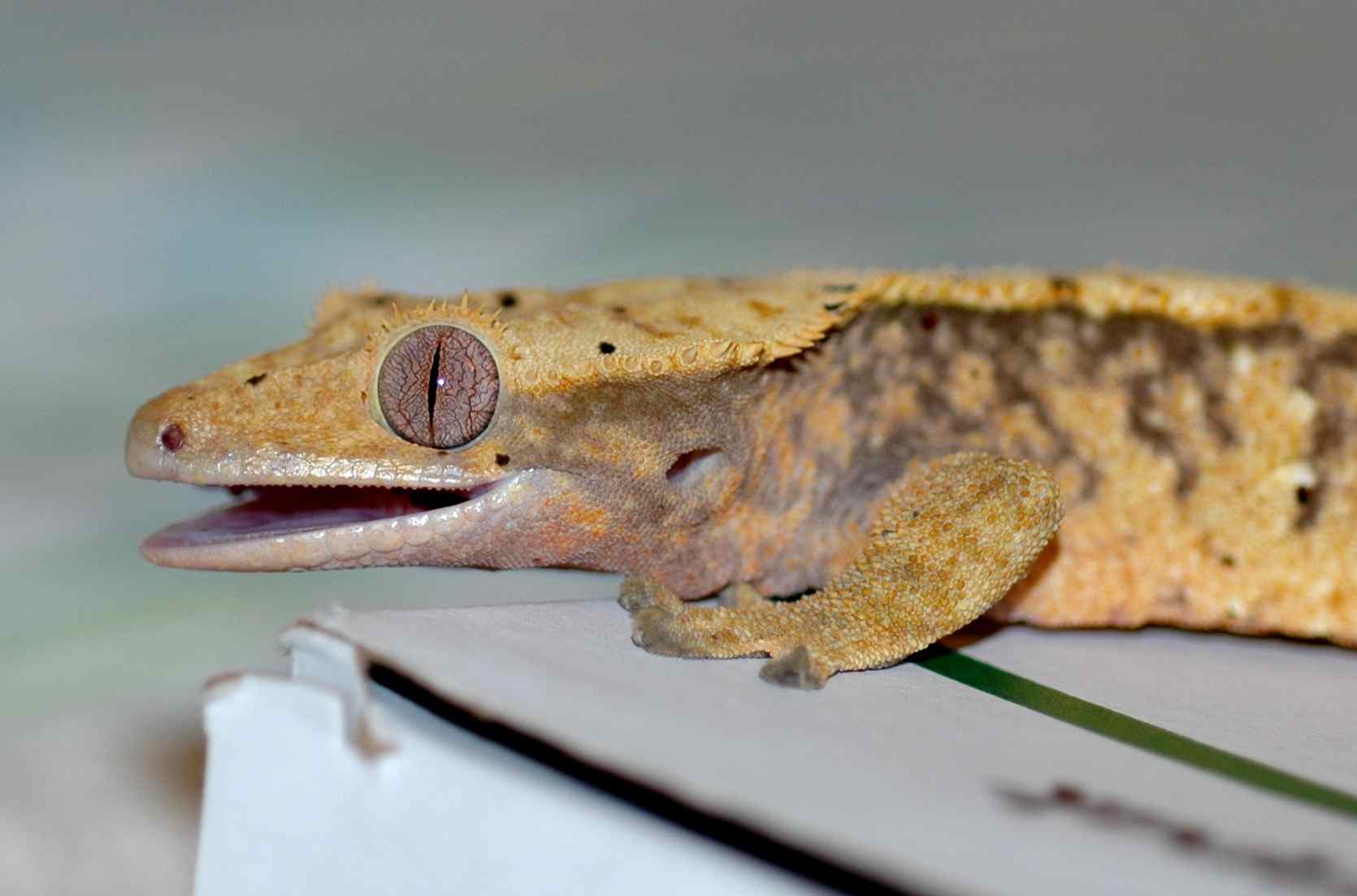
Here is what people are actually searching to end up at my blog: “is a gecko a bird.”
So, as I blog to please you, dear readers, I will now attempt to respond to some of the actual search terms that have led people to TLB.