Velella velella! Or, falling off the edge of the world

They were strewn all along the beach, these transparent, tripartite things. At first glance they looked like plastic trash, but they felt organic in my fingers.

velella5

Fortunately I happened to be beachcombing with a world expert on marine invertebrates. “Ooh,” he said, “Velella!”

Velella velella, or by-the-wind sailor: a living sailboat, a jellyfish on a stiff frame. In their preferred state, i.e. when not washed up on beaches, these animals float on the ocean surface with their tentacles just below the water, to catch food, and their upright sails above the water, to catch the wind.

velella8


Continue reading

Avian flight III: hummingbird flight

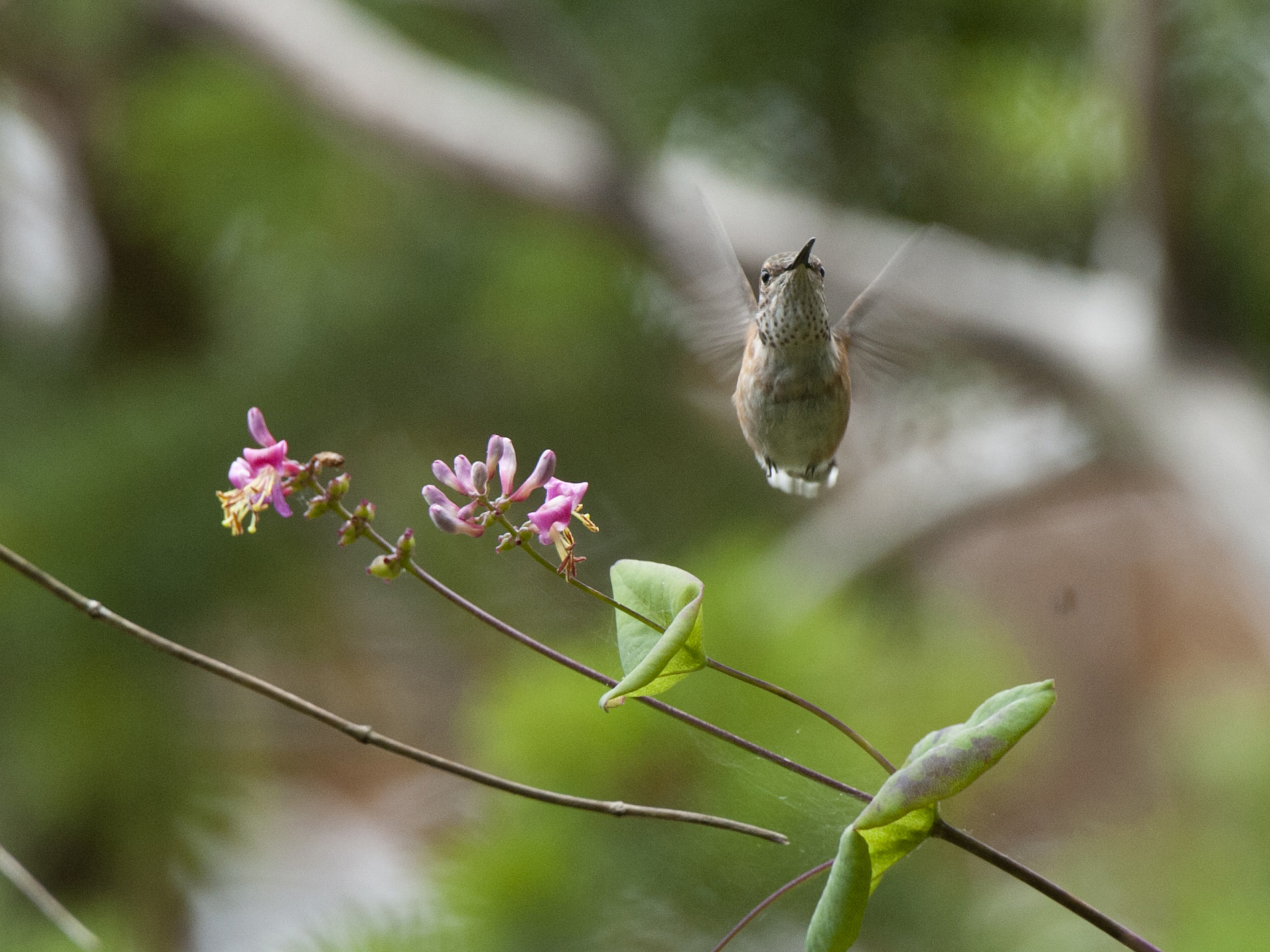
Hummingbirds are amazing fliers. They fly forward at up to 26 miles per hour; they fly backward; they hover. They beat their wings 50 times a second, so all you see is a blur, with that enameled little body floating serenely in the middle. They are flight acrobats. They are flight artistes. How do they do that?

Rufous Hummingbird. Photo by M. LaBarbera

Rufous Hummingbird. Photo by M. LaBarbera

It helps that they are quite small. The amount of power that you can get out of your muscles increases as muscle mass (size) increases—bigger muscles, more power—but the amount of power increases less quickly than mass does. That is, if you double the size of the muscle, you get less than twice the amount of power out of it. This means that as an animal gets bigger, its ratio of muscle power to muscle mass decreases. An ant can carry enormous things for its size. A small bird can generate enough power with its muscles to hold its own body aloft and still in the air—to hover. A California Condor? Not so much. Hummingbirds’ small size means that they are, relative to their own body mass, very strong.

Rufous Hummingbirds are small. Photo by M. LaBarbera

Small size is a Rufous Hummingbird’s secret weapon.
Photo by M. LaBarbera

Continue reading

The many (and changeable) colors of the Pacific tree frog

We spend a lot of time looking for junco nests in my field work, which means we spend a lot of time looking at the ground, which means we see a lot of these little guys:

2014_frogs13

Pacific tree frogs come in two main flavors: brown and green.

2014_frogs6

Some frogs stay the same color for their entire lives, but some can change from brown to green, or vice versa, depending on whether the background is dark (brown) or light (green). You can see how this might be handy if you want to blend in with the background.

You can't see me!

You can’t see me!

Continue reading

The sky is falling: birds and hail

The season of the summer disaster movie is upon us: Godzilla is stomping San Francisco, and I’m sure we’re all eagerly anticipating the premiere of Sharknado 2. To liven up the cinemas a bit, as a relief from the overabundance of sequels (I mean really, Sharknado 2!), I would like to propose a new genre mash-up: the animated talking birds disaster movie. It would be like those dancing penguin movies, or the solemn-looking owl movie (I have seen none of these…), plus disasters. The first one could be called Hailstorm!

It would not be a children’s movie. It would be terrifying.

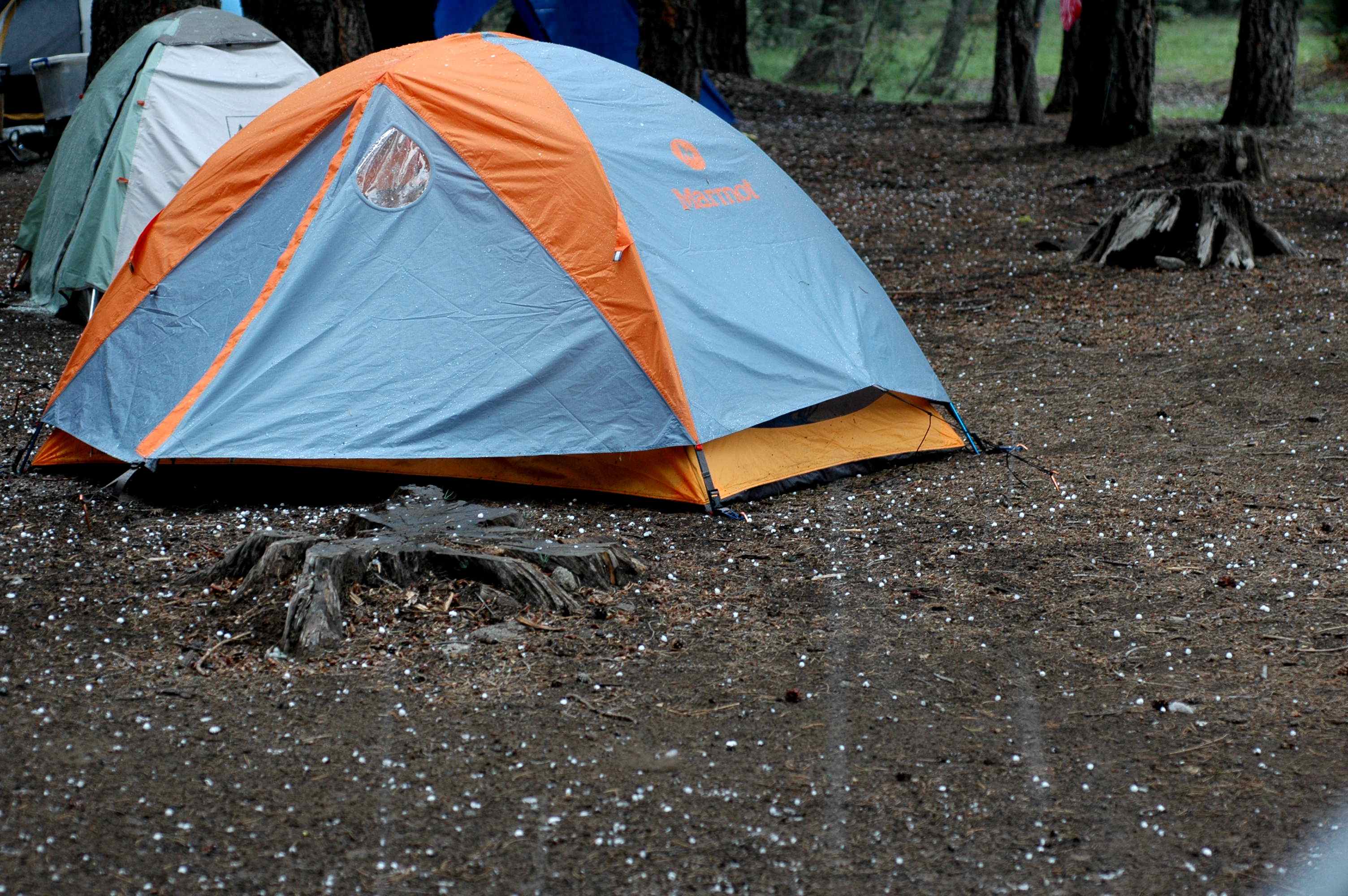
It hailed on us a few days ago for about half an hour. The hail was mostly small, not larger than 1 cm in diameter, and the only animal reaction I saw was a decidedly alarmed chickaree—although to be fair, chickarees almost always look alarmed. I saw no evidence of damage afterwards; all of the junco nests we were monitoring weathered the storm just fine.

We hid in our tents.

You know the hail isn’t too bad when you can safely hide from it in a tent.

But sometimes hail is a sharper-fanged beast.

Continue reading

Ducklings with superpowers

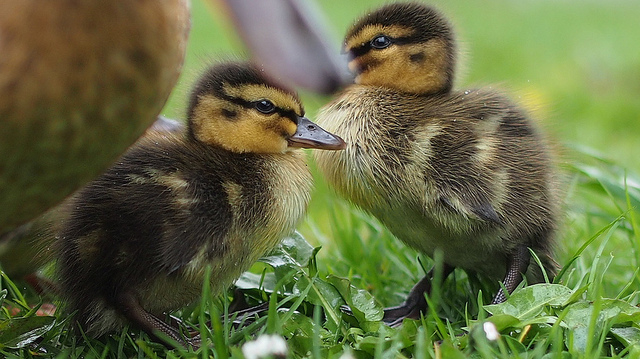
Everyone knows ducklings: yellow fuzz, big flat bills, big flat feet, cute little waddles all in a line after Momma, and superpowers.

Photo by Farrukh*

Photo by Farrukh*

What, didn’t you know that last part?

Death-defying leaps!

Several duck species nest high above the ground in tree cavities. This is safer than nesting on the ground, predator-wise, but it also means that the ducklings hatch very, very high up. And then they have to get down.

When they hatch, the ducklings weight very little, which helps: the less you weigh, the less you are hurt by falling. Terminal velocity—the fastest that gravity will make you fall—depends on weight, so small creatures are essentially safe from falling no matter how far they fall. The cushiony leaf litter on the ground helps the ducklings too. And notice how they flatten out, spreading their little legs out behind and their wing stubs out front, their bodies as spread out as possible: they are gliding—albeit not as well as a true glider like a flying squirrel, but nevertheless slowing their descent so that they can land safely.

Continue reading

Animal visual illusions

Animals interact visually all the time. Males try to look big and scary to rivals, or sexy to females. Prey animals try to look inedible—or better, invisible—to predators. Sometimes these animals use visual trickery to assist their cause.

You’ve probably encountered visual illusions before. Here are some classic ones:

a) The vertical line looks longer than the horizontal line, even though they're both the same length. b) The top line looks longer than the bottom line, even though both are the same length. c) The middle circles are both the same size, but the one on the left looks bigger. d) The middle grey rectangle is just solid grey, but against the gradient background, it looks like a gradient. e) Both circles are the same shade of orange, but the one surrounded by black looks brighter.

a) The vertical line looks longer than the horizontal line, even though they’re both the same length. b) The top line looks longer than the bottom line, even though both are the same length. c) The middle circles are both the same size, but the one on the left looks bigger. d) The middle grey rectangle is just solid grey, but against the gradient background, it looks like a gradient. e) Both circles are the same shade of orange, but the one surrounded by black looks brighter.

Animals can use visual illusions a) and b) to appear bigger by changing their posture. Vertical stances make you look bigger than horizontal ones, and making a Y with your limbs looks bigger than letting them fall down. So if you’re a male peacock spider trying to look big and sexy to a female, you can raise a pair of back legs up in a Y to look bigger than you really are.

Peacock spider display. Photo by Jurgen Otto*

Peacock spider display. Photo by Jurgen Otto*

Continue reading

Safe behind these castle walls, eggs: how birds’ nests protect their precious contents

Recently I was lucky enough to spend some time in Spain, where the land is dotted with hilltop castles and the winding narrow streets of the old cities are encircled by sturdy stone walls. I crouched behind crenellations, pretending to be a bowman awaiting attack, and climbed dark winding staircases glad that no defending army waited at the top.

Winding staircase in the Olvera castle. Photo by Q. Stedman

Winding staircase in the Olvera castle.
Photo by Q. Stedman

It’s exciting and romantic to imagine castles and walled cities in the flush of functionality, but it’s hard to ignore that the motivating force for those structures was real, unromantic, gut-knotting peril and fear. The people who lived in those cities put up thick stone walls with their hands because they thought other people were going to come and unromantically kill them—which they sometimes did.

Gulls standing guard over Tarifa.

Gulls standing guard over Tarifa.

When birds build nests, they’re responding to that same threat. Eggs and baby birds are easy targets for anything from mice to snakes to deer to toucans. To keep them safe, birds too rely on stout walls, secret passageways, and defending armies.

Continue reading

Seeing through scales and walking with six legs

There are a lot of scientific journals out there. There are the big shots (Science, Nature), the bird journals (The Auk, The Condor), the topic-specific (Behavioral Ecology), etc. And then there is The Journal of Experimental Biology, or JEB. I love JEB. It claims to be the journal for “comparative animal physiology” but that doesn’t cover the half of it. JEB is about crazy, wonderful strangeness—strange animals and strange scientific methods. Following are two characteristically odd JEB studies: snake eyes and how walking sticks walk.

Leucistic (lacking pigment) black rat snake is looking at YOU.

Leucistic (lacking pigment) black rat snake is looking at YOU.

Continue reading

“Ordinary Extraordinary Junco” and the wider world of juncos

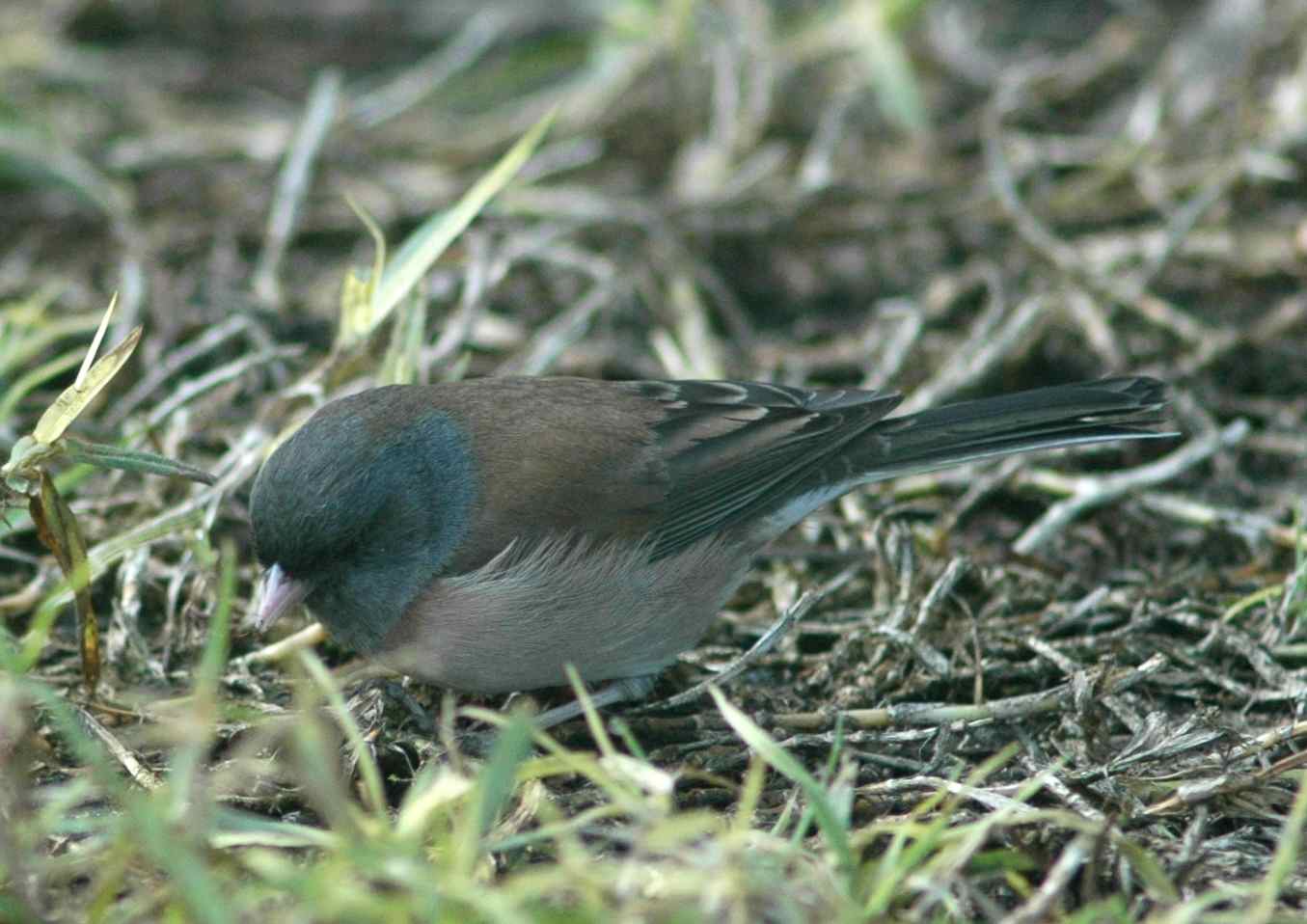
ARKM, a male junco from one of my study sites in the Sierra Nevada mountains

ARKM, a male junco from one of my study sites in the Sierra Nevada mountains. Photo by M. LaBarbera

Ah, my noble research junco. Dramatic black hood, peach flanks, rusty back, hopping around the Sierra Nevada mountains and (hopefully) giving me insights into behavior, life history, and adaptation to environmental variability. That’s the story you mostly get from this blog, because it’s the one that I’m most intimately wrapped up in. But it’s a very small piece of the larger world of juncos and junco research.

The Junco Project has produced a series of videos entitled “Ordinary Extraordinary Junco,” all about the wide world of junco research. The videos are wonderful, covering the research in an interesting and accessible way, and filled with great footage of juncos doing every possible thing. If you only have time to watch one, check out Chapter 2: Appalachian Spring, which shows the field methods that I also employ, like nest searching, mist netting, banding, and collecting blood. It’s one thing to see photographs, and quite another to see how these birds look in motion. (As you watch, try to ignore the sound of my so-intense-it’s-audible envy of the resources these junco researchers have—aviaries! eight field assistants! nest cameras! radio-tracking devices!)

Just as my research is one tiny part of junco research overall, my population of juncos is a tiny portion of the juncos that are out there – and many of them are quite different. The juncos in Berkeley, CA, despite being quite far away from the Sierra Nevada juncos and many thousands of feet lower in elevation, look pretty much the same as “my” juncos…
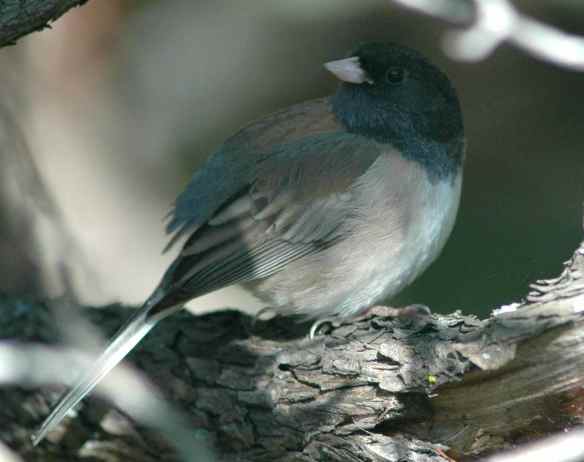
juncos_everywhere_Berkeley5

Continue reading

Could ducks in the water melt ice?

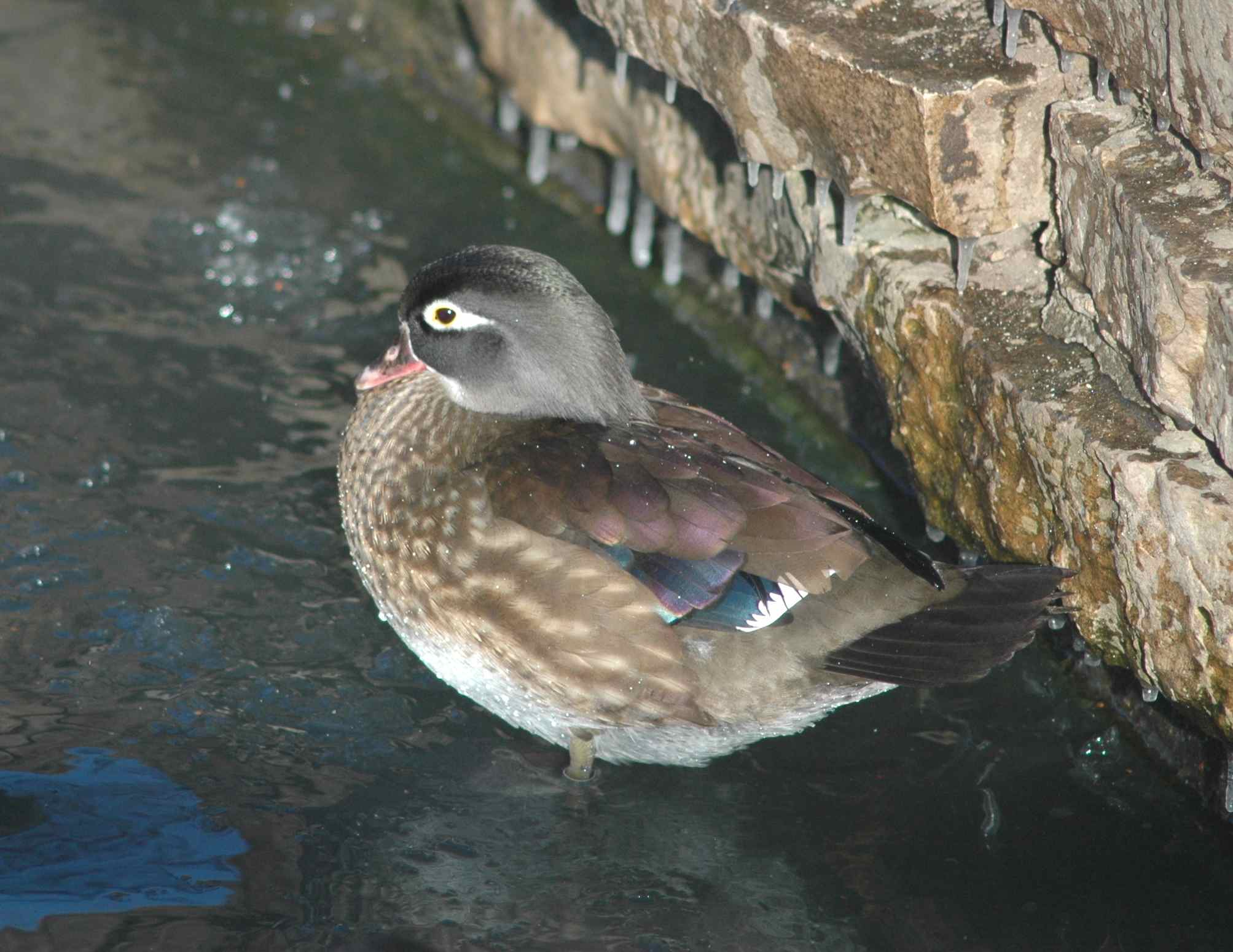
Female Wood Duck in Chicago in the winter.

Female Wood Duck in Chicago in the winter.

A reader question today! Dolores asks: Would the body heat of a modest mixed gathering of water birds (gulls, ducks etc) melt ice at the edges of a pond?

The answer to this depends on context. We can start by establishing some extreme end-points: one duck at the edge of a huge lake in way-below-freezing weather would not be able to melt any ice.

Female Common Goldeneye in Lake Michigan: it's a good thing the lake is already melted, 'cos you're not going to melt anything.

Female Common Goldeneye in Lake Michigan: it’s a good thing the lake is already melted, ‘cos you’re not going to melt anything.

Twenty ducks splashing around spiritedly in a kiddie pool with the barest skin of ice in weather just at the freezing point would probably, if you waited long enough, cause the ice to melt.

Between our two endpoints are more “normal” circumstances: a group of waterbirds hanging out at a pond. Could they melt any ice?

Continue reading