Unknown's avatar

About toughlittlebirds

I'm a graduate student in the Museum of Vertebrate Zoology at UC Berkeley. I'm interested in why animals do what they do. Disclaimer: I don't speak for UC Berkeley or the MVZ in anything I write - if you don't like something, I'm the only one to blame!

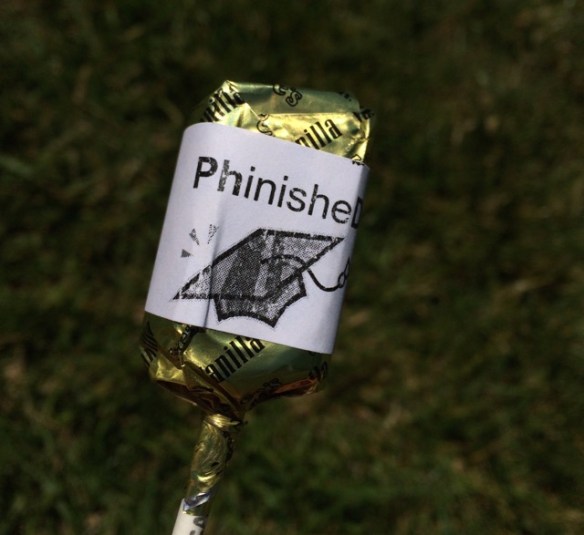
It took me 6 years to earn this lollipop

At UC Berkeley, when you file your PhD dissertation and everything is accepted—your committee signs off on the science; the administration confirms that your margins are the correct size—you get a lollipop.

IMG_5177


I assume at some point you also get a diploma, but no one ever talks about that. Everyone just wants the lollipop.

IMG_5176 (1)


If you had a lollipop that had taken you six years to earn, would you save it or eat it?

It’s all connected: birds, introduced trout, and talking trees

We all know about food webs—or we think we do. Herbivores eat plants, then predators eat herbivores, and if one part of the web is affected, other parts are impacted too. Seems pretty simple—except that the threads in those webs sometimes connect things you would never expect.

For example: trout and a songbird, the Gray-crowned Rosy-Finch, in an alpine habitat. The fish are in the water and the birds are on land—how connected can they be? If the birds were Bald Eagles or Ospreys or Great Blue Herons, sure, they would be connected because the birds eat the fish. If the birds were ducks, maybe the trout would be an occasional threat to the ducklings. But this is a Gray-crowned Rosy-Finch:

3213837447_80503ab4f7_b

Photo by Blake Matheson*

They’re not going to be eating fish, and their babies definitely don’t float about on the water.

The reason that we need to worry about what threads on the food web those trout might be tugging at is that the trout are introduced, nonnative species. Alpine lakes often don’t have any fish in them naturally. In the Sierra Nevada and many other mountain habitats, however, people have stocked these lakes with fish so that people can come and fish them for fun. This has been a problem for aquatic species such as frogs, which get gobbled up quite happily by the new fish, but nobody was particularly worried about the effects on songbirds.

It turns out that we should have been.

Continue reading

Why it’s important to clean up fishing line

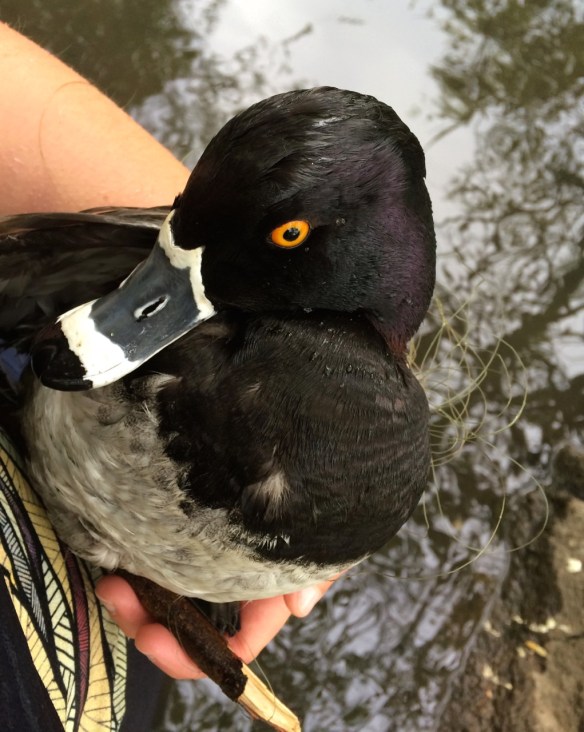
Anza_duckThis handsome bird is a male Ring-necked Duck, but not a happy one. I spotted him splashing in a small lake where a tangle of thin tree branches hung low over the water. A duck having a bath, I thought. Then, as he took a break from splashing and his head drooped so low that his bill went under the surface of the water, Maybe not.

His right foot was caught in a snarl of fishing line and attached to one of the submerged tree branches. The foot was bloody and, from what I could see, the leg broken, probably as a result of his attempts to free himself. There was absolutely no way he could have escaped the fishing line on his own: it was wrapped many times around his foot, the branch, and other branches. It probably caught his foot loosely at first, while he was diving for food; then, as he tugged at it, pulled tighter and tighter, until he was trussed to that branch and pulling against his own flesh when he struggled. Fishing line is made not to snap.

Continue reading

Birds as friendly faces

A birder’s brain responds to photos of familiar bird species in a way that is, neurologically, “strikingly similar” to the way that anyone’s brain responds to photos of familiar human faces (Tanaka & Curran 2001): birders seem to use a similar strategy to recognize birds as everyone uses to recognize people they know. If you are a birder, this probably isn’t surprising; certainly, to me, recognizing a bird species feels similar to recognizing a friend. And it isn’t only birders: the study also looked at “dog experts”—which I did not know existed before I read this—and found the same pattern when those experts looked at photos of dogs. If you are passionate about models of cars or architectural styles or garden flowers, I wouldn’t be surprised if you experience the same thing.

(Bafflingly, the study reports that the photos it showed to the birders included “the robin, sparrow… oriole… [and] hawk,” none of which are actually individual species. Which sparrow, guys? Didn’t you talk to your birders at all while you were studying their brains?)

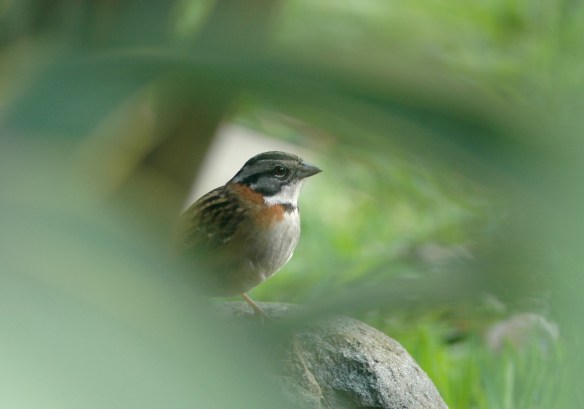
DSC_0605

The sparrow, obviously. (Rufous-collared Sparrow, San Jose, Costa Rica.)

Continue reading

Find the nest 5

This nest is a great example of juncos’ love of sloping ground. In some cases, like this one, the sloping ground is slope-y enough to call a wall. I wouldn’t call this a typical junco nest, but it’s not really surprising either: juncos are reliably creative with their nesting choices, which must make it difficult for predators to find them. This nest certainly seemed well-hidden—and it didn’t have to worry about being stepped on, either.

This slideshow requires JavaScript.

Poison frogs are excellent parents


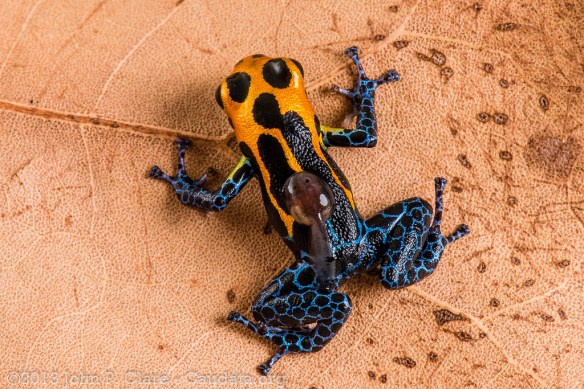
Ranitomeya_imitator_John_Clare2

Ranitomeya imitator giving his tadpole a piggy-back ride. Photo by John Clare*

You can find poison frogs at zoos, aquaria, and some museums now: tiny and colorful, often hard to see in the vegetation-rich tank until— oh! all those little blue things, that’s them! They’re so pretty! You watch for a while, and they sit on their leaves unmoving, doing accurate impressions of the plastic toy frogs being sold in the gift shop, until you get bored and move on to the next exhibit.

They have a secret: they have rich lives full of interesting behaviors. They just aren’t interested in doing those behaviors in front of you.

Continue reading

Spinning science

Recently I was discussing my dissertation progress with another volunteer at the bird banding station. “I have all the data,” I said, “I just need to figure out how to spin it.”

She looked taken aback. “Well, it’s data,” she said. “It’s information. You don’t spin it; it just is.”

“Right,” I agreed quickly, in my best Objective Scientist voice. “Of course.”

I thought about this exchange a lot over the next few weeks. It had been a while since I had talked about my research at length with a non-scientist, and her reaction to my word choice made an impression. Why had I said “spin”? Did I mean “spin”?

DSC_0154

“Spin” your data? Outrageous!

I paid more attention than usual to the word choices my colleagues made, and quickly realized that we all talk about spinning our data. We also talk about interpreting our data, and framing our data: similar and related concepts, but not exact synonyms for spinning the data. “Spinning” sounds underhanded, deceitful. It sounds like we are making the data say what we want it to say. Shouldn’t the data speak for itself?

Continue reading

Birds in the hand again (finally!)

Today was my first day volunteering at a local bird banding station. This place is great: they have been banding birds for decades, recording population changes and individual measurements, and they care a lot about both the birds and the data.

More importantly, though:  I finally got my hands on some birds again.

SFBBO_LISP

Lincoln’s Sparrow, obviously delighted to be involved.

It’s been a while. I had an abbreviated field season this summer, so I haven’t held a bird since July. Since then I’ve been applying for postdocs and writing my dissertation, both of which involve a lot of sitting inside and staring at a computer screen. I need some bird time. That is, after all, the whole reason why I’m applying for postdocs and writing a dissertation: because I love these guys.

SFBBO_RCKI1

Male Ruby-crowned Kinglet showing his “crown”.

Continue reading

Hidden worlds: whale falls

I like to read science fiction. I particularly enjoy a good alien world, like Neal Asher’s world of hyper-aggressive invertebrates or Lois Bujold’s planet of radially symmetric beasts. Still better than these, however, are the alien worlds right here on Earth, hidden in plain sight. (Well… if “on the same planet” counts as “in plain sight.”) The hidden world I’d like to talk about today is that of whale falls.

A “whale fall” is just a nice way of saying a dead whale: when a whale dies in the ocean, it sinks—falls—to the bottom, and you have a whale fall. Whale falls are different from other dead animals in two big ways. First, they are, well, big. No other living animal gets as big as our biggest whales. When one of those dies, that’s a lot of dead whale.

Also, whale falls are pretty cool in their pre-fall form.

Also, whale falls are pretty cool in their pre-fall form.

Second, when they fall to the ocean floor, they change the environment on the ocean floor dramatically. A dead animal in a forest or jungle or lake is a piece of dead meat in a habitat already full of other kinds of food: leaves, berries, insects, fish, etc. Some animals in these habitats will scavenge on the dead meat, but many other animals will ignore it. The deep ocean floor is not like a jungle. It is barren, with no sunlight to support plants or plankton, which are generally the food sources that the rest of a food chain depends on. The only organic food sources near the deep sea floor are the dead things that fall down from the water column above, picturesquely named “marine snow;” and that water column is filled with creatures trying to eat anything they can find, so not a lot makes it all the way to the bottom. When a dead whale lands on the ocean floor, it is the equivalent of an enormous banquet being dropped into the middle of a desert.

When a whale falls, it gives rise to an entire ecosystem by itself.

Continue reading

Thanks for your patience!

Black Crowned Crane appreciates your understanding.

Black Crowned Crane appreciates your understanding.

Hi loyal readers,

I just wanted to say thanks for hanging in there – I’ve been short on posts these last few months. It’s not that I’m out of cool biology to cover! Rather, it’s that I’m trying to write my dissertation and apply for some postdocs with coinciding due dates, so all of my writing-about-science-ideas energy has been going towards those goals. Once the postdoc applications are submitted, I’ll be able to write more here again. (And these postdocs, if I got any of them, would make for some great research blog posts—cross your fingers!)

In the meantime, here are some more birds that appreciate your patience with me.

Southern Lapwing says "thank you" with a swagger.

Southern Lapwing says “thank you” with a swagger.

Continue reading