Learning how to eat like a bird

When you’re an altricial baby bird, life is either great or over. If it isn’t over—that is, assuming you aren’t eaten by a mouse, chipmunk, snake, slug, coyote, etc.—then your life is sitting still in the warm and having food shoved in your face. Excellent.
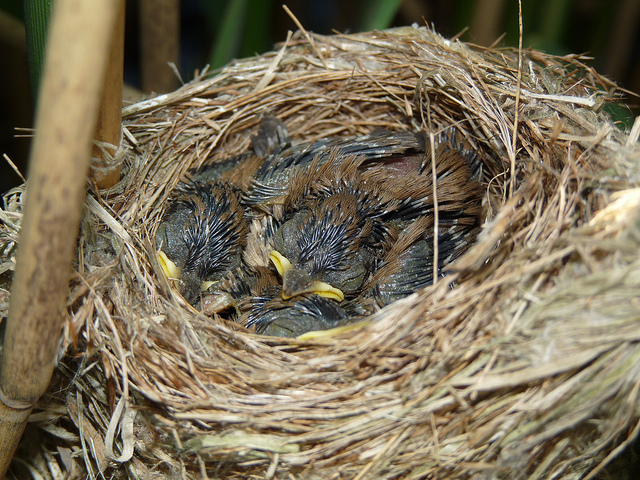
Reed Warbler chicks. This is the life.Photo by nottsexminer

Reed Warbler chicks. This is the life.
Photo by nottsexminer

But that doesn’t last. After you fledge, your parents keep feeding you, but soon they start feeding you less. You can follow them around begging, but soon even that doesn’t do any good. You have to face it: you need to learn how to catch your own food. But that food flies and crawls and runs away!

Doesn't matter. I can catch it.Photo by David Mikulin

Doesn’t matter. I can catch it.
Photo by David Mikulin

We tend to think of wild animals as “instinctually” being able to do everything they do, but in fact, a lot of those skills have to be learned and practiced. Two of my favorite scientific papers looked at how fledgling birds developed their foraging skills. As adults, they were the expert bug-catchers you see all the time; but as fledglings, they did—well, about as well as the four-year-old child of a champion fisherman would do, the first time you handed her the fishing rod.

Continue reading

Badges of status, or, keeping House Sparrows honest

In many bird species, the males have to acquire and defend a good territory – filled with great food or great places to put a nest – in order to have a prayer of attracting a mate. There’s even evidence that some females pay more attention to the quality of the male’s territory than to the quality of the male, so having a good territory is a big deal.

In these species, males fight a lot. They fight to get territories and then they fight to keep them. It’s a bit like a football game: you have to run fast and smash into people in order to get the ball, and then continue running fast and smashing into people (and withstanding them smashing into you) in order to hang onto it.

Male House Sparrows fighting.Photo by Jessica Lucia

Male House Sparrows fighting.
Photo by Jessica Lucia

Take that!Photo by Jessica Lucia

Photo by Jessica Lucia

All that fighting takes a lot of time and energy, not to mention risk of injury. So the birds (and many other resource-defending animals) have found a less-dangerous shortcut: instead of fighting, they wear “badges of status,” color markings on their body that stand for how tough they are. Birds with less-tough badges don’t bother challenging the tougher birds, and everyone has to fight less. Sounds great, right? It’s the equivalent of a football player wearing a jersey that says “I’m Tougher Than You,” and the other football players just leaving him alone. So much less violent!

… but it doesn’t seem like it should work, does it? If it did, then anybody could put on a jersey that says “I’m Tougher Than Everybody” and win the Superbowl. What stops the birds from lying?

Continue reading

Avian flight I: built for flight

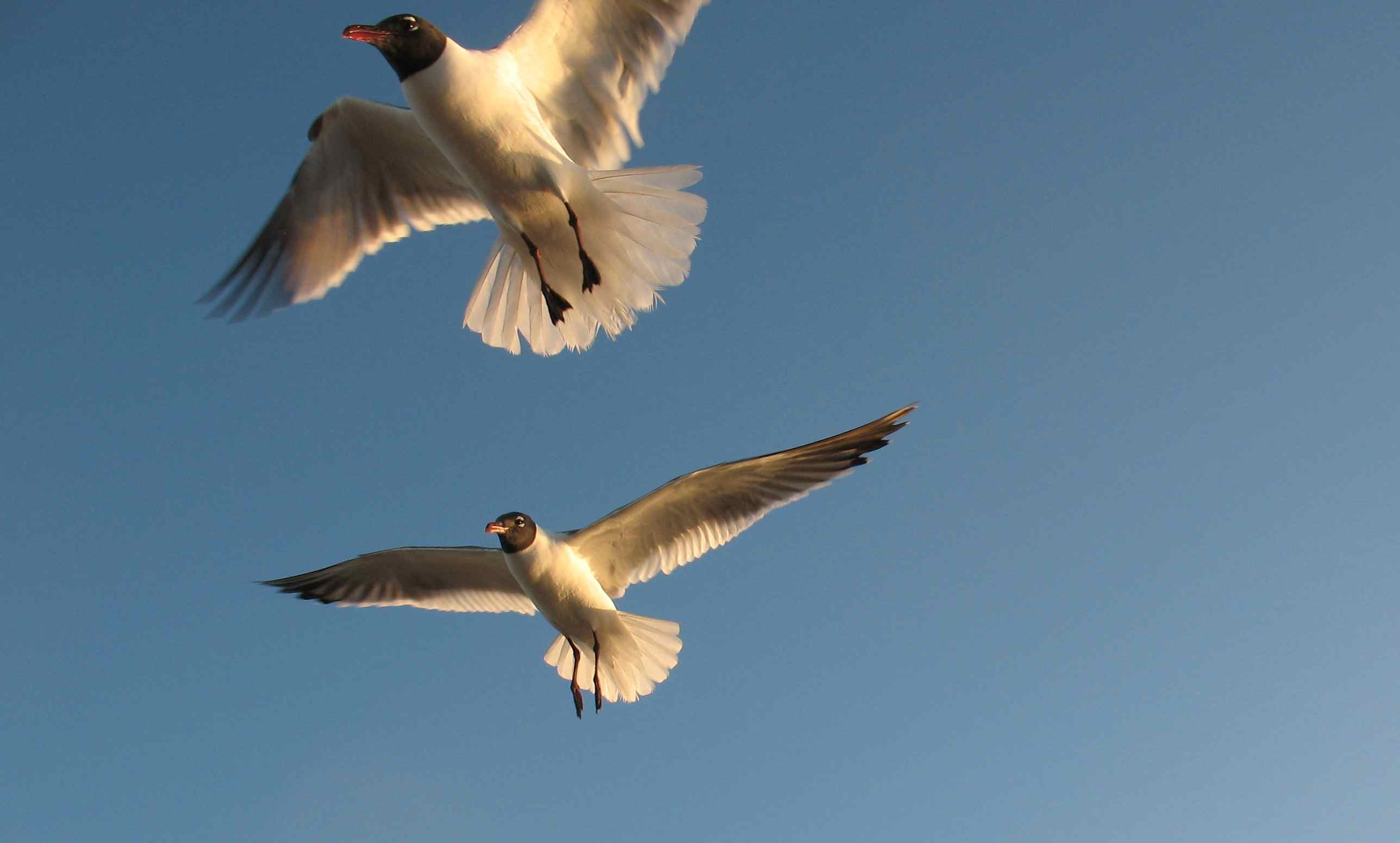
Laughing Gulls in flight

Laughing Gulls in flight

Everything about avian morphology has been shaped by the requirements of flight. Flight is hard. Animals are heavy, being largely composed of water, and air is not dense; you have to work hard to generate any force by manipulating air. The problem for any flying animal is to be light yet powerful – and to still be a viable animal, capable of eating and storing energy and making babies. A hypothetical weak but extremely light animal – think an air-jellyfish – might be able to fly, but would probably starve. While the ocean is filled with floating particles that real jellyfish can catch simply by passively floating, the air is not so bountiful. (You could argue that web spiders filter-feed in air, but… all right, I don’t know if air-jellyfish are impossible. I think we’re getting off-topic here.)

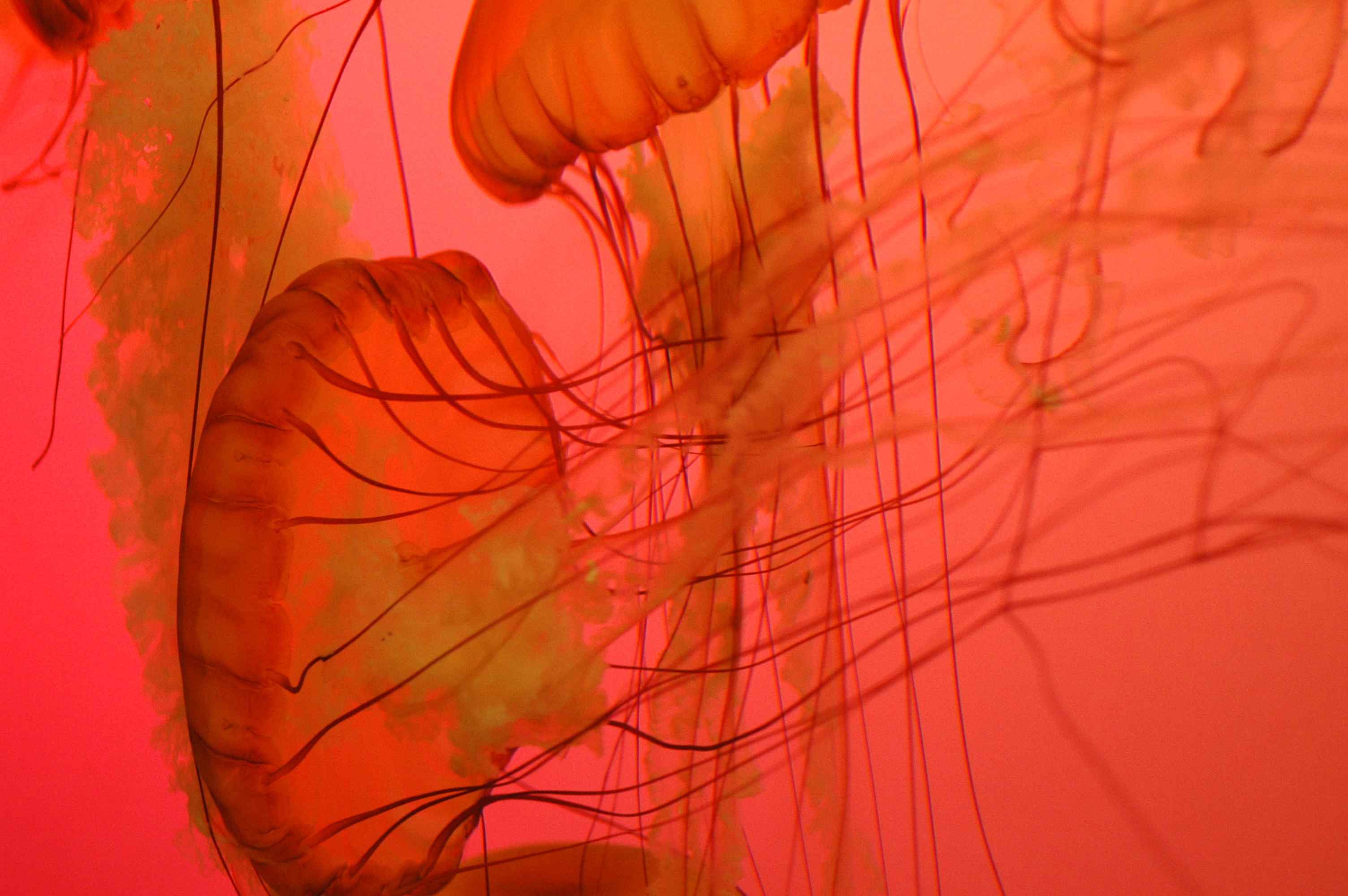
Air-jellyfish floating in a pink sunset.(Or, Northeast Pacific sea nettle in an artistically-lit tank at the Shedd Aquarium.)

Air-jellyfish wafting through a pink sunset.
(Or, Northeast Pacific sea nettle in an artistically-lit tank at the Shedd Aquarium.)

In any case, birds didn’t start out as light, thin, filmy creatures. They started out as small raptor-y dinosaurs. Natural selection acts only on the traits that are present: massive change to the shape of an organism is hard. (Not impossible! But comparatively rarer.) Birds started out with backbones, four limbs, a head, two eyes, etc., and they evolved flight from that initial morphology.

But how do you make a dinosaur that can fly? Dinosaurs are strong, yes, but they are heavy. Bones are heavy; muscle is heavy; fat is heavy; teeth are heavy.

Continue reading

Statistics: not lying is harder than you think

In order to make sense of the data I collect, I use statistics. The statistical tools available for data analysis these days are pretty incredible, leaps and bounds ahead of the simple, classical statistics like chi-square, which worked great – if you had perfect data.

Field biologists like me don’t have perfect data. We have really, really terrible data, from a statistical perspective. We have unbalanced sample sizes, measuring 15 birds here, 21 here, 9 there; we have data with weird things in common, like measurements from different groups of nestlings, some of which are siblings; and we always have tons of noise in our data – because it was weirdly rainy that year, and also hot, and also the oak trees put out more acorns than usual, and that one chick was from a runt egg, and…

Excuse me, I generate only AWESOME data.

Excuse me, I generate only AWESOME data.

Continue reading

Think like a scientist: levels of analysis

Today’s discussion question is: why do the lovebirds Sam and Jesse spend a lot of time together?

Jesse and Sam pause in their destruction of a picture frame to wonder what business it is of yours how they spend their time.

Jesse and Sam pause in their destruction of a picture frame to wonder what business it is of yours how they spend their time.

“Well,” someone says, “it’s because lovebirds’ brain reward centers are stimulated when they interact with their mate. Happy molecules trigger happy receptors, and the birds get happy. So they seek out that reward.”

“No,” someone else says, “it’s because a lovebird that interacts with its mate more has a stronger pair bond, making it less likely to be cuckolded. Lovebirds who spend more time with their mates have more chicks and so pass more genes on to the next generation.”

Continue reading

A few more ways birds keep warm

Happy New Year! In honor of brand-shiny-new 2013, I have… a continuation of the last post. I left a few things out of that post, since it was starting to get quite long; and then in the course of researching to answer some comments, I found some more things; so here are a few more ways that birds keep warm.

Continue reading

How do birds keep warm?

I’m currently visiting Chicago, relishing the finger-stiffening, face-numbing cold and wind that make up a proper midwest winter. Whenever I look out from the warmth of my big puffy coat and see a bird, I feel a little bad for enjoying the weather so much. I can go home and make myself hot tea; they can’t.

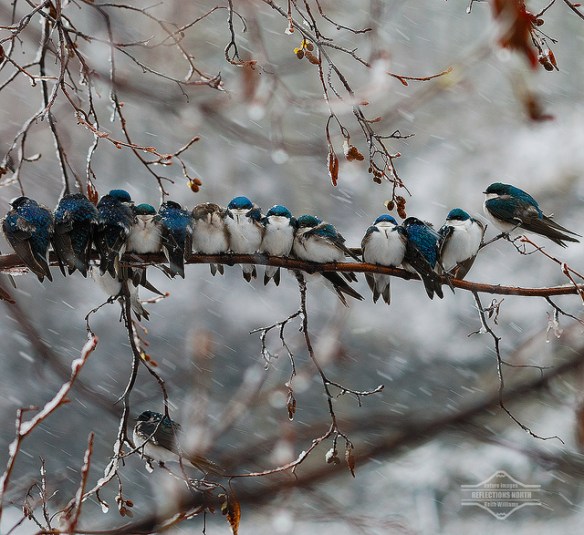
Very cold Tree Swallows. Photo by Keith Williams

Very cold Tree Swallows (up in the Yukon, not Chicago!). Photo by Keith Williams

Like mammals, birds are endothermic (“warm-blooded”), meaning that they maintain their body temperature independent of the outside environment. This almost always means keeping themselves warmer than the outside air. Birds have quite high natural body temperatures, even higher than ours, so any given outside temperature seems even colder to them than it does to us.

Birds are also smaller than we are (well, omitting the ostrich), which means that they have a higher surface-area-to-volume ratio than we do. This is a problem because the volume  (inside) of an animal is where heat is produced and stored, while the surface (skin) of the animal is where heat is lost to the environment. Imagine holding your hand in a bitter wind: how would you keep it warm? By making a fist. Making a fist reduces the surface-area-to-volume ratio of your hand, and lets it keep warm longer. In contrast, if you hold your hand out flat with all the fingers spread, your surface-area-to-volume ratio is larger, and your hand will get cold very quickly. Because birds have higher surface-area-to-volume ratios than we do, keeping warm is harder for them. How do they do it?

Continue reading

Climate change in the Sierra Nevada mountains

Climate change will affect every corner of the globe in some way, from rising average temperatures to ocean acidification to increasingly extreme and unpredictable weather. It may eventually lead to coastal habitat becoming submerged and the desertification of once-green areas. Currently, however, one of the areas in which climate change exhibits its most dramatic effects is on mountains.

Sierra Nevada mountains

Sierra Nevada mountains

On mountains, the variation in elevation causes habitats to change over relatively small areas. Species may be adapted to just a small strip of habitat within a certain elevational range. With changing climatic conditions, those strips of habitat may move on the mountain, and species then have to follow that strip – track their climatic niche – or stay put and adapt rapidly to the new conditions there.

Continue reading

What a PhD means

The general public–and especially the media–appears to be conflicted over what it means when a person has a PhD. There are three main schools of thought:

1) A PhD means you are an awesome genius and know everything.

2) A PhD means you are an ivory tower elitist and know nothing.

3) A PhD means you belong to a nefarious conspiracy dedicated to lending credibility to lies in order to get money or fame.

Sometimes several of these are combined. Believe both #1 and #3, and you’ve got one of the main arguments of climate change deniers (“Climate scientists are lying and spreading false fear in order to keep their jobs secure, and we know this because we found one climate scientist who says climate change isn’t real!”).

The ivory tower elitist PhDs are in a conspiracy of lies to make the public continue to give them research money, and I believe this because the guy who told me has a PhD, so you know he’s right!

None of these three are true.

Continue reading