Something is not quite right here. What is it?


Something is not quite right here. What is it?
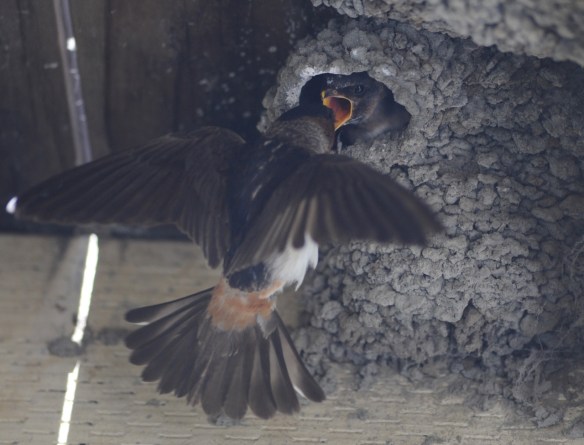
The baby bird says “FEED ME!!” but it doesn’t know that you’re not this momma Cliff Swallow.
One of the veterinarians at the animal rehabiliation hospital recently lamented to me that so many animals she sees are “killed with kindness.” The most common problem by far is that of feeding baby birds. Well-meaning rescuers find a baby bird in need; they search the internet and find statements like “Baby birds must be fed every hour or they will die.” Terrified that the bird will starve before they can get it to the animal hospital—maybe the hospital is closed for the night; maybe it’s a 40-minute drive away—they feed the bird. It makes intuitive sense that babies need to eat, after all. What is not intuitive to us is how easy it is to fatally injure a baby bird by feeding it incorrectly.
“Nowhere on the internet says ‘It’s okay to not feed baby birds for a while, they won’t starve,'” the vet said. “And then they come in fed on milk or something, because the internet said that was a good idea, and they die.”
So: It is okay to not feed baby birds for a while. They will not starve in the several hours it takes to get them to the animal hospital. They will not starve overnight if you find them at 6pm and the animal hospital doesn’t open until 9am the next morning. Baby birds expect to fast the night: their parents sleep, after all. The risk to the bird of starvation is much smaller than the risk of a human trying to feed it without the necessary expertise.
The egret chicks at the nesting colony are growing. They’re doing some neat stuff as they grow, like practicing walking very carefully along branches.
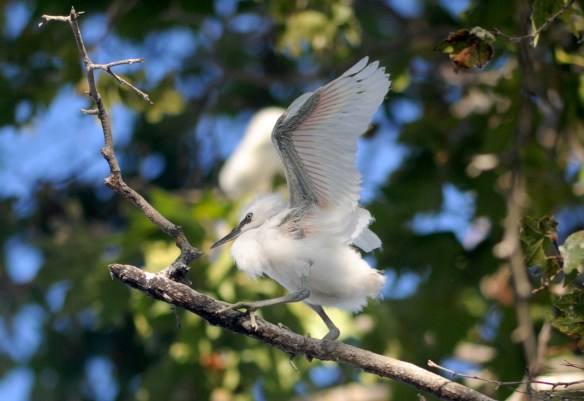
But they are also getting up to a lot of nonsense.
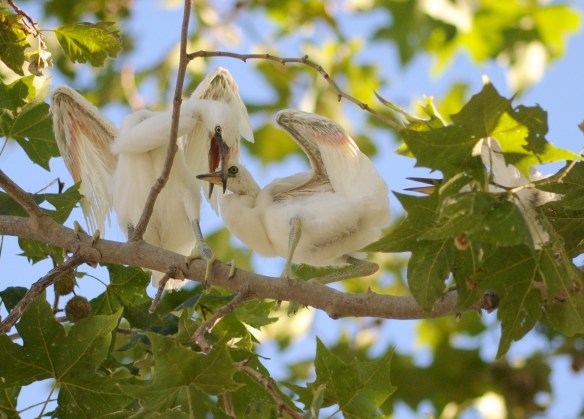
Siblings! No fighting, no biting!
Hummingbirds wear a public image of fragile, ethereal beauty: tiny jewels whirring through the air, occasionally pausing to drink daintily from a flower. Their unusual appearance supports this: the iridescent feathers, the long dainty bill, the near-invisible feet all make them seem quite apart from the everyday world of animals who don’t shimmer in the sun and do have feet.
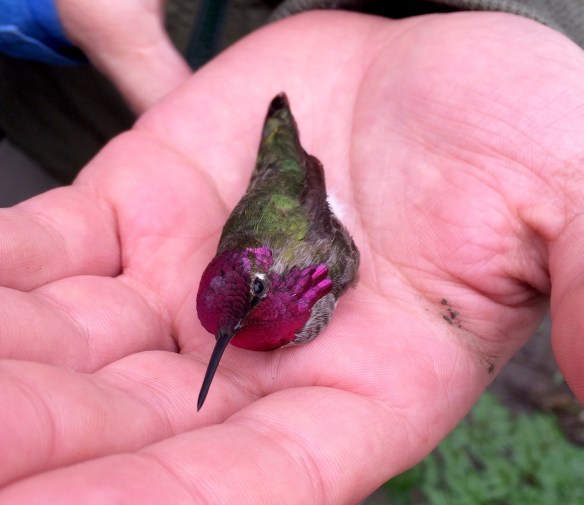
80% gemstone, 15% fairy from a storybook, only maybe 5% actual bird. He doesn’t even have feet! (Yes he does.)
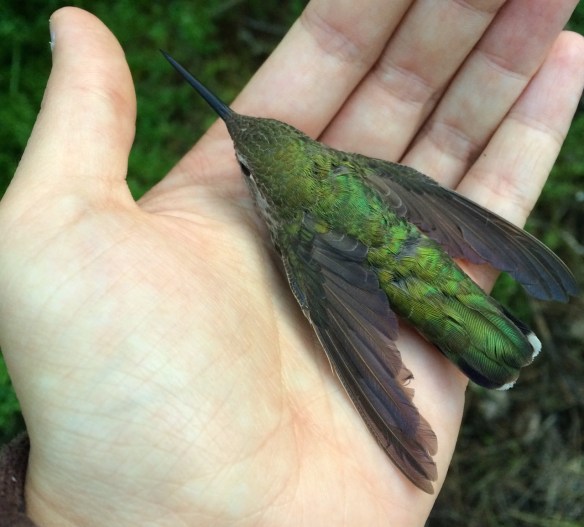
But hummingbirds, like all birds, evolved from dinosaurs. Hidden under that glimmering exterior is a tiny, fierce raptorial dinosaur.
The birds are having babies, those babies are learning to fly, and they are flying into our nets at the banding station. They’re not really babies by this point: most of them are independent of their parents. They may have been out of the nest for a month or more, and are technically “juveniles” or “immatures.”
At the banding station we collect data on each bird we catch, including that bird’s age. It’s important to record the age if we can, because the more accurate we are with the age the first time we catch a bird, the more accurate we can be later. If we caught a bird in 2014 and recorded that it was a juvenile, then when we catch it in 2016, we’ll know it’s exactly 2 years old. If we didn’t bother to age it back in 2014, then in 2016 we would only know that it was at least 2. That maybe seems like a small distinction, but the lifespans of wild birds are still an area in which we lack a lot of information, so knowing exact ages is valuable.
How do you tell if a bird is a juvenile or an adult? In some species, the juveniles are dramatically different colors than the adults. Juvenile juncos, brown and streaky, look distinct from adults even from a distance—until they molt, at least. But the differences can be a lot more subtle.
Here is a Common Yellowthroat from the banding station:

How old is it?
I’ve previously discussed how scientists are interested in pigeons’ ability to perceive art. A New York City artist has taken this to its logical conclusion and created an art installation for pigeons.

Egrets are beautiful, especially in their breeding plumage, when they sport long curved plumes and dramatically colored faces.
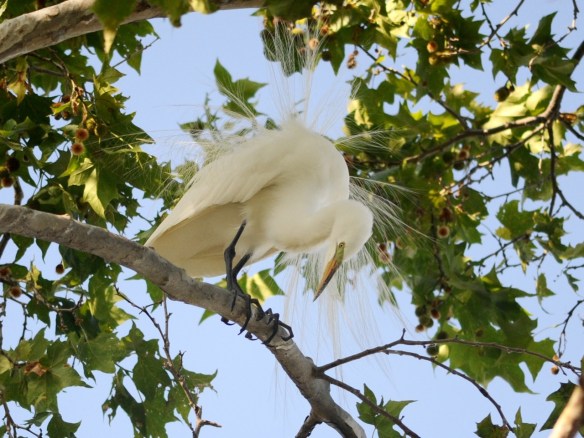
Great Egret displaying breeding plumes and a green face.

Snowy Egret with similar plumes and a red face.
Those breeding plumes are so beautiful that demand for them—for decorating women’s hats—almost drove egrets to extinction, and concern for the heavily persecuted egrets is what gave rise to the bird conservation movement in the early 20th century.
Egrets earn those luscious plumes. Before they get to be adults in breeding plumage, egrets must survive a cutthroat childhood in considerably less impressive dress.

Yikes, THAT’S what our chicks look like??
While my previous post, grumpy as it was, is true, I left out some important things. If you find yourself in the possession of a baby bird, the best thing you can do is to get it to a licensed wildlife rehabilitator. There are a few cases, however, where this may not be possible. Some rehabbers don’t accept invasive species (pigeons, Common Starlings, House Sparrows) or domestic species (e.g. domestic ducks). Some places don’t have a wildlife rehabber anywhere nearby (although do check—you might be surprised!).
If you’re in this situation, the internet is your friend. You can find recipes for nestling bird diets and instructions on care posted by people who care for those invasive species. Don’t just try to go with your gut: your intuition is mammal-based, and will mislead you. Search for reputable-seeming internet sources, and ideally find ones where you can contact the people to get detailed advice. There is a community of starling-keepers out there who may be able to help (especially if you’ve found a starling; unfortunately, bird species do differ in the care of their babies).
The most important thing is do not try to force-feed your bird water. Birds have an opening in their throat that leads to their lungs, and it is incredibly easy to drown them. Put the bird somewhere dark and warm and do your internet research before trying to do anything else with the bird.
Also, if you do an internet search on my name, you will find my email address. I am not a licensed rehabber and am definitely not the best person you could contact, but I’d certainly prefer to be asked how to keep the bird alive, rather than asked why it died.
Please, please, please do not “rescue” baby birds if they are covered in feathers. They are fine: they are hiding, and being fed by their parents, and growing, and soon they will be able to fly even if they can’t yet. If you find a naked pink baby bird, and can’t see the nest it fell out of and put it back, then please use the internet to find a local wildlife rehabilitator and bring the animal to them. They know how to keep baby birds alive. It is difficult. If you try to raise a baby bird yourself, without specialized knowledge, it will probably die. I volunteer at a wildlife rehabilitation hospital, and our care of baby birds is complicated, from determining the diet to the amount to the best way to house and eventually release them. We are constantly advised by trained veterinarians. This is not something you should be trying to do at home unless, for some reason, there is absolutely no way to get the animal to a rehabilitator (maybe you live on a tiny island in the middle of the ocean?), and even then, you should contact a rehabilitator and ask for advice. Don’t just try to guess. You will guess wrong.
I know you want to help. I know you mean well. But good intentions will not prevent you from killing a baby bird. And then you comment on this blog to ask me why it died, and I get so many of these comments, so many stories of people accidentally-but-avoidably killing birds, and it makes me dread checking the comments on this blog in case there is another one of these stories. The baby bird died because you are not a bird and not a trained wildlife rehabilitator. Let the birds raise their babies.
I covered this is in this older post, including ways that you can help birds.
This wildlife rehabilitator has a good article on how to tell if an animal needs your help.
I was supposed to be done with field work after summer 2015, but you know how it is. The birds call. You realize that a few more blood samples would put the patterns you’re seeing in context in an illuminating way. You miss those feathery little dudes.
 The small amount of field work I did this year took place much earlier than my usual field work because I was sampling juncos at a much lower elevation. Down here, the juncos are breeding in mid-March. Up at my usual sites, they wait until late May. That early start happened to be convenient for me, since I needed to analyze any data I got in time to file my dissertation in mid-May.
 Tough Little Birds