You can walk on glass walls, right?
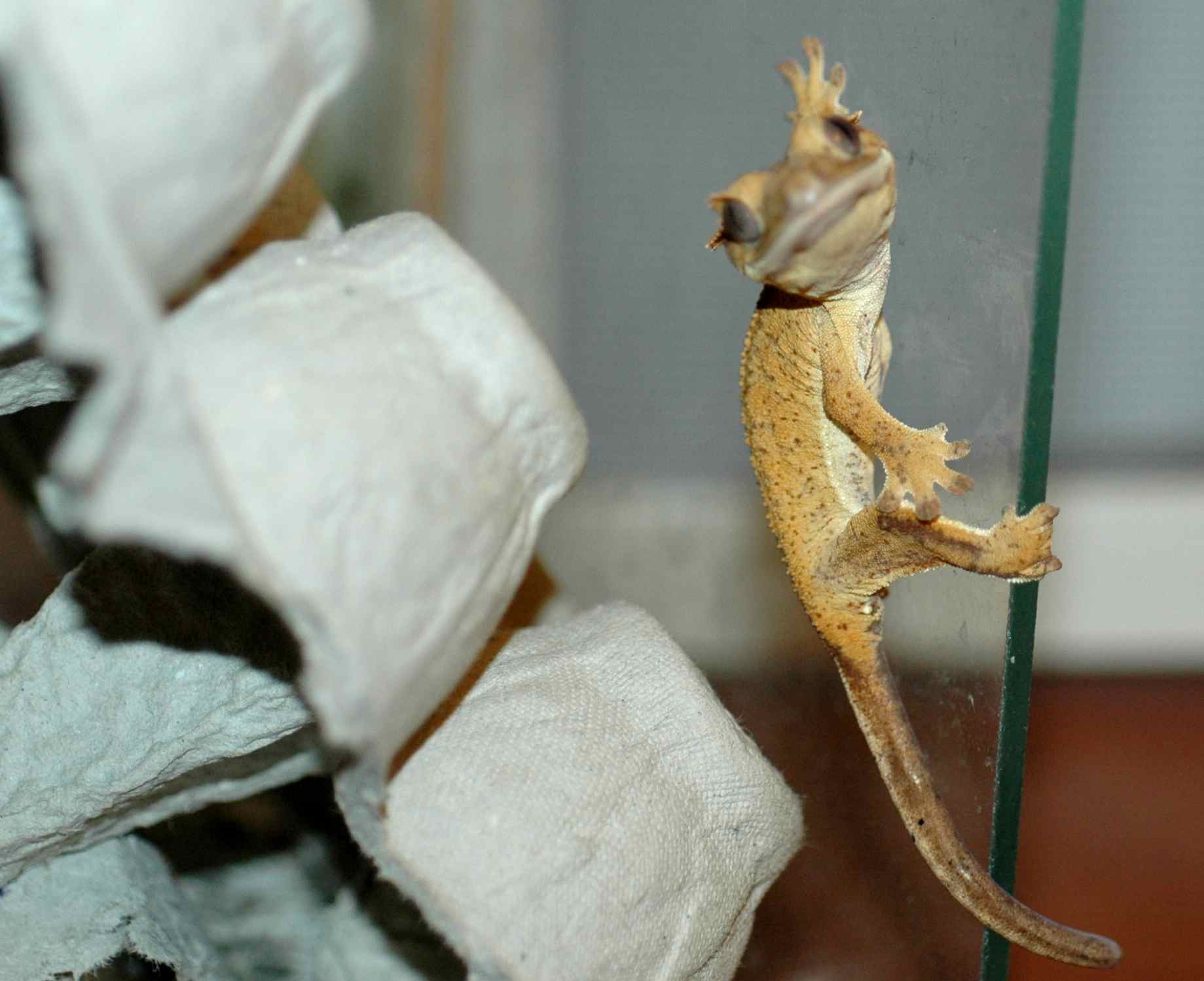
October, about to jump onto an egg carton

Oh, you say you can’t do that. So how come October can?
You can walk on glass walls, right?
October, about to jump onto an egg carton
Oh, you say you can’t do that. So how come October can?
Last year, I waited to order color leg bands (for banding the juncos) until spring. This turned out to be a mistake, since everyone else ordered their leg bands at the same time, so all the good colors got backordered and I spent the first half of the field season banding my birds in just orange, lime, green, light blue, brown, and grey. If you’re wondering whether brown or grey bands show up on a junco leg: well, no, they don’t.
I learned my lesson. I’ll have a full arsenal of colors for this field season:


I think this is the least dignified photo of Limpet I have ever taken
In order to make sense of the data I collect, I use statistics. The statistical tools available for data analysis these days are pretty incredible, leaps and bounds ahead of the simple, classical statistics like chi-square, which worked great – if you had perfect data.
Field biologists like me don’t have perfect data. We have really, really terrible data, from a statistical perspective. We have unbalanced sample sizes, measuring 15 birds here, 21 here, 9 there; we have data with weird things in common, like measurements from different groups of nestlings, some of which are siblings; and we always have tons of noise in our data – because it was weirdly rainy that year, and also hot, and also the oak trees put out more acorns than usual, and that one chick was from a runt egg, and…
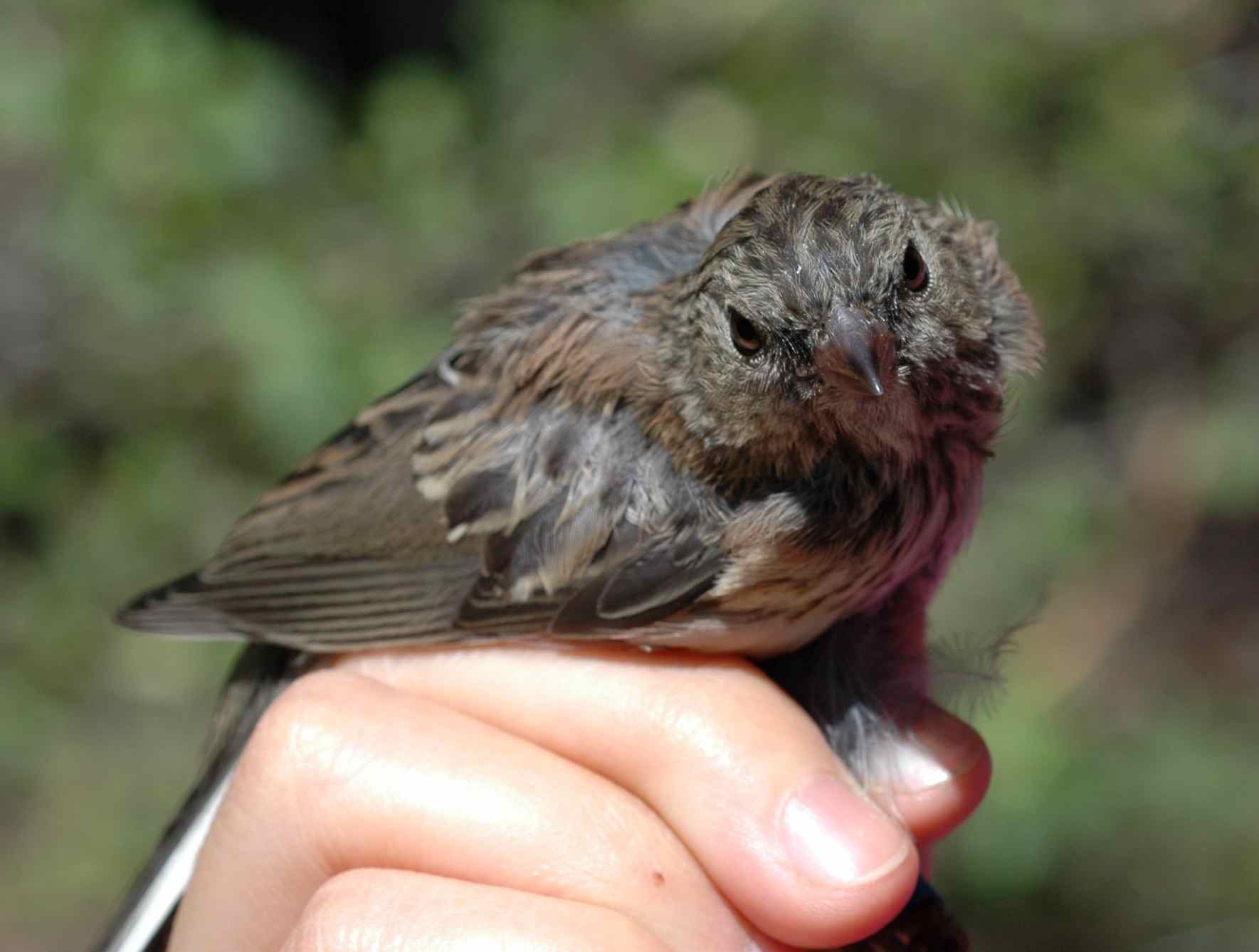
Excuse me, I generate only AWESOME data.
In the course of my junco specimen bill measuring – I’ve measured 561 so far – I’ve handled ratty specimens and fine ones, old and not-quite-so-old. (Most of the specimens are from before 1950, so they’re all fairly old.) It’s fun to see how much variation there is even among individuals from the same subspecies and the same state. Here are my three favorite specimens:

This male has lovely red-brown spots on his head.
Today’s discussion question is: why do the lovebirds Sam and Jesse spend a lot of time together?

Jesse and Sam pause in their destruction of a picture frame to wonder what business it is of yours how they spend their time.
“Well,” someone says, “it’s because lovebirds’ brain reward centers are stimulated when they interact with their mate. Happy molecules trigger happy receptors, and the birds get happy. So they seek out that reward.”
“No,” someone else says, “it’s because a lovebird that interacts with its mate more has a stronger pair bond, making it less likely to be cuckolded. Lovebirds who spend more time with their mates have more chicks and so pass more genes on to the next generation.”
The Cornell Lab of Ornithology’s Macauley Library of sounds and videos has been fully digitized and posted online for browsing for free by everyone. It is really fun to explore.
Ever wanted to know what an Oilbird sounds like? It sounds like this!
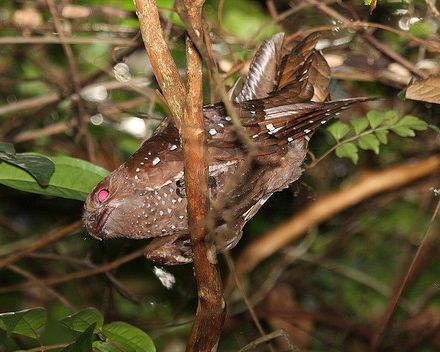
Oilbird. Photo by Dominic Sherony
Check out a colorful mantis shrimp swiveling its crazy eyes, then listen to it making sounds eerily like those of a drum set!
Go eye-level with Adelie Penguins, get close enough to a sea turtle to count the scales under its chin, then listen to a baby walrus ruff like a puppy!
Here is an article from the Lab of O – scroll to the end for links to: the earliest recording (a Song Sparrow from 1929); the sounds of an ostrich chick still in the egg; the haunting clarinet-like moan of the idri, a lemur; a bird of paradise apparently imitating a very melodious UFO; and a cute video of an American Dipper living up to its name by bobbing and dipping.
And then explore the library yourself! Hooray for open-access science.
Back in the day, there was no internet, and researchers had to search for papers by actually searching. In a library, with old copies of journals. Sometimes they wrote to authors, and the authors mailed them physical copies of their papers. (When you publish a paper, journals still offer you the option to order hundreds of these physical copies, called “offprints.”) I know, right? Ridiculous.
Now we can just search online. Instead of sifting through piles and piles of journals, I search, download, and in mere seconds can have the paper I wanted saved on my computer under some totally non-obscure name like “fledgling_conflict+habitat_yellowwarbler” that I will definitely not forget the meaning of in a week.
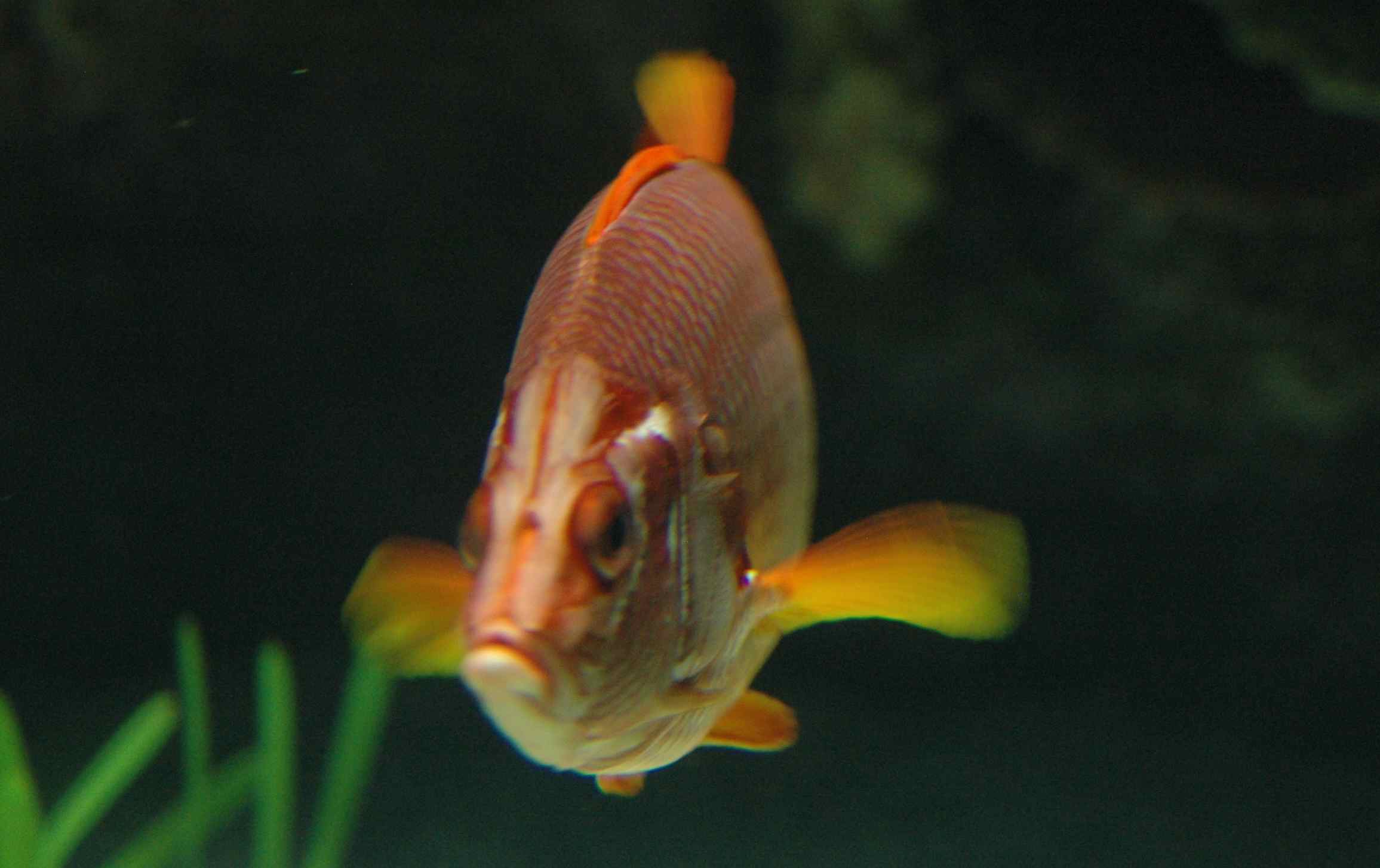
Judgmental fish thinks you will definitely forget what that file name means.
Yet despite this incredible technological progress, there are still some perils to searching the literature:
“You work in a museum and you don’t collect? At all?” My officemate glanced up from labeling specimen tags to give me an incredulous look.
“Yep,” I said.
I work in a museum filled with hundreds of thousands of specimens, and I do not add to them. I do not collect: i.e., “sacrifice” (kill) birds in order to add them to the museum’s collections. Many researchers would consider this to be poor teamwork, even poor manners – here I am measuring bills, benefiting from others’ collecting work, and not contributing! What is my problem?

Dark-eyed Junco specimens that I have measured
Happy New Year! In honor of brand-shiny-new 2013, I have… a continuation of the last post. I left a few things out of that post, since it was starting to get quite long; and then in the course of researching to answer some comments, I found some more things; so here are a few more ways that birds keep warm.
I’m currently visiting Chicago, relishing the finger-stiffening, face-numbing cold and wind that make up a proper midwest winter. Whenever I look out from the warmth of my big puffy coat and see a bird, I feel a little bad for enjoying the weather so much. I can go home and make myself hot tea; they can’t.
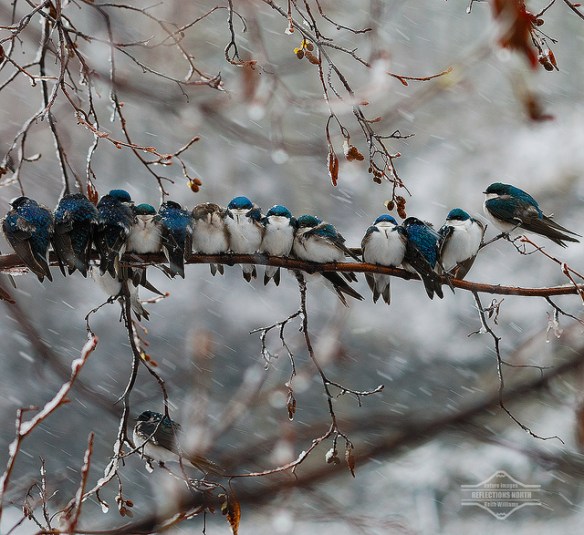
Very cold Tree Swallows (up in the Yukon, not Chicago!). Photo by Keith Williams
Like mammals, birds are endothermic (“warm-blooded”), meaning that they maintain their body temperature independent of the outside environment. This almost always means keeping themselves warmer than the outside air. Birds have quite high natural body temperatures, even higher than ours, so any given outside temperature seems even colder to them than it does to us.
Birds are also smaller than we are (well, omitting the ostrich), which means that they have a higher surface-area-to-volume ratio than we do. This is a problem because the volume (inside) of an animal is where heat is produced and stored, while the surface (skin) of the animal is where heat is lost to the environment. Imagine holding your hand in a bitter wind: how would you keep it warm? By making a fist. Making a fist reduces the surface-area-to-volume ratio of your hand, and lets it keep warm longer. In contrast, if you hold your hand out flat with all the fingers spread, your surface-area-to-volume ratio is larger, and your hand will get cold very quickly. Because birds have higher surface-area-to-volume ratios than we do, keeping warm is harder for them. How do they do it?
 Tough Little Birds