Anyone who has read Anna Karenina knows the famous line: all happy families are alike; unhappy families are all unhappy in their own way.
For birds, this is not true. Family conflict in birds is generalizable.
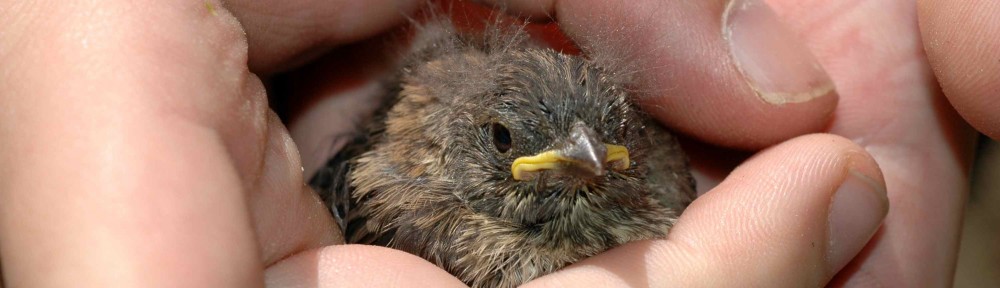
Anyone who has read Anna Karenina knows the famous line: all happy families are alike; unhappy families are all unhappy in their own way.
For birds, this is not true. Family conflict in birds is generalizable.
You know it’s the end of the breeding season when everyone starts molting.
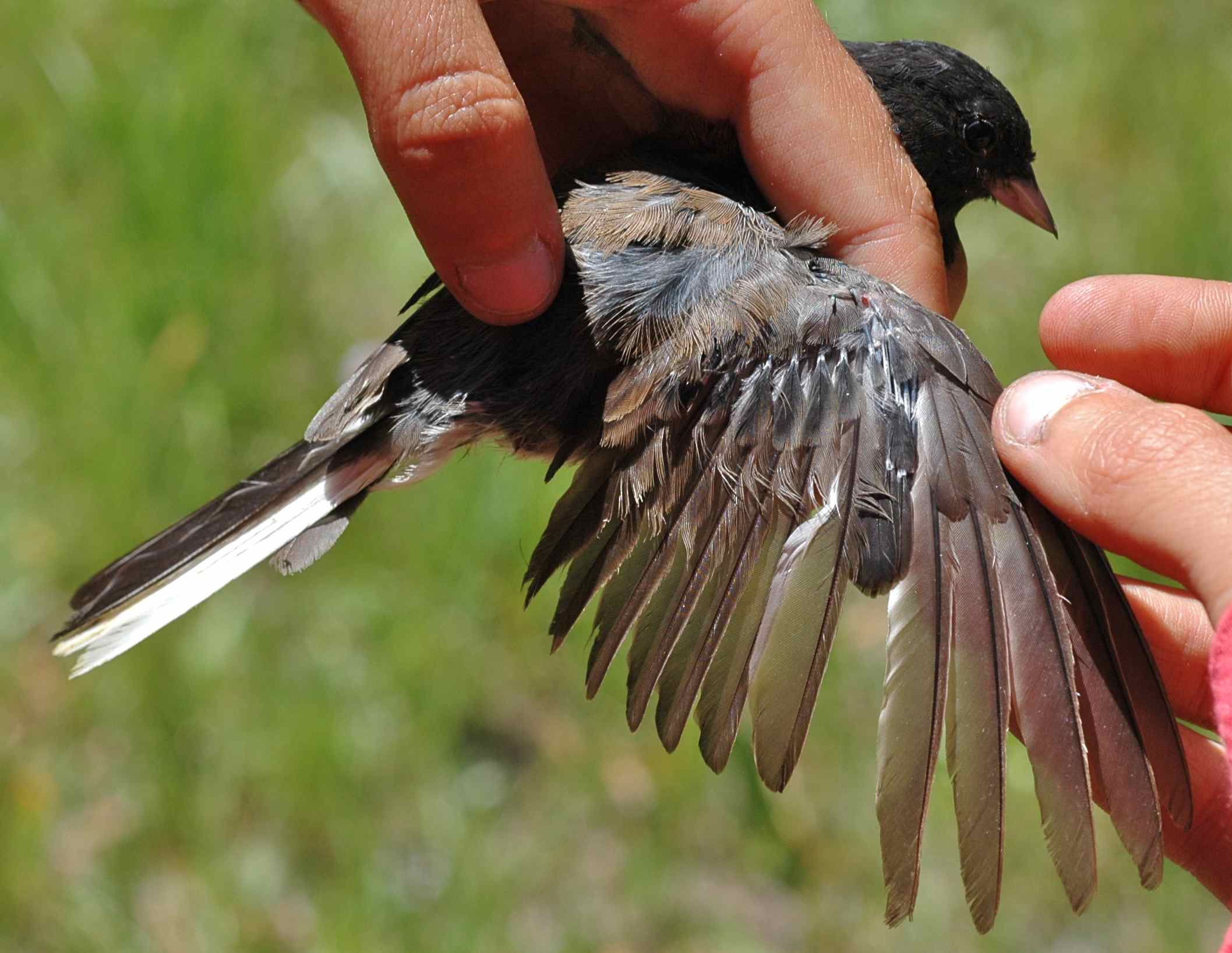
ALGE molting his primaries and secondary coverts
If you get too close to a nest or a young fledgling, the parent juncos will often give a repeated, angry chip call. I don’t understand how this could possibly be adaptive—I would understand a snake-like hiss, or a tiger roar, but no one’s scared of “chip”—but as silly as it is for the parents to broadcast, effectively, “My nest is here, don’t come find it!” I do appreciate the help.
On our last trip we noticed SNAE and his unbanded mate chipping insistently.
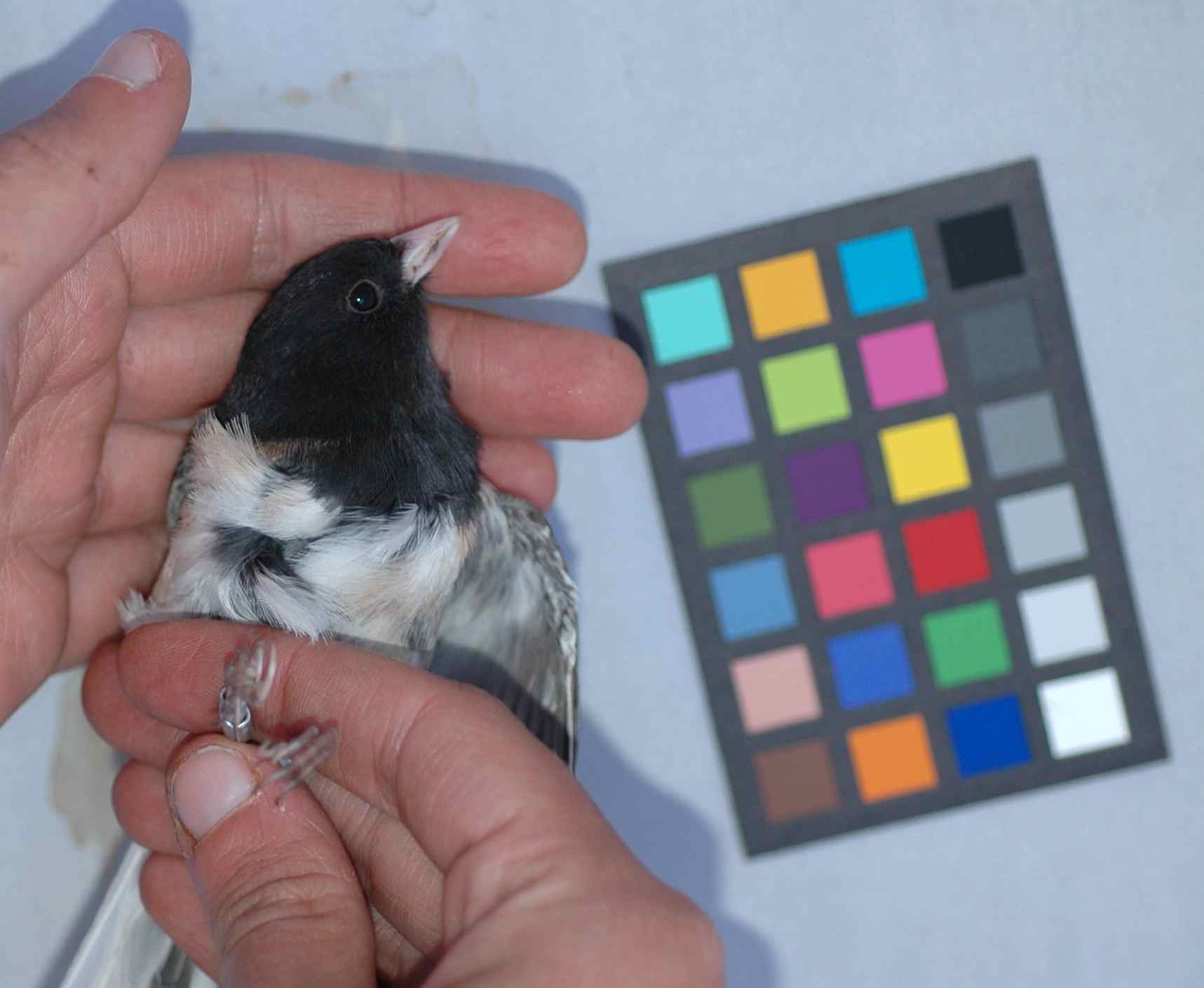
SNAE. I photograph all the juncos I catch from several angles like this; the color standard card you see in the background lets me compare colors among pictures, to look at color differences among the juncos.
On our last trip, finally, we managed to catch some fledglings. We had been seeing them around for weeks, but as they didn’t seem to respond to playback, and they never flew the right direction when we tried to chase them into the net, we’d caught none.
On this last trip something had changed. No longer were all of the fledglings attended by their parents; instead, they formed foraging flocks of parents, attended fledglings, and apparently-independent fledglings. Attended fledglings are hard to catch because their parents lead them away from danger. Independent fledglings, it turns out, aren’t so careful. We set up the net where we observed the flock foraging, and within ten minutes the juncos drifted back into the area and resumed foraging.
BOAR was the first fledgling we caught.
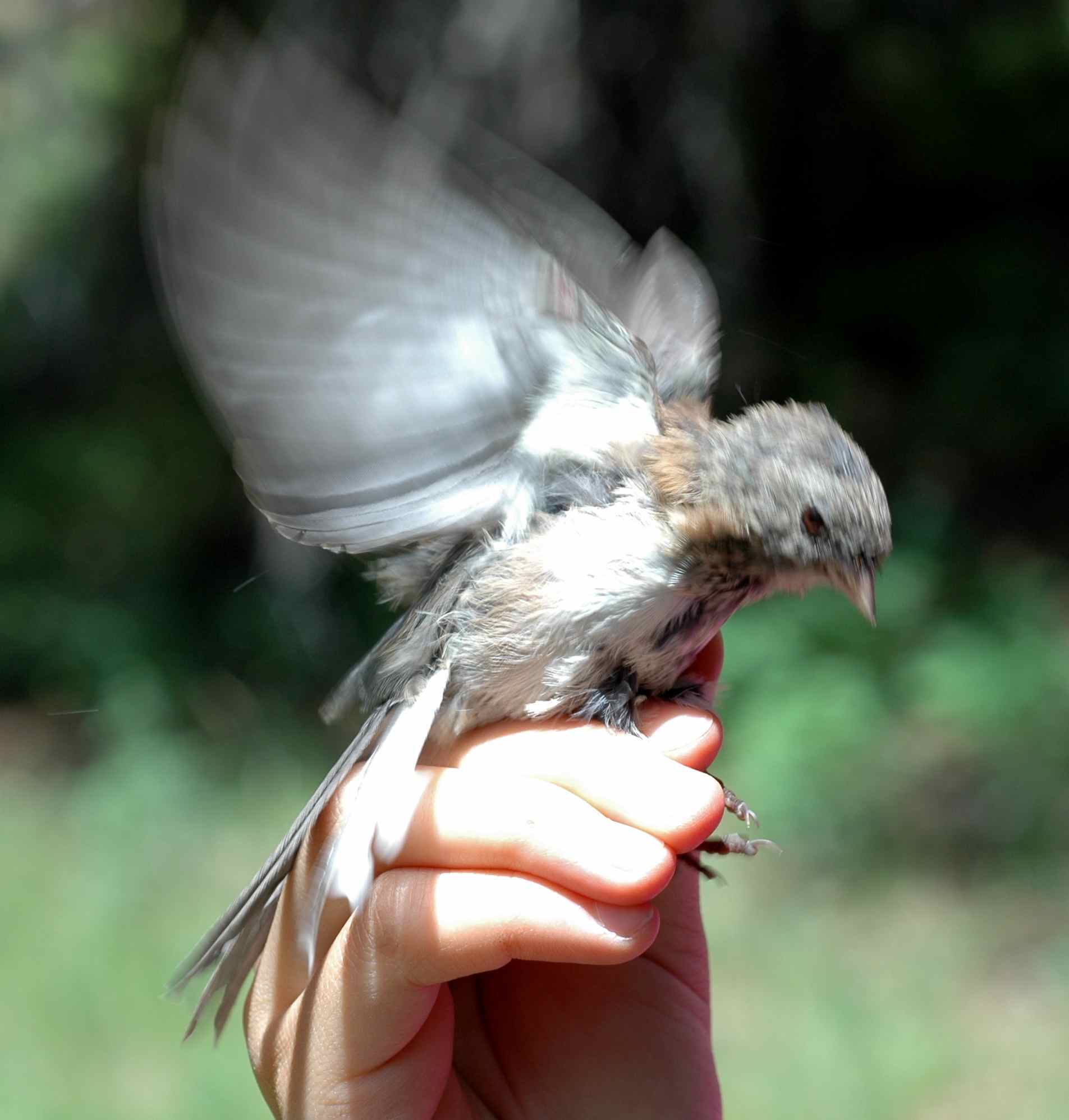
BOAR
Imagine you’re an albatross, a large seabird that spends months aloft over the open ocean. Now it’s the breeding season: time to head back to your favorite island, do some amusing courtship dances, and lay an egg. But you’re in the middle of the vast, featureless open ocean. How do you find your way back?
Homing pigeons, taken from their roosts and driven up to 800 km away, can fly home. (Several pigeons have received the animal version of the medal of honor for doing this while carrying messages in wartime.) Arctic shorebirds like the Red Knot will fly from the Arctic to southern South America, over 13,000 km, twice a year. Birds are very good at navigation. How do they do it?
A conference, a brief vacation, and getting back into non-field-work have conspired to keep me away from the blog for far too long; humblest apologies!

Red-breasted Nuthatch scoffs derisively at your apology!
The conference was the North American Ornithological Conference, which combined the usually-separate annual meetings of many ornithological societies into one gigantic über-meeting with 1500+ attendees, almost all of whom were presenting their research as either a talk or a poster.
Although the last month has brought nests, chicks, and all the excitement they entail, it has also seen increasingly frustrating field work. In the beginning of the field season, we caught between two and five juncos every day; now we’re down to two, one, or none.
Some of them simply don’t respond to our playback at all. Locations that we know have juncos—because we’ve seen them, darnit, we’ve banded them—appear junco-less, our Radio Shack speaker spewing junco calls with no response. Other juncos respond half-heartedly, distractedly. They sing for a minute, then resume foraging. Or, as I watched GAEL do recently, they sing back softly while preening their feathers.

GAEL ignoring us. Photo by M. LaBarbera.
We spend a lot less time handling birds now, and a lot more time muttering, “Jerk juncos.”
Melanic color-dependent antipredator behavior strategies in barn owl nestlings. By Valentin van den Brink, Vassilissa Dolivo, Xavier Falourd, Amélie N. Dreiss, and Alexandre Roulin. Behavioral Ecology, 2011.
I’ve been slacking off on the Featured Papers, since it’s the field season and I’ve been reading almost nothing less than usual; but this paper is too crazy not to mention.
One of birds’ most endearing qualities has to be their care of their chicks. Sparrows fly in and out of nests in the rafters of gas stations, doggedly exhausting themselves to feed their hungry offspring; ducks and geese lead lines of fuzzy yellow babies across roads and around ponds; and we humans see ourselves in this tender parental care, and say “Aww.”
But child-rearing in birds is stranger than you think.
If you have ever driven through Yosemite National Park, you’ve seen them: distinctive yellow signs with a silhouette of a bear and the admonition, “Speeding Kills Bears.” Although it doesn’t say so on the sign, each sign is placed where a bear has been killed by a car.
On our last trip, driving through Yosemite on our way home, we saw the truth of this first-hand: a black bear lying dead at the side of the road, his blood still red on the asphalt. He was young, no larger than a St. Bernard. His muzzle was delicate, his ears soft. Like many of the black bears I’ve seen, he was not just black, but had an elegant sweep of blond across his shoulders, like a shawl.
 Tough Little Birds