Birds who can see what we can’t

Seeing in the ultraviolet

Even in the visible spectrum, birds can discriminate more subtle color distinctions than we can, thanks to their at-least-five functional cone photoreceptor types (we only have three). But it’s in the ultraviolet (UV) part of the spectrum where they literally can see what we can’t.

Somewhat disappointingly, birds don’t generally have secret UV patterns the way that, for example, some flowers do (Andersson 1996). Instead, they seem to use UV to augment signals we can already see: bluebirds turn out to reflect UV, as do the spots on some thrushes, and so on. But the UV can still contain information invisible to our eyes. In the Alpine Swift and the European Starling, better-fed chicks reflect more UV from their skin; their parents can use this information to give more food to scrawny chicks in good times, or to cut their losses and favor the healthiest chicks in lean times (Bize et al. 2006).

Starling adult and fledglings - who may be too old and feathered to reflect much UV from their skin now, but are definitely still hungry. Photo by Tina S. White.

Starling adult and fledglings – who may be too old and feathered to reflect much UV from their skin now, but are definitely still hungry.
Photo by Tina S. White.

Continue reading

Genetics is complicated: mouse edition

Genetics is complicated. I have taken courses to this effect; I have taught the concept in Introductory Biology. Mendel’s peas with their neat logical Punnett squares were a lucky rarity—each trait governed by just one gene, each of those genes on a separate chromosome. The genetic basis of the vast majority of traits is far more complex. If the genes involved aren’t physically linked (called “linkage disequilibrium”) then they are pleiotropic (influencing many different traits at once), or epistatic (modified by other genes), or simply so subtle that their effects disappear in the noise of environmentally-caused trait variation. Relating traits to genes is hard.

I know this; I understand it; but until recently, I had never actually seen it. Then my pet mice decided to give me an object lesson in genetics.

What happens when you think you have all female mice, but you actually have mostly females and one male?

This happens. (Incidentally, doesn't this look like a mouse version of the Canadian flag?)

This happens.
(Unrelatedly: doesn’t this look like a mouse version of the Canadian flag?)

Continue reading

Avian flight II: albatross flight

Albatross spend most of their lives in flight. They forage in the open ocean, where food may be separated by many miles, and they head for islands only to breed. They have been documented making around-the-world trips in just 46 days (take that, Jules Verne!) and flying for weeks at an average speed of 950 km per day (Croxall et al. 2005). That’s 40 km per hour, so you could beat them in a car (if you could stay awake that long), but still!

I am awesome. Photo by Tony Schneider

I am awesome.
Photo by Tony Linde

How can an animal spend so much time in such fast flight? How do albatross not waste away and die from the sheer energetic effort?

Continue reading

Learning how to eat like a bird

When you’re an altricial baby bird, life is either great or over. If it isn’t over—that is, assuming you aren’t eaten by a mouse, chipmunk, snake, slug, coyote, etc.—then your life is sitting still in the warm and having food shoved in your face. Excellent.

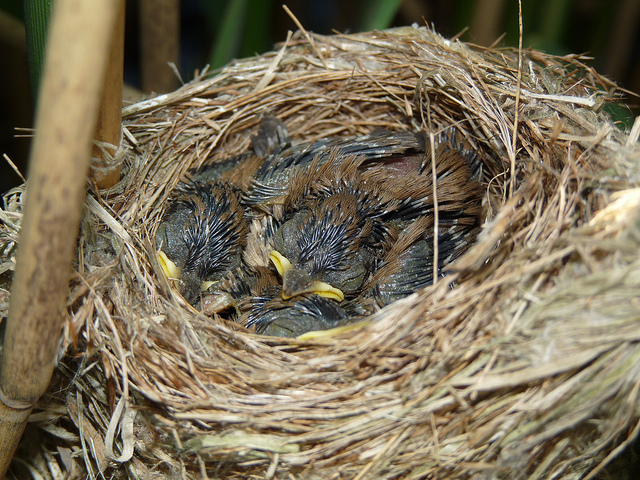
Reed Warbler chicks. This is the life.Photo by nottsexminer

Reed Warbler chicks. This is the life.
Photo by nottsexminer

But that doesn’t last. After you fledge, your parents keep feeding you, but soon they start feeding you less. You can follow them around begging, but soon even that doesn’t do any good. You have to face it: you need to learn how to catch your own food. But that food flies and crawls and runs away!

Doesn't matter. I can catch it.Photo by David Mikulin

Doesn’t matter. I can catch it.
Photo by David Mikulin

We tend to think of wild animals as “instinctually” being able to do everything they do, but in fact, a lot of those skills have to be learned and practiced. Two of my favorite scientific papers looked at how fledgling birds developed their foraging skills. As adults, they were the expert bug-catchers you see all the time; but as fledglings, they did—well, about as well as the four-year-old child of a champion fisherman would do, the first time you handed her the fishing rod.

Continue reading

Badges of status, or, keeping House Sparrows honest

In many bird species, the males have to acquire and defend a good territory – filled with great food or great places to put a nest – in order to have a prayer of attracting a mate. There’s even evidence that some females pay more attention to the quality of the male’s territory than to the quality of the male, so having a good territory is a big deal.

In these species, males fight a lot. They fight to get territories and then they fight to keep them. It’s a bit like a football game: you have to run fast and smash into people in order to get the ball, and then continue running fast and smashing into people (and withstanding them smashing into you) in order to hang onto it.

Male House Sparrows fighting.Photo by Jessica Lucia

Male House Sparrows fighting.
Photo by Jessica Lucia

Take that!Photo by Jessica Lucia

Photo by Jessica Lucia

All that fighting takes a lot of time and energy, not to mention risk of injury. So the birds (and many other resource-defending animals) have found a less-dangerous shortcut: instead of fighting, they wear “badges of status,” color markings on their body that stand for how tough they are. Birds with less-tough badges don’t bother challenging the tougher birds, and everyone has to fight less. Sounds great, right? It’s the equivalent of a football player wearing a jersey that says “I’m Tougher Than You,” and the other football players just leaving him alone. So much less violent!

… but it doesn’t seem like it should work, does it? If it did, then anybody could put on a jersey that says “I’m Tougher Than Everybody” and win the Superbowl. What stops the birds from lying?

Continue reading

A few more ways birds keep warm

Happy New Year! In honor of brand-shiny-new 2013, I have… a continuation of the last post. I left a few things out of that post, since it was starting to get quite long; and then in the course of researching to answer some comments, I found some more things; so here are a few more ways that birds keep warm.

Continue reading

How do birds keep warm?

I’m currently visiting Chicago, relishing the finger-stiffening, face-numbing cold and wind that make up a proper midwest winter. Whenever I look out from the warmth of my big puffy coat and see a bird, I feel a little bad for enjoying the weather so much. I can go home and make myself hot tea; they can’t.

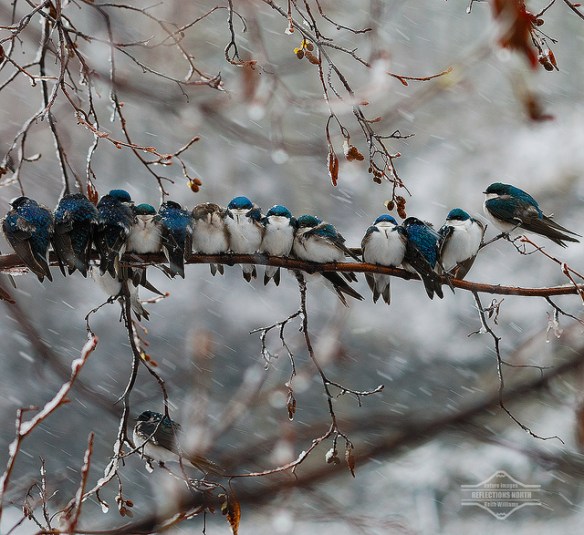
Very cold Tree Swallows. Photo by Keith Williams

Very cold Tree Swallows (up in the Yukon, not Chicago!). Photo by Keith Williams

Like mammals, birds are endothermic (“warm-blooded”), meaning that they maintain their body temperature independent of the outside environment. This almost always means keeping themselves warmer than the outside air. Birds have quite high natural body temperatures, even higher than ours, so any given outside temperature seems even colder to them than it does to us.

Birds are also smaller than we are (well, omitting the ostrich), which means that they have a higher surface-area-to-volume ratio than we do. This is a problem because the volume  (inside) of an animal is where heat is produced and stored, while the surface (skin) of the animal is where heat is lost to the environment. Imagine holding your hand in a bitter wind: how would you keep it warm? By making a fist. Making a fist reduces the surface-area-to-volume ratio of your hand, and lets it keep warm longer. In contrast, if you hold your hand out flat with all the fingers spread, your surface-area-to-volume ratio is larger, and your hand will get cold very quickly. Because birds have higher surface-area-to-volume ratios than we do, keeping warm is harder for them. How do they do it?

Continue reading

Featured paper: the heartbeats of fighting penguins

Viblanc VA, Valette V, Kauffmann M, Malosse N, Groscolas R. 2012. Coping with social stress: heart rate responses to agonistic interactions in king penguins. Behavioral Ecology 23(6):1178-1185.

Most animals live solitary lives, interacting with their own kind only to mate, raise young, or fight. In contrast are group-living animals, from meerkats to humans to Greylag Geese. Their sociality means an easier time locating mates and spotting predators, but it can also mean more disease and competition for resources. This competition can lead to injury and stress.

King Penguin colony. Photo by Liam Quinn.

King Penguin colony. Photo by Liam Quinn.

Breeding King Penguins crowd onto shores in huge numbers and claim tiny territories – about one-half of a square meter – where they incubate their egg and then brood the resulting chick. They have to defend these territories constantly, on average 100 times per hour. This occurs over a tiny space, since the penguins have an egg or chick on their feet and so can’t move much; most aggressive interactions are with neighbors no more than 50 cm away. Stressful interactions may not sound like a big deal – hey, we’re all stressed, right? – but these penguins are trying to maintain a high body temperature in cold conditions and keep their baby warm, and while doing that, they fast for weeks. They do not have energy to waste on stress.

Continue reading

Climate change in the Sierra Nevada mountains

Climate change will affect every corner of the globe in some way, from rising average temperatures to ocean acidification to increasingly extreme and unpredictable weather. It may eventually lead to coastal habitat becoming submerged and the desertification of once-green areas. Currently, however, one of the areas in which climate change exhibits its most dramatic effects is on mountains.

Sierra Nevada mountains

Sierra Nevada mountains

On mountains, the variation in elevation causes habitats to change over relatively small areas. Species may be adapted to just a small strip of habitat within a certain elevational range. With changing climatic conditions, those strips of habitat may move on the mountain, and species then have to follow that strip – track their climatic niche – or stay put and adapt rapidly to the new conditions there.

Continue reading

Featured paper: turkeys help their relatives get lucky

Featured paper: Thanksgiving edition. And it’s doubly relevant – it’s about turkeys and family!

AH Krakauer. 2005. Kin selection and cooperative courtship in wild turkeys. Nature vol. 434, pp. 69 – 72.

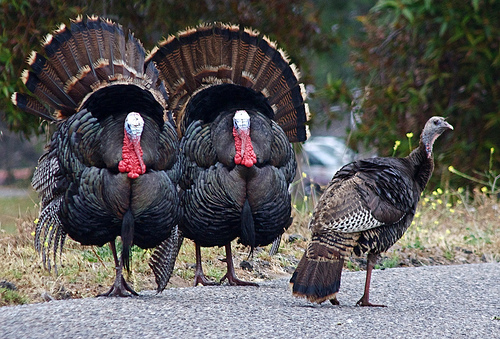
Wild turkeys males show off in front of females in the hopes of being impressive enough to get to mate. While some males show off alone, others form “coalitions” of two to four males and all display for females together. However only one male in each coalition – the dominant male – ever gets to mate. So why in the world do the other male turkeys help him, if they never get to mate? Why don’t they display alone, where they’d at least have a chance at mating?

[Photo from Smart Kitchen]

Continue reading