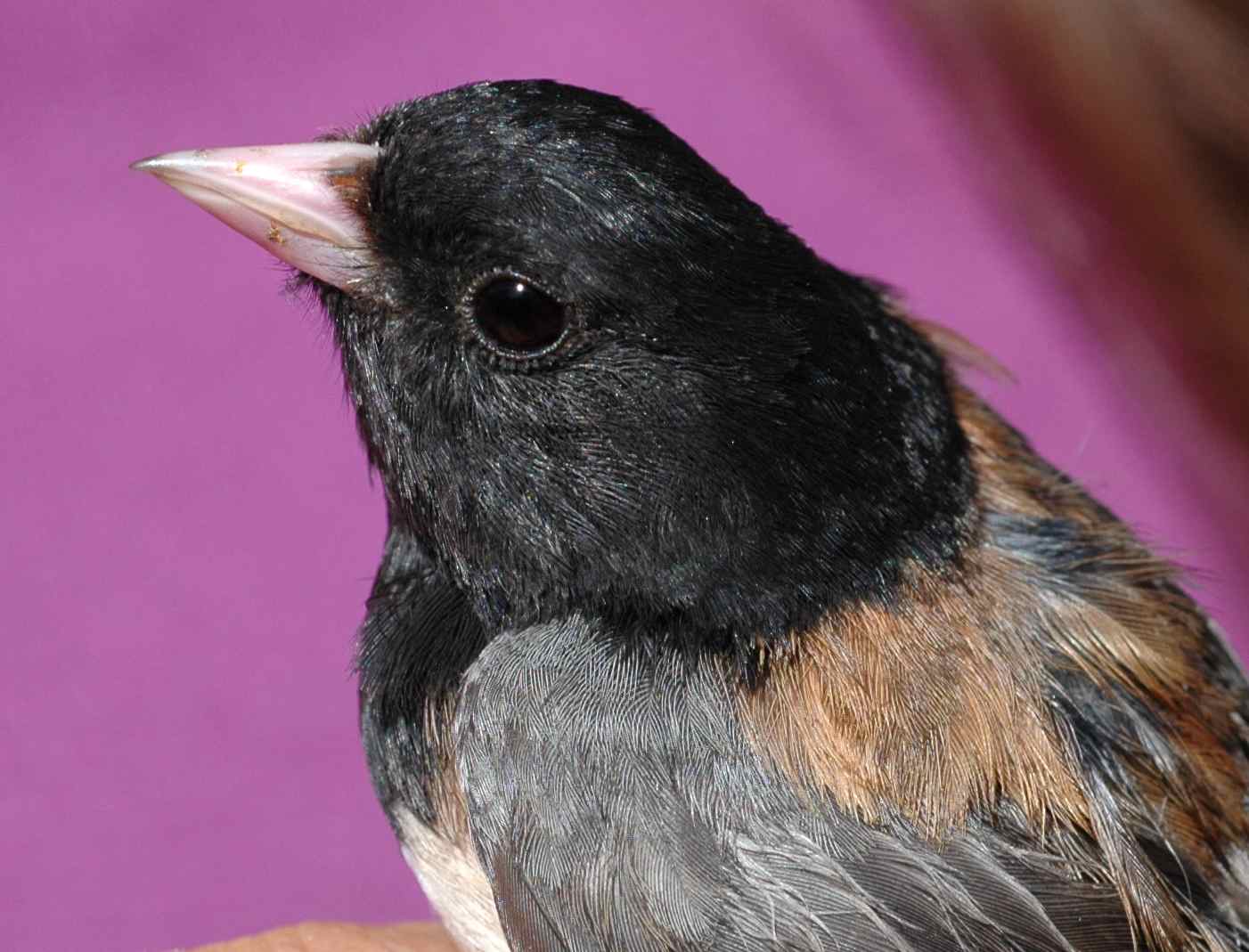
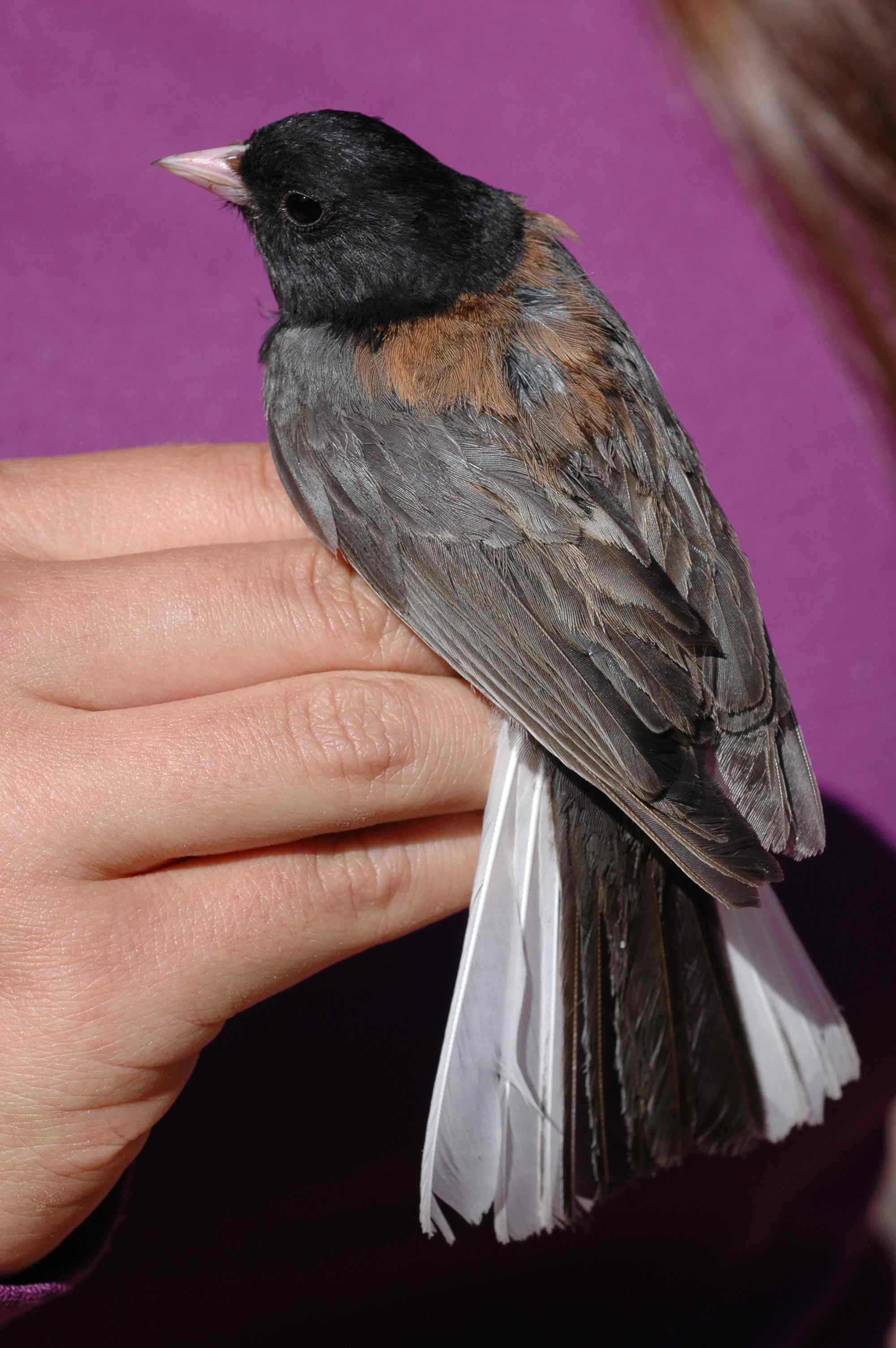
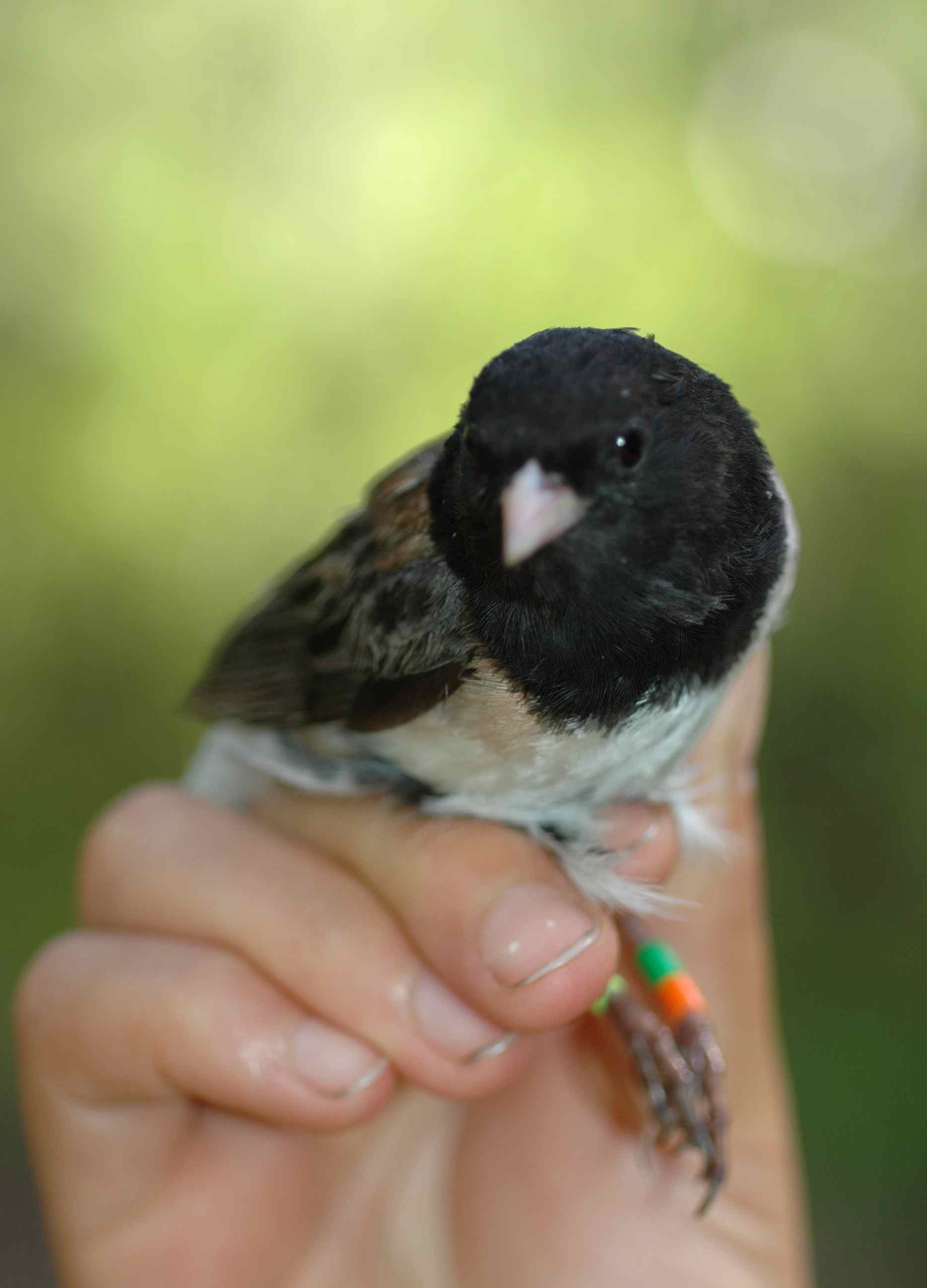
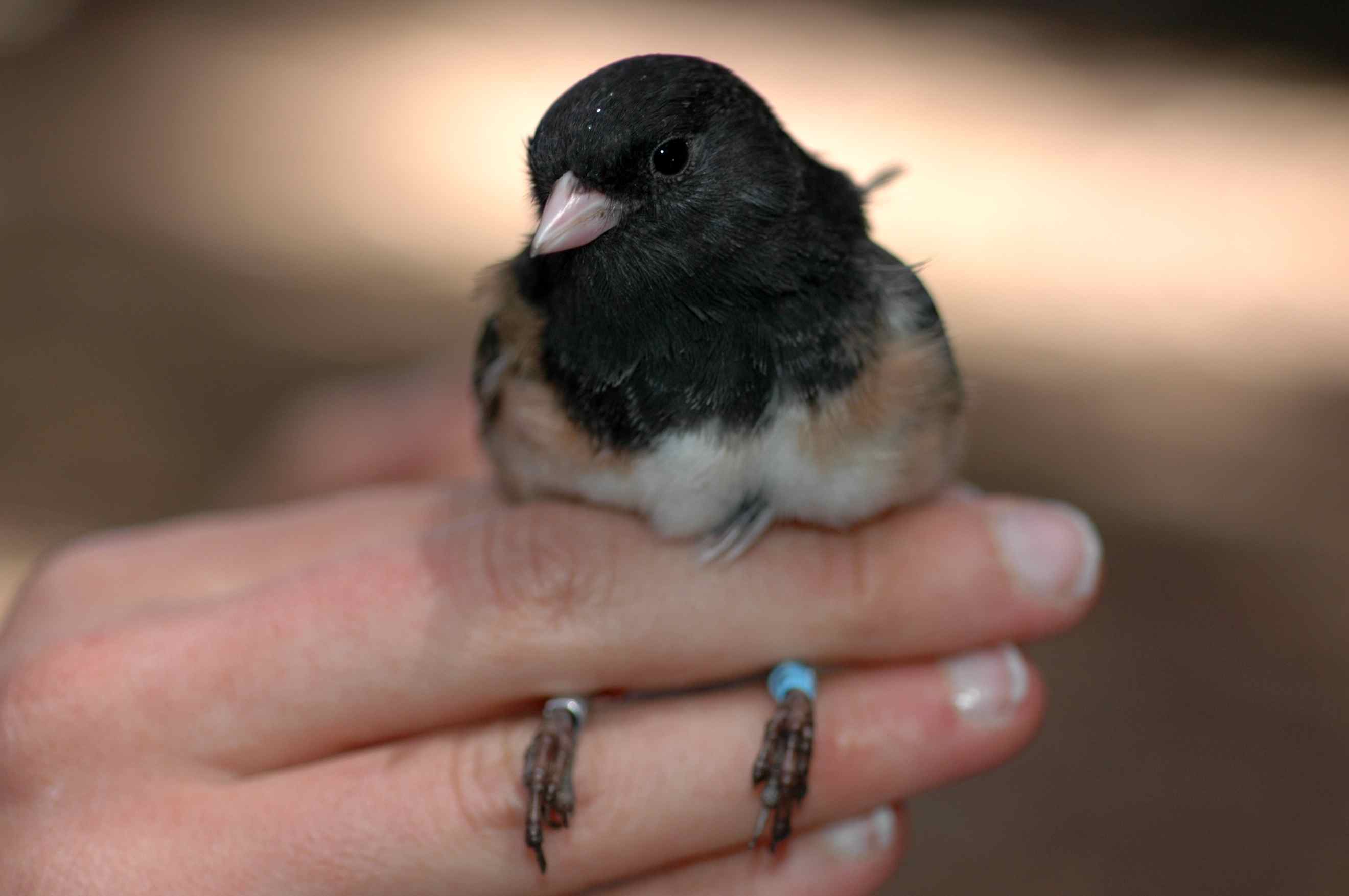
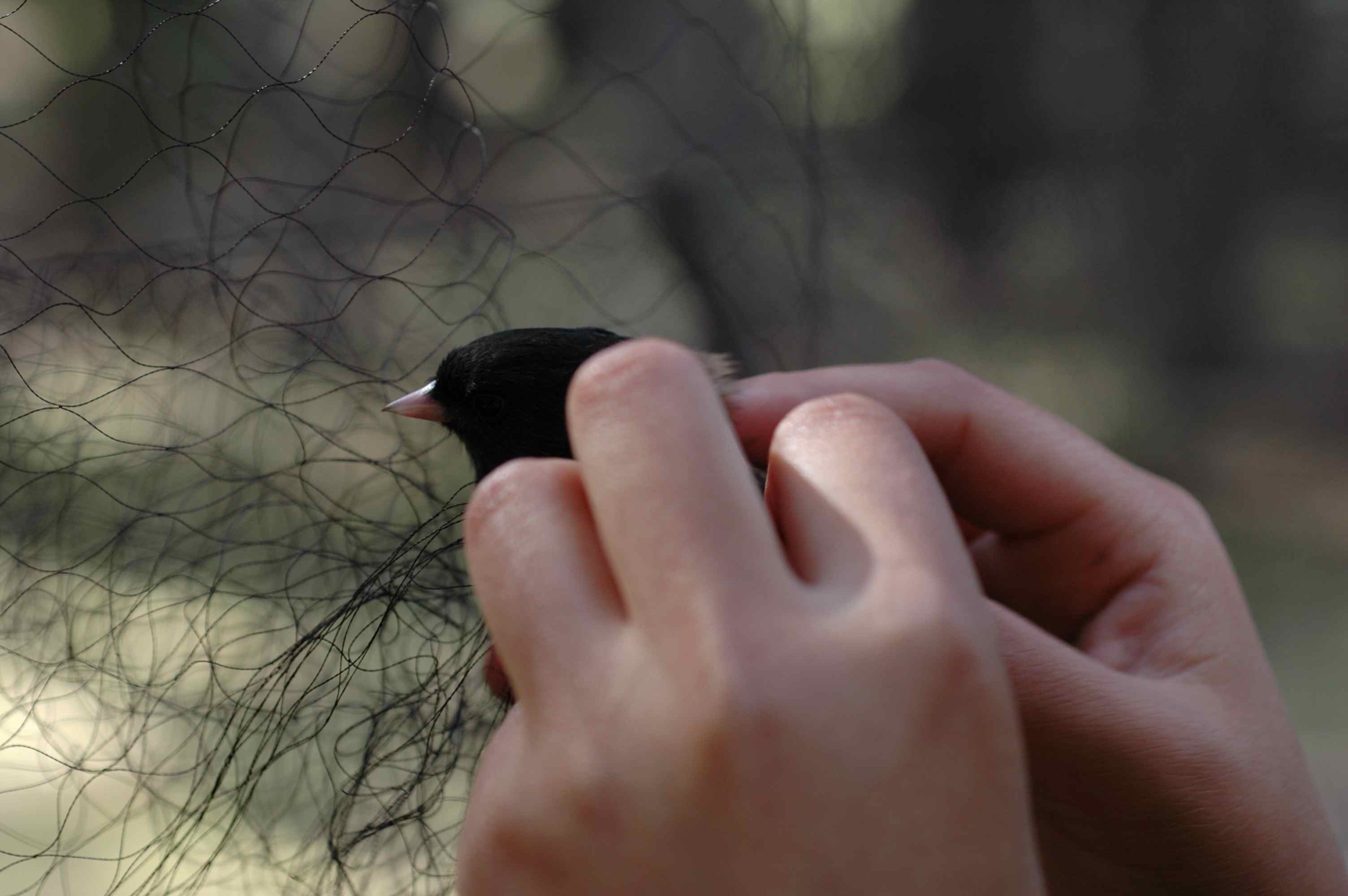
Almost all birds incubate their eggs: keeping them warm while the embryo develops into a chick. In order to transfer heat better from their body to the eggs, many birds develop brood patches (a.k.a. incubation patches). The bird loses feathers from her belly, and the bare skin becomes wrinkly and swollen with fluid. In juncos only the female develops a brood patch, since she does all the incubating, but in species where males also incubate, males can develop brood patches too.
Tag Archives: Dark-eyed Junco
LAGG
Meet LAGG (Lime – Aluminum – Green – Green).
He lives a good 30-minute walk from a campground off Highway 120, far from any other junco territory, as seems to be the rule in our low-elevation sites. We did not see a mate with him—which is strange, to me, because from my subjective human perspective I think he is the handsomest male junco we have caught so far. His head is stark black, no brown feather edges; his back is a rusty red-brown; his tail feathers have lots of white. But of course, there’s no reason to think that female juncos have the same taste in male juncos that I do—and that’s one of the things I’m hoping to find out: what aspects of junco appearance matter to female juncos?
SNAG
Meet SNAG (his leg bands are Sky blue – browN – Aluminum – Green). He lives at approx. 3100 ft above sea level, in a campground along Highway 120 in Stanislaus National Forest. He seems to be doing well: he has a mate, and when I say he lives in a campground, well… actually his territory appears to encompass the entire campground!
His mass is about normal for what we’ve been seeing – 17.6 grams – and he has no visible subcutaneous fat, like most of the juncos we’ve caught. So he’s probably fine, but he could stand to eat more. And he’s working on it: when we caught him he had prey in his bill! They look like aphids to me, but I haven’t really tried to identify them yet.
Eight angry juncos
In the mid-elevation sites we visited last week, juncos were reliably everywhere. The challenge was luring them into the nets.
Not so in the low-elevation sites we just visited. We spent most of our time looking for juncos; once we found them, we had them in the nets sometimes within thirty seconds of starting playback. This was the land of the few aggressive juncos.
At three sites we found just eight juncos, compared to eighteen at the three mid-elevation sites. This is not an elevational difference I anticipated, which is neat!
A bird in the hand
What happens when we catch a junco:
We band it with the uniquely numbered US Fish & Wildlife band. This is the first priority because once the bird has this on, we can identify it later even if it escapes. Then we add the three colored leg bands so that we can identify it later even from a distance.
We caught juncos
The first field expedition was a success! Almost exclusively thanks to the ingenuity, good mist netting sense, and all around awesomeness of my three field assistants. Over three sites we banded a total of 18 juncos. And there are many, many juncos still to go!
Since I’m on field time – wake up at 5:30, go to bed at 9:00 – I’m ready to crash, so I’ll leave you with some photos for now, with more info to come in the future.
Follow-up: almost nobody understands mirrors
Since several people have contacted me to defend junco intelligence after the mirror post yesterday, I thought I might talk a bit more about birds and mirrors.
Very, very few species understand mirrors, and an enormous majority of them behave as if the mirrored images are real, as the junco did. The list of birds that do not recognize themselves in the mirror is long: Budgerigar; House Sparrow; Kea; Black-capped Chickadee; Zebra Finch; Cedar Waxwing; Glaucous-winged Gull; Blue Grouse; Peach-faced Lovebird; reviewed in (1). In 1964, Edith Andrews kept an injured junco in a cage with a mirror and observed that it was quieted by the mirror, liked to perch next to it, and “appeared to be smitten with its own image” (2).
Juncos do not understand mirrors
The other day I saw a junco perched on the ledge of the front side window of a parked car. As I watched, he flew at the side-view mirror, a full head-on charge. When that didn’t seem to work, he sat back on his perch on the window, looked at the mirror, and charged again. And again. When some people passing by scared him up into a tree, he waited until they were gone, and then he flew back down and resumed his attack. He was really determined to win this fight against Mr. Uppity Mirror Junco.
I’m hoping this was a fluke. No one wants to think that their study species is dumb.
Cute?
I’m going to show you some pictures. They will be cute. Ready?
How do these adorable critters relate to my bird research?