Featured paper: turkeys help their relatives get lucky

Featured paper: Thanksgiving edition. And it’s doubly relevant – it’s about turkeys and family!

AH Krakauer. 2005. Kin selection and cooperative courtship in wild turkeys. Nature vol. 434, pp. 69 – 72.

Wild turkeys males show off in front of females in the hopes of being impressive enough to get to mate. While some males show off alone, others form “coalitions” of two to four males and all display for females together. However only one male in each coalition – the dominant male – ever gets to mate. So why in the world do the other male turkeys help him, if they never get to mate? Why don’t they display alone, where they’d at least have a chance at mating?
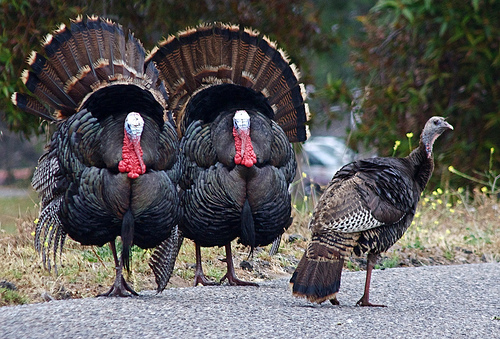
[Photo from Smart Kitchen]
Continue reading

This is fun. Is fun the right word?

I’m waiting to find out if my big grant proposal will be rejected without review on an über-technicality.

Hold on while I refresh my email again… nope, still no news.

The error was a small omission of part of a section; basically a poor copy-paste job. It wasn’t my error, but I should have caught it before submitting, as should about eight other people involved in this process – some of whose job description is to catch technical errors in grant proposals, none of whom did – but in the end it’s my proposal, and I’m the one who should have caught it.

I may be allowed to fix the error, or I may be rejected on the spot, without even any helpful feedback (which is half the reason to apply for these things – even if you don’t get the funding, the feedback is valuable).

Isn’t this fun? Suspense! (whimper) Hold on while I refresh my email again…

Junco withdrawal

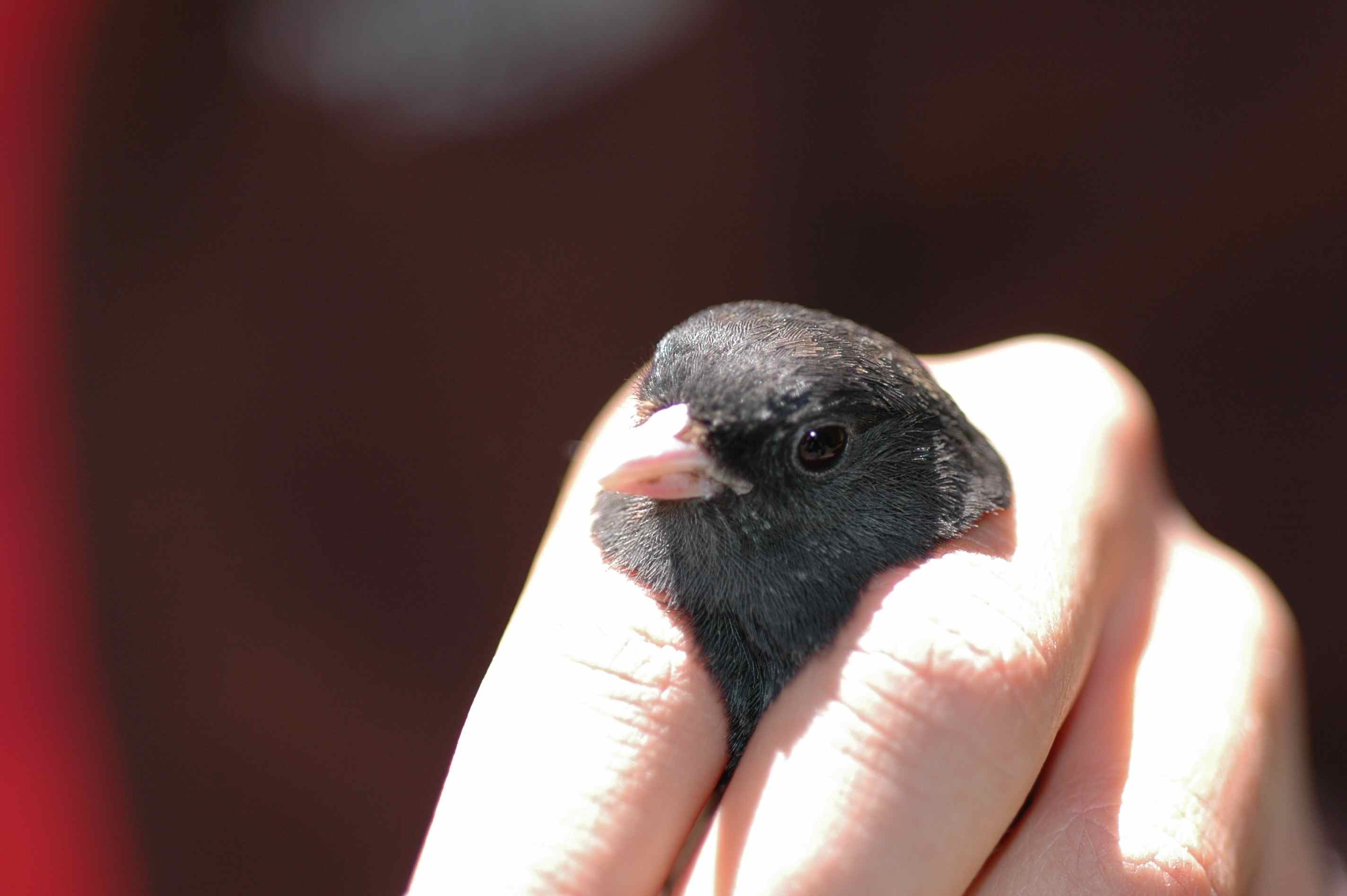
I miss the juncos. I see juncos around campus, but it’s not the same: they have no bands, so I don’t know who they are. (Except for the weird white-splattered junco, who doesn’t need bands to be distinctive. I was delighted to see him last week.)

I miss those warm, fragile bodies in my hand. I miss going back and finding them again and again.

NOLA

Continue reading

Think like a scientist: clever Hans

Clever Hans was a horse. He lived in the early 1900s, had an article written about him in the New York Times (“Berlin’s Wonderful Horse: He Can Do Almost Everything but Talk“), and has a scientific phenomenon named after him: the Clever Hans Effect.

Why was Hans clever? He could do math – even fractions! He could tell time! He could use a calendar! He could recognize currency! He could tell the difference between musical tones! He could identify people from photographs! He could not only understand German but read and spell it! Basically, clever Hans was smarter than your Honor Roll student. And he was a horse.

That seems plausible, right?

Right?

Extremely historically accurate depiction of clever Hans doing math

Many animals are highly intelligent. For example, I have no doubt that psychologist Irene Pepperberg’s late, great African Grey Parrot Alex could have performed most of clever Hans’ tasks. But, sad to say, clever Hans was a fraud.

Continue reading

Kinky kakapo, lyrical lyrebird, moonwalking manakin

I’m on vacation to clear out my brain after finishing the big grant application, so here’s a lazy-blogger post: three classic bird videos.

The kakapo is a very rare, flightless parrot in New Zealand. This one has a thing for human cameramen.

The lyrebird, like a mockingbird or a mynah, shows off by perfectly imitating the sounds of other birds… and camera shutters, car alarms, and chainsaws.

Manakins, like birds of paradise, have brightly-colored males who perform elaborate dances to attract mates. The Red-capped Manakin male’s dance will be familiar to fans of Michael Jackson.

Adventure of a freelance science mouse

Two of my labmates study chipmunks. Recently they have been working with an engineer to develop a small tag that they can attach to a chipmunk to record the chipmunk’s movements. This, if it works, will let them “see” what the chipmunk is doing without actually watching–and bothering–the chipmunk, which would be great: one of the difficulties of behavioral ecology is that, for animals as for subatomic particles, observing the thing often affects the very nature of that thing.

Part of developing this tag is being able to check how well it works. Unfortunately, our lab doesn’t have any chipmunks just hanging around on which to test the tag. So instead, for an unofficial, exploratory test run, we recruited one of my domestic mice.

Oreo the freelance science mouse

Continue reading

Rituals

Ritual is everywhere in the natural world. From braving flight over expansive, stormy seas, to the tenuous, exhausting work of rearing chicks, to squabbling for social rank on the wintering grounds, birds tread and hop and fly recognizable annual patterns.

And so do field biology graduate students.

Our most obvious ritual is the field season. Our study subjects follow an annual pattern and so must we: the ornithologists out May through August, give-or-take; my labmates the high-elevation chipmunk researchers waiting impatiently in June for the snow on Tioga Pass to melt; those studying South American fauna gone in our winter for the Southern Hemisphere summer. Only the tropical biologists are unpredictable.

Continue reading

Scary birds

In honor of Halloween: some birds you would not want to meet in a dark alley at night. (Warning: first two sections contain photos of predation.)

Shrikes

Loggerhead Shrike. Photo by Jeff Jones.

Shrikes are medium-sized birds—the Northern Shrike is slightly smaller than an American Robin—and, upon first glance, fairly unassuming. Perhaps you notice the somewhat raptor-like bill; perhaps the extra notch on that bill, the tomial tooth; perhaps not. But it is only because you are much, much bigger than a shrike that you can afford to be so careless of this fearsome predator.

Continue reading

Think like a scientist: correlation

Correlation does not equal causation. Done!

Just kidding. It isn’t enough simply to state that classic phrase because in the real world, we’re often still stuck with using correlations. If you want to know how lifelong exercise habits affect lifespan, you can’t take two groups of people and force one group to exercise and the other not to (“GET BACK IN THAT CHAIR! That is TOO MUCH walking to the corner store for one day!”), while keeping everything else exactly the same between the groups (“I don’t care if you’re not hungry, everyone eats one cupcake on Tuesdays!”), for their entire lives. Even if you didn’t mind knowing that you, too, would be dead before the study was over, it would be completely unethical. Instead, you study people’s natural exercise habits, and try to correlate them with lifespan. Continue reading

Featured paper: side-blotched lizards play rock-paper-scissors

B Sinervo and CM Lively. 1996. The rock-paper-scissors game and the evolution of alternative male strategies. Nature vol. 380, pp. 240-243.

(Side note: I don’t want to feature-paper too many Science or Nature papers, since those journals are so high-profile that you’re likely to hear about the work elsewhere, and part of the point of this feature is that papers in “lesser” journals can be awesome too; but this paper is classic and fun, so I’ll make an exception.)

Male side-blotched lizards come in three flavors colors: orange-throated, blue-throated, and yellow-throated. Orange males are highly aggressive and defend large territories. Blue males are less aggressive, defending smaller territories. Yellow males look like females and don’t defend territories at all. All three colors compete to mate with females and have offspring. Throat color is highly heritable: orange males have orange sons, blue males have blue sons, yellow males have yellow sons.

Continue reading