Featured paper: cuttlefish are lying cheaters

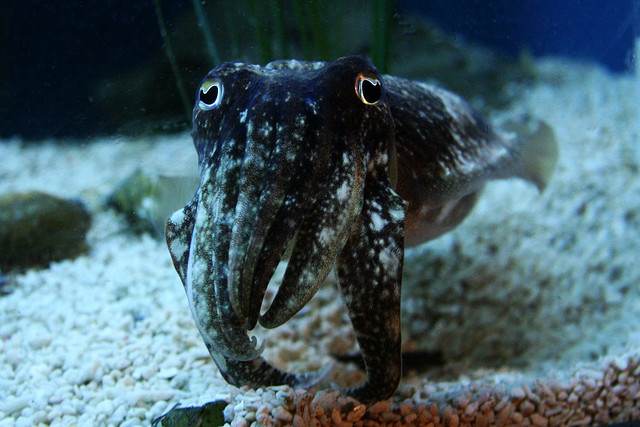
Although the cuttlefish may be best known for making those flat cuttlefish bones that your pet bird nibbles to get calcium, this paper shows that it should be known for being a lying cheater.

That was uncalled for. Photo by Tom Olliver

That was uncalled for.
Photo by Tom Olliver

Cuttlefish, like their relatives the squids and the octopuses, are masters of visual communication. They can change their appearance almost instantaneously (video here), and they use color and pattern to say things like “Back off, I’m angry!” and “Pretty lady, I would like to do some romance with you now,” and “Please don’t do romance with me, I am male.”

Continue reading

Featured paper: the heartbeats of fighting penguins

Viblanc VA, Valette V, Kauffmann M, Malosse N, Groscolas R. 2012. Coping with social stress: heart rate responses to agonistic interactions in king penguins. Behavioral Ecology 23(6):1178-1185.

Most animals live solitary lives, interacting with their own kind only to mate, raise young, or fight. In contrast are group-living animals, from meerkats to humans to Greylag Geese. Their sociality means an easier time locating mates and spotting predators, but it can also mean more disease and competition for resources. This competition can lead to injury and stress.

King Penguin colony. Photo by Liam Quinn.

King Penguin colony. Photo by Liam Quinn.

Breeding King Penguins crowd onto shores in huge numbers and claim tiny territories – about one-half of a square meter – where they incubate their egg and then brood the resulting chick. They have to defend these territories constantly, on average 100 times per hour. This occurs over a tiny space, since the penguins have an egg or chick on their feet and so can’t move much; most aggressive interactions are with neighbors no more than 50 cm away. Stressful interactions may not sound like a big deal – hey, we’re all stressed, right? – but these penguins are trying to maintain a high body temperature in cold conditions and keep their baby warm, and while doing that, they fast for weeks. They do not have energy to waste on stress.

Continue reading

Featured paper: turkeys help their relatives get lucky

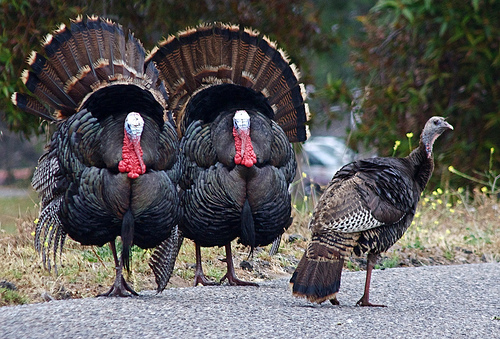
Featured paper: Thanksgiving edition. And it’s doubly relevant – it’s about turkeys and family!

AH Krakauer. 2005. Kin selection and cooperative courtship in wild turkeys. Nature vol. 434, pp. 69 – 72.

Wild turkeys males show off in front of females in the hopes of being impressive enough to get to mate. While some males show off alone, others form “coalitions” of two to four males and all display for females together. However only one male in each coalition – the dominant male – ever gets to mate. So why in the world do the other male turkeys help him, if they never get to mate? Why don’t they display alone, where they’d at least have a chance at mating?

[Photo from Smart Kitchen]

Continue reading

Featured paper: side-blotched lizards play rock-paper-scissors

B Sinervo and CM Lively. 1996. The rock-paper-scissors game and the evolution of alternative male strategies. Nature vol. 380, pp. 240-243.

(Side note: I don’t want to feature-paper too many Science or Nature papers, since those journals are so high-profile that you’re likely to hear about the work elsewhere, and part of the point of this feature is that papers in “lesser” journals can be awesome too; but this paper is classic and fun, so I’ll make an exception.)

Male side-blotched lizards come in three flavors colors: orange-throated, blue-throated, and yellow-throated. Orange males are highly aggressive and defend large territories. Blue males are less aggressive, defending smaller territories. Yellow males look like females and don’t defend territories at all. All three colors compete to mate with females and have offspring. Throat color is highly heritable: orange males have orange sons, blue males have blue sons, yellow males have yellow sons.

Continue reading

Featured paper: barn owl chicks’ spots

Melanic color-dependent antipredator behavior strategies in barn owl nestlings. By Valentin van den Brink, Vassilissa Dolivo, Xavier Falourd, Amélie N. Dreiss, and Alexandre Roulin. Behavioral Ecology, 2011.

I’ve been slacking off on the Featured Papers, since it’s the field season and I’ve been reading almost nothing less than usual; but this paper is too crazy not to mention.

Continue reading

Featured paper: nest predation

Corey Tarwater. 2008. Predators at nests of the Western Slaty Antshrike (Thamnophilus atrinucha). The Wilson Journal of Ornithology, volume 120(3): pp 620-624.

Nest predation is a major worry for most birds. Chicks in the nest are essentially helpless, and parents usually can’t do much to stop predators, although they will try. Losing broods to predation is common. In this study, 79% of nests were lost to predation. If you’re a Western Slaty Antshrike, you can expect 4 out of every 5 broods of chicks you have to get eaten!

Yet actually seeing these—or any—predation events is extremely rare. Dr. Tarwater describes five nest predation events on Western Slaty Antshrikes (small, cryptic brownish birds) in Panama, one she observed in person and the rest of which she caught on video.

Continue reading

Featured paper: fledging House Wrens are funny

(This will be a regular feature: blurbs about papers I like.)

Today’s paper: “The process and causes of fledging in a cavity-nesting passerine bird, the House Wren (Troglodytes aedon)” by L. Scott Johnson, Robin L. Rauch, and Sara N. Dellone. Published in 2004 in Ethology 110, pages 693-705.

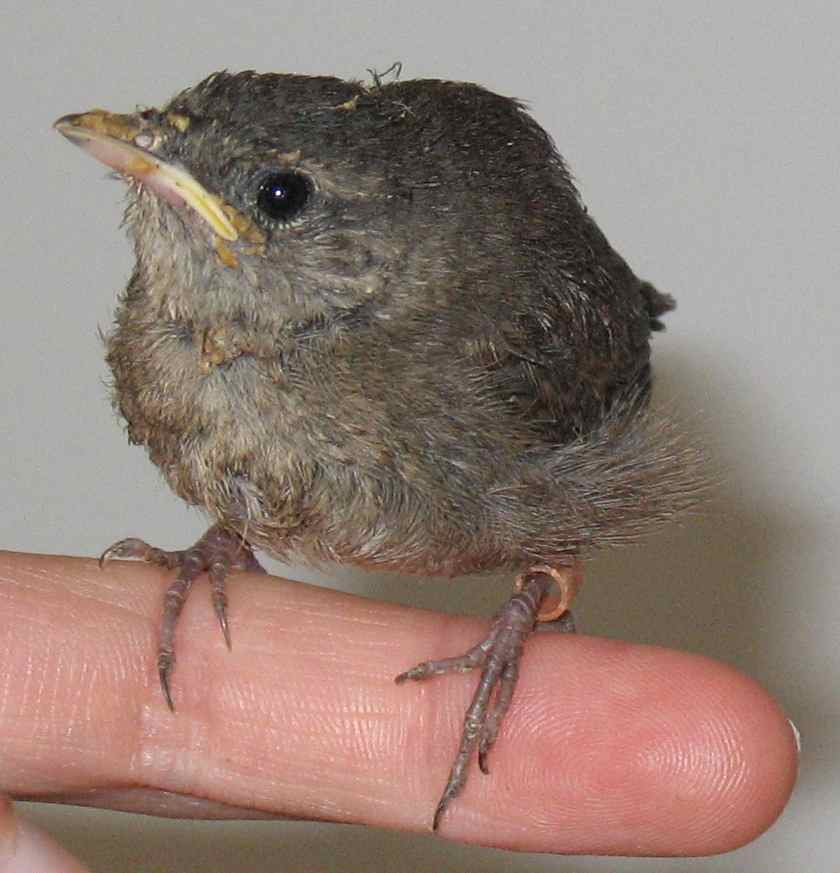
Fledging is the act of leaving the nest for the first time. In birds with altricial (helpless, naked, dependent) young, this is a big step: the chicks go from sitting in a nest to flying around like adult birds. Or trying to fly around, anyway. Fledglings often aren’t very good at flying at first.

A rehabbed House Wren nestling (and messy eater) nearly ready to fledge

Continue reading