Damaged feet, but still hopping

Juncos use their feet more than many birds, not just to perch but to hop about while feeding. Their legs and feet, viewed close, are a contradiction: incredibly slender and fragile-seeming, but also covered in a hard, scaly, tough surface. You hope for their sake that the fragility is the illusion and the toughness reality, but of course each is a little true.

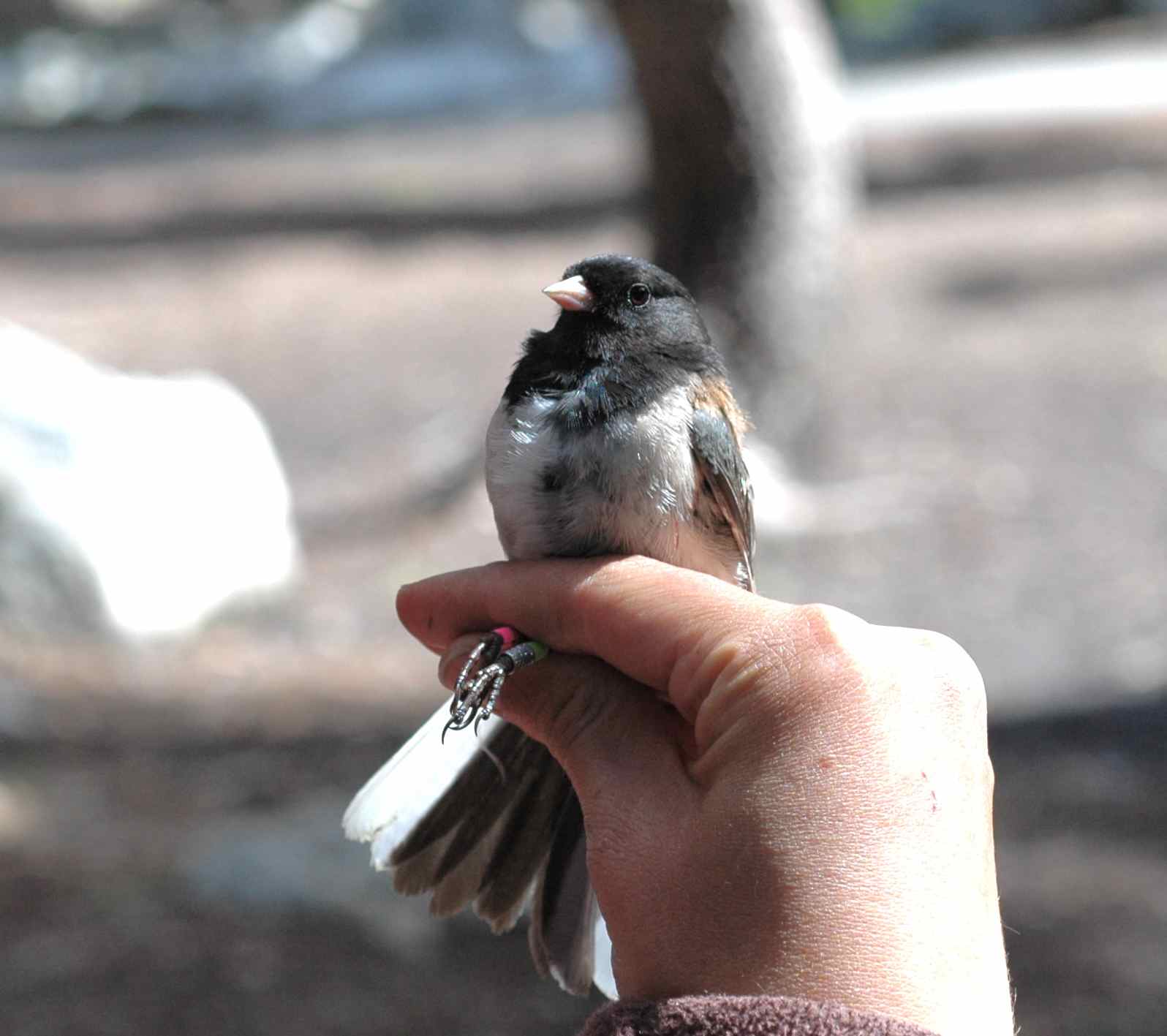
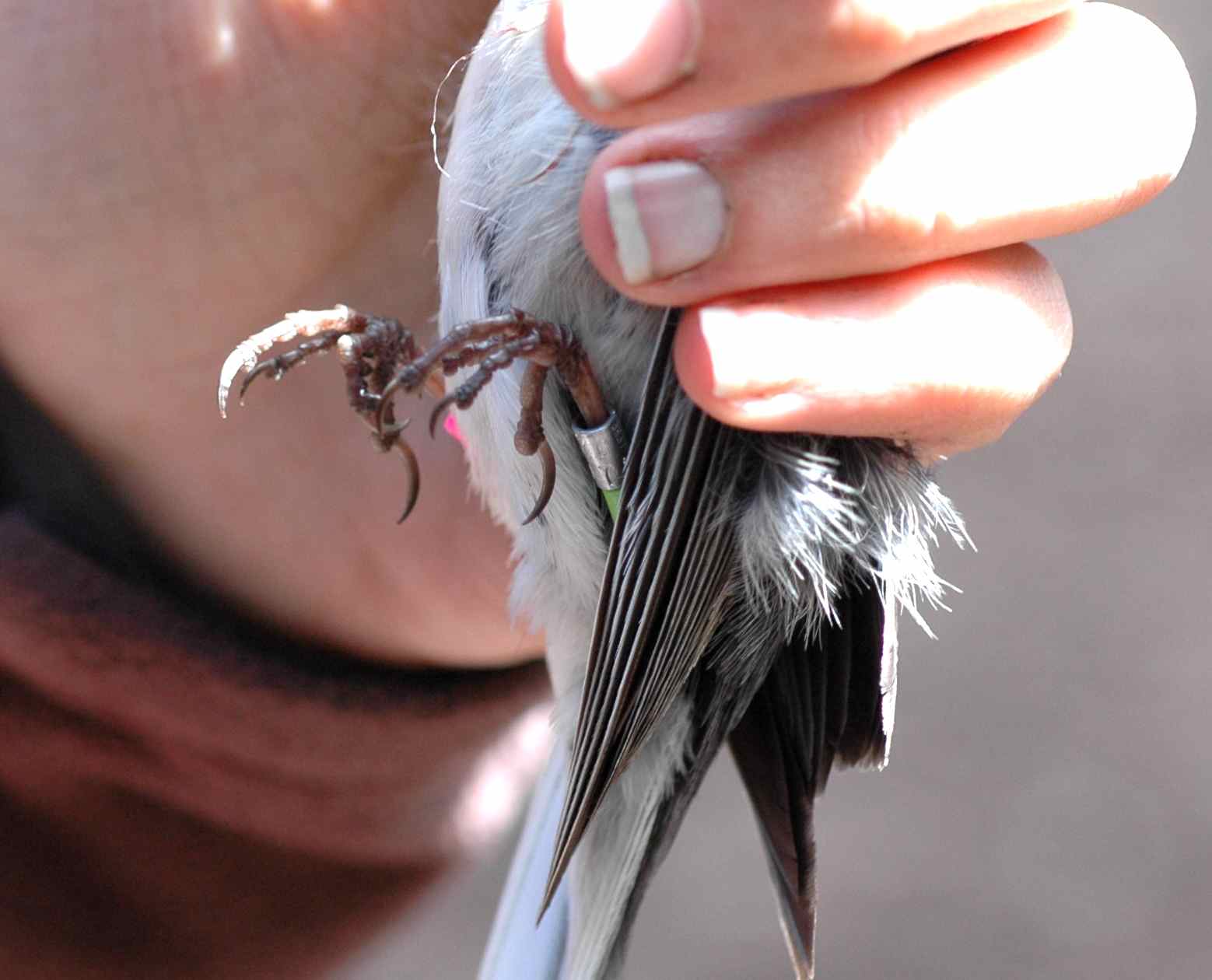
LANK has a permanently bent toe on his right foot. When he perches, his weight rests on what should be the top of the toe, and I imagine the same is true when he stands on the ground.
LANK

LANK

The bent toe is the left-most top toe on his right foot

The bent toe is the left-most top toe on his right foot.
2013-feet_LANK

View from the other side, for comparison with his healthy left foot.

Continue reading

One hundredth junco

I forgot to mention in the last post: I banded my one hundredth junco a few days ago. (Well, I didn’t band him; I’m training field assistants to be able to band, so one of them banded him. But I caused him to be banded.)

Me with RROA, my hundredth junco.

Me with RROA, my hundredth junco.

We banded him RROA, which is a combination with a history: in my previous work on House Wrens, RROA was a male wren who managed to breed for three years, which was much longer than any of our other wrens. He was a bit of a celebrity. Here’s hoping that the combination brings such luck to junco RROA too.

First juncos of the 2013 field season!

I got back from our first bout of field work yesterday, and I can say that if things keep going the way they did, we’re going to be banding a lot of juncos this year. That is excellent: the more we band, the more we can identify individually by sight, allowing us to observe the behavior of each. It’s much more informative to be able to say “KARL chased RRAY” than “one junco chased another junco”. Too, when we band them we also take measurements and pictures, so we can relate their behavior to things like condition and size.

Male GILA. The bands on his legs are read top-left, bottom-left, top-right, bottom-right: he has Green, shrImp, Lime, Aluminum, hence GILA.

Male GILA. The bands on his legs are read top-left, bottom-left, top-right, bottom-right: he has Green, shrImp, Lime, Aluminum, hence GILA.

GILA had an unusual white feather on the back of his head.

GILA had an unusual white feather on the back of his head.

Continue reading

Scouting: snow, fog, and little red spiders

I’m switching up my field sites a bit this year, using some from 2012 but also adding new ones. I’ve known the general area where they would go, but this week I went scouting the area to figure out exactly where I’ll be observing juncos this summer. Here are the highlights, in photograph form. (The quality of the animal photos isn’t great because I brought my taking-pictures-of-mountains camera instead of my taking-pictures-of-birds camera.)

scout_snow+tree

Continue reading

The local juncos, mutant and otherwise

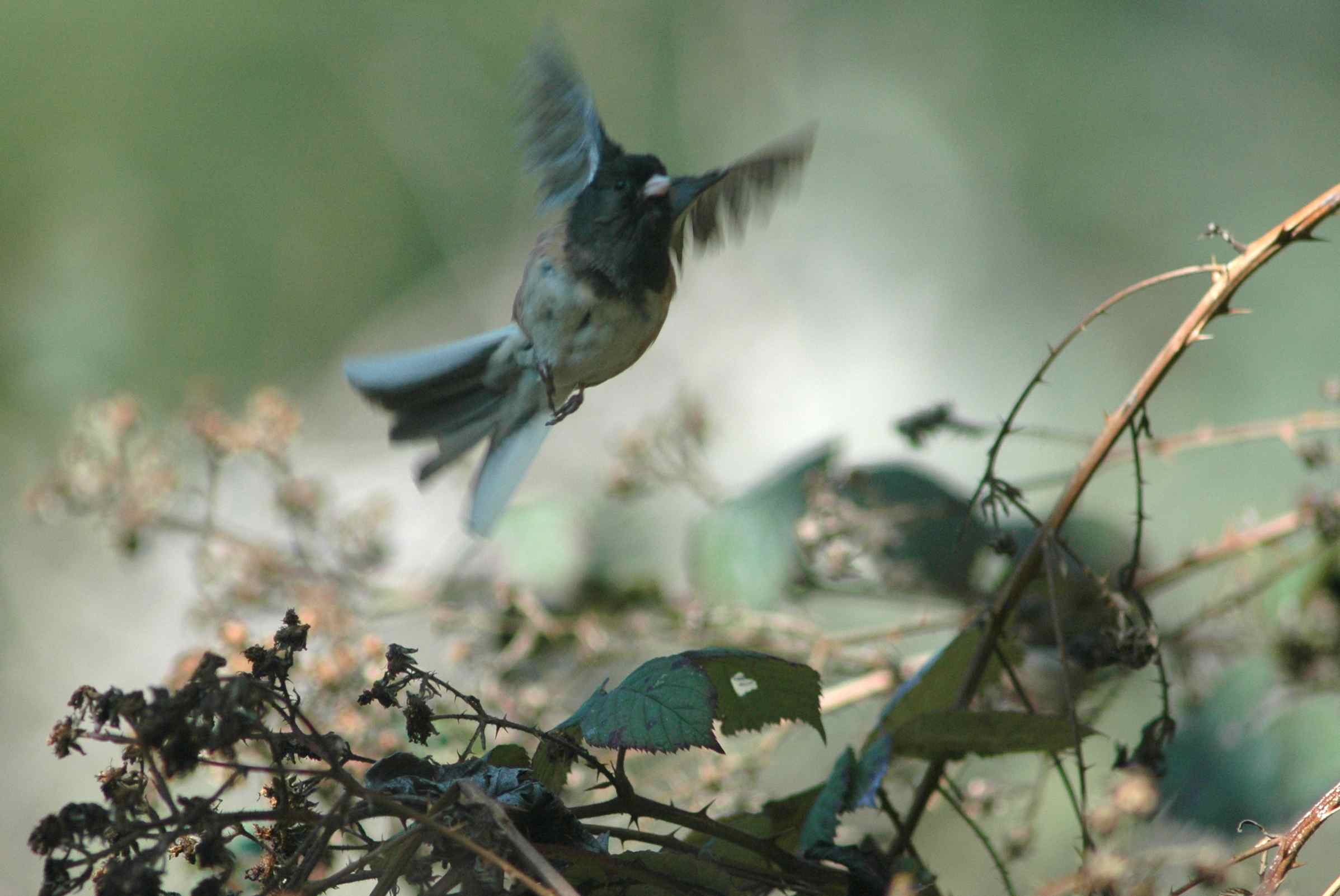
After mentioning my local mutant junco here several times, I figured I owed you a photo, so I went stalking him today. In searching for him I also found lots of normal-looking juncos. I did eventually find my white-splashed bird, so read on to see this unusual junco – after first admiring the regular juncos, because every junco is awesome.

cj_flight

Continue reading

Three specimens

In the course of my junco specimen bill measuring – I’ve measured 561 so far – I’ve handled ratty specimens and fine ones, old and not-quite-so-old. (Most of the specimens are from before 1950, so they’re all fairly old.) It’s fun to see how much variation there is even among individuals from the same subspecies and the same state. Here are my three favorite specimens:

This male has lovely red-brown spots on his head.

This male has lovely red-brown spots on his head.

Continue reading

The other juncos

As I mentioned before, I don’t get to be out in the field interacting with the juncos right now. I am, however, making use of the other juncos: the ones that don’t fly away, don’t stress out when I handle them, and are always there when I go to look for them. The ones that live about twenty feet from my office.

I work in a museum, remember?

The other juncos

Continue reading

Junco withdrawal

I miss the juncos. I see juncos around campus, but it’s not the same: they have no bands, so I don’t know who they are. (Except for the weird white-splattered junco, who doesn’t need bands to be distinctive. I was delighted to see him last week.)

I miss those warm, fragile bodies in my hand. I miss going back and finding them again and again.

NOLA

Continue reading

Think like a scientist: correlation

Correlation does not equal causation. Done!

Just kidding. It isn’t enough simply to state that classic phrase because in the real world, we’re often still stuck with using correlations. If you want to know how lifelong exercise habits affect lifespan, you can’t take two groups of people and force one group to exercise and the other not to (“GET BACK IN THAT CHAIR! That is TOO MUCH walking to the corner store for one day!”), while keeping everything else exactly the same between the groups (“I don’t care if you’re not hungry, everyone eats one cupcake on Tuesdays!”), for their entire lives. Even if you didn’t mind knowing that you, too, would be dead before the study was over, it would be completely unethical. Instead, you study people’s natural exercise habits, and try to correlate them with lifespan. Continue reading

Blood secrets

Sometimes doing science feels like doing magic. Take a fantastical witch brewing eye of toad and nightshade flower in a cauldron, substitute a 1.5 ml tube for the cauldron, AW1 Buffer for the nightshade flower, and blood of junco for the eye of toad, and that’s me.

(And that “eye of ___” thing happens in science too: a few of my herpetologist colleagues have been talking lately about what you can learn from preserved lizard eyes.)

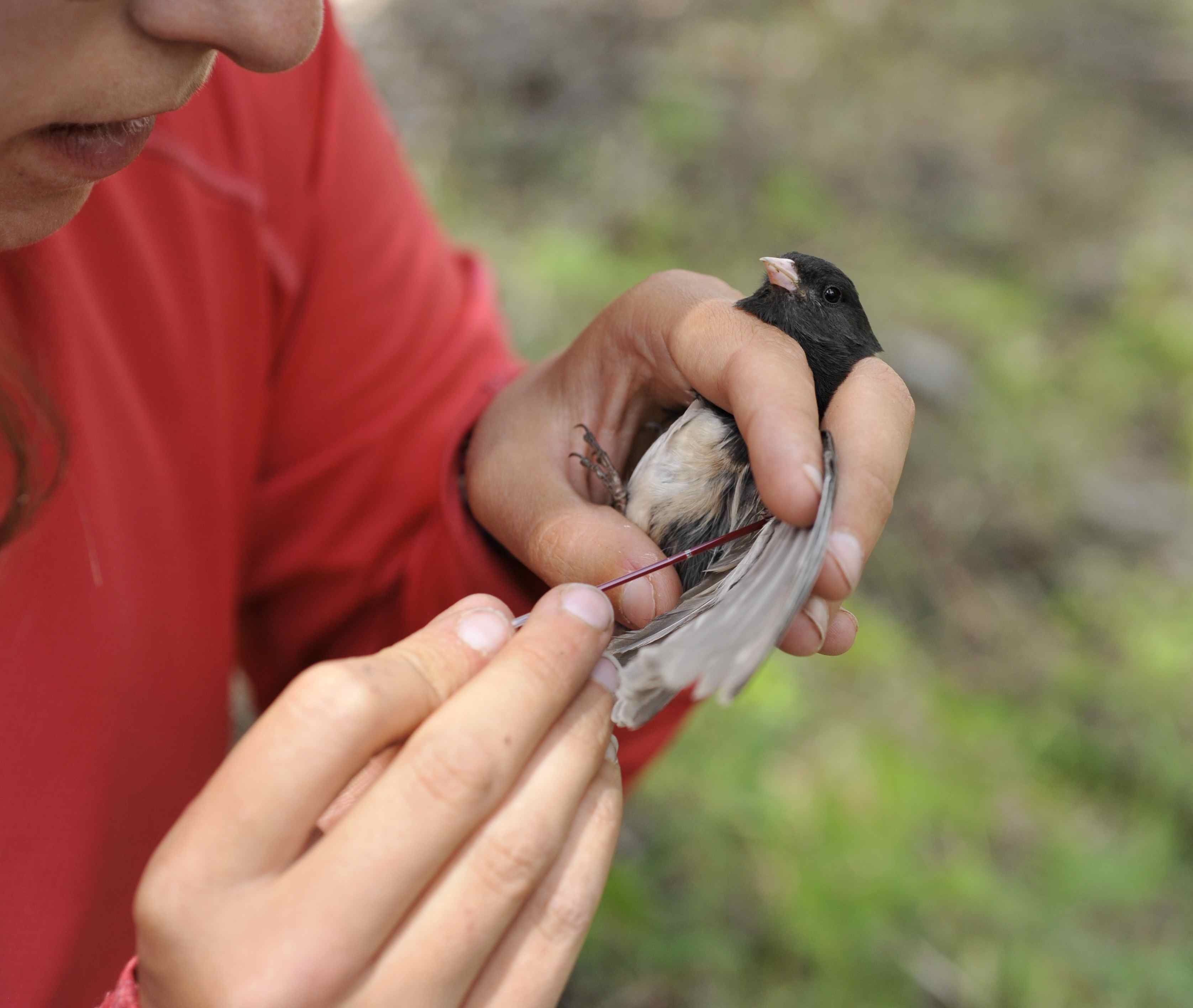
One of the things I do when I capture a junco is to collect a blood sample. I use a sterile needle, collect very little blood, and don’t let the bird go until I’m sure the bleeding has stopped. The birds usually don’t even flinch. They act much more upset when I blow on their chests to look for brood patches (I think it feels cold to them) than they do when I take blood.

Me collecting blood from GRAY. The blood moves up the tiny capillary tube on its own. Photo by M. LaBarbera.

Continue reading