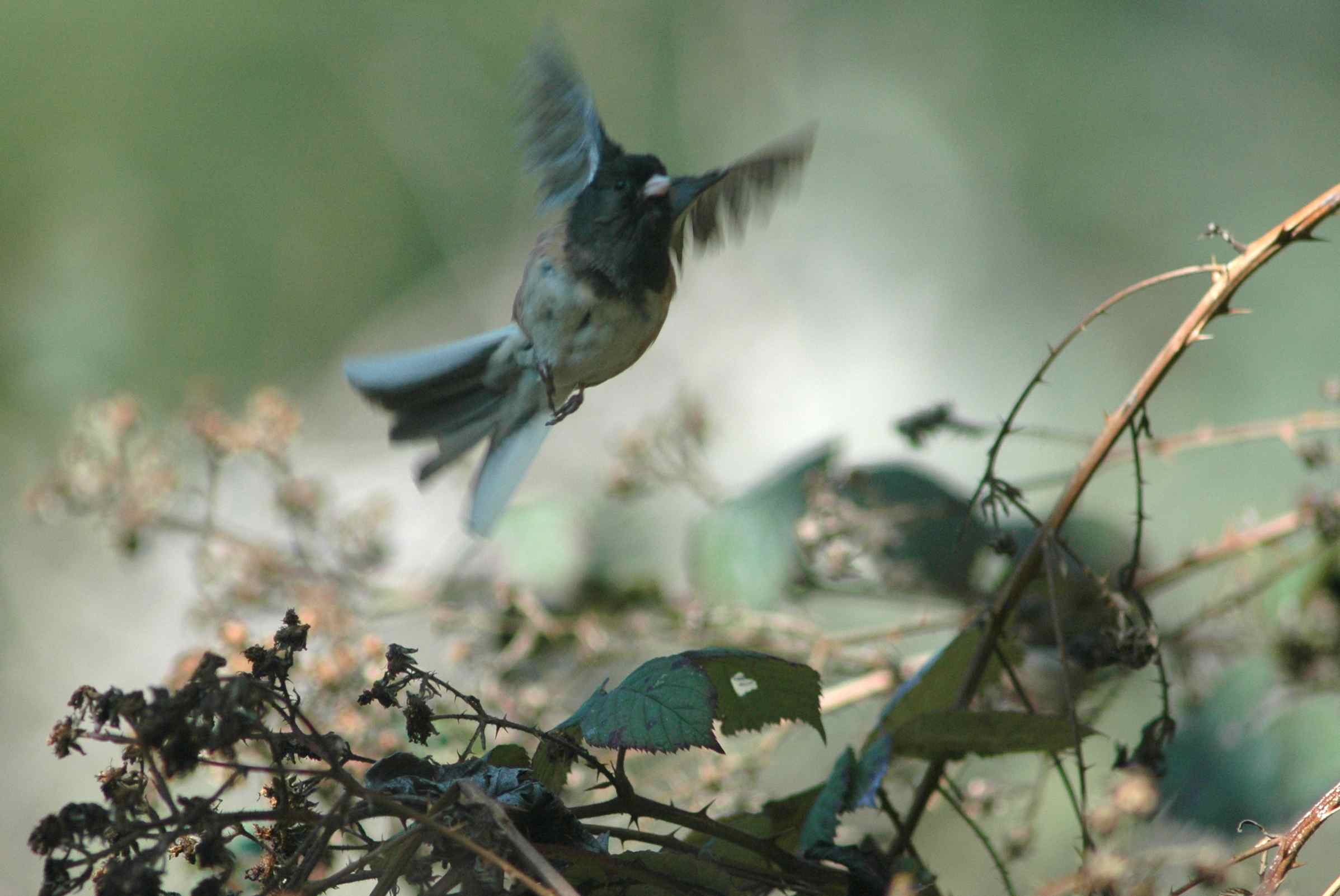
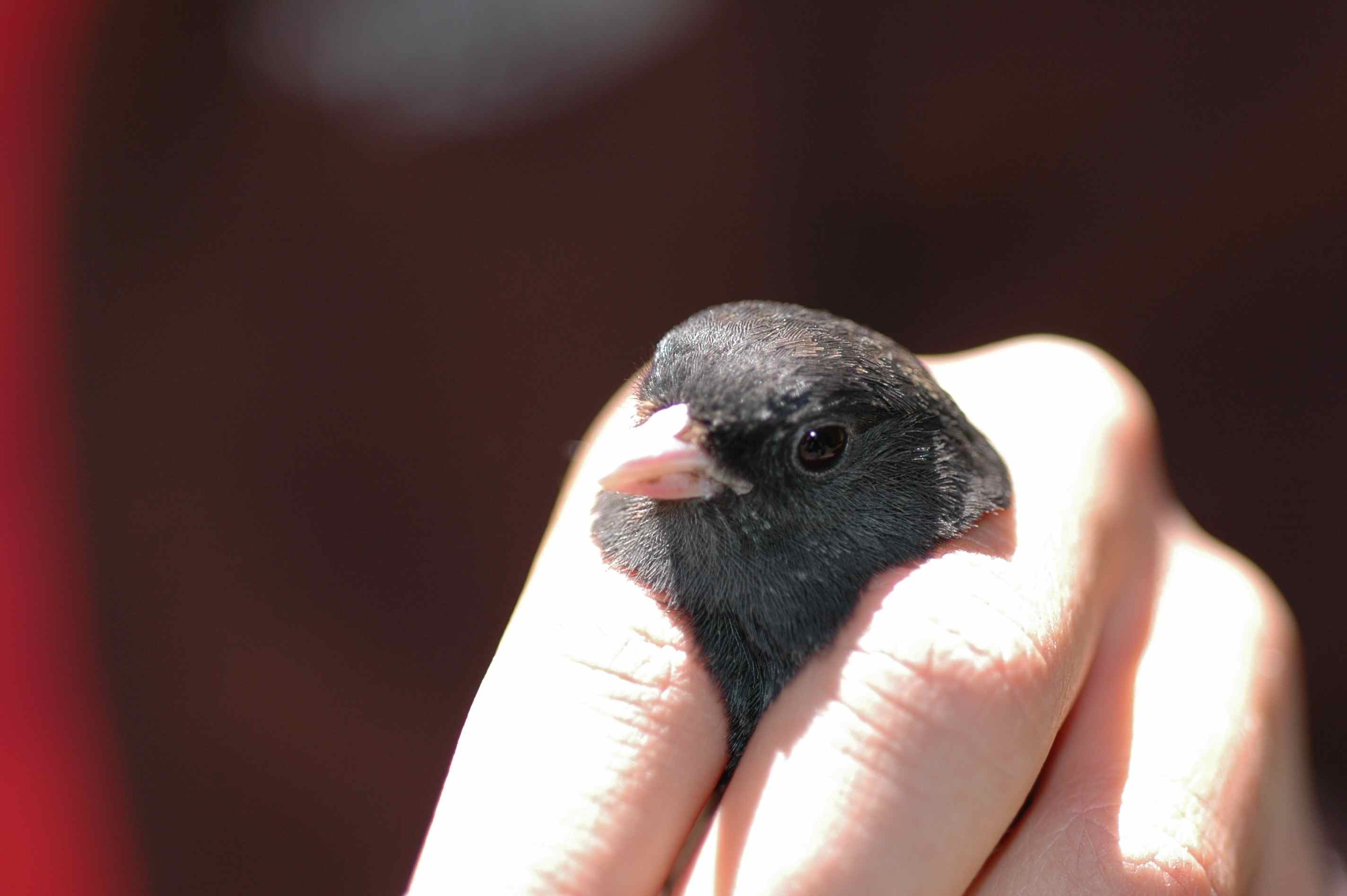
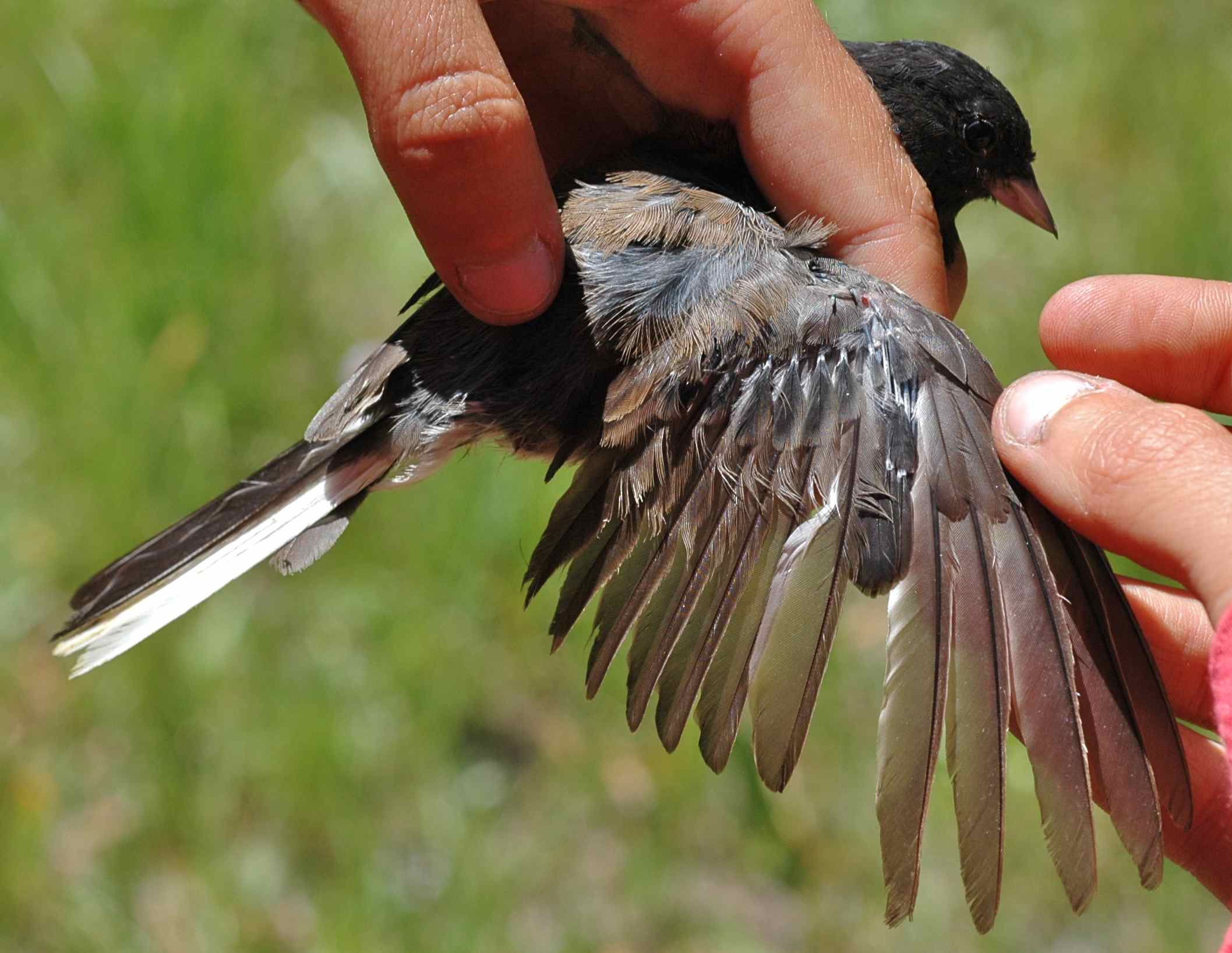
I’m switching up my field sites a bit this year, using some from 2012 but also adding new ones. I’ve known the general area where they would go, but this week I went scouting the area to figure out exactly where I’ll be observing juncos this summer. Here are the highlights, in photograph form. (The quality of the animal photos isn’t great because I brought my taking-pictures-of-mountains camera instead of my taking-pictures-of-birds camera.)
Tag Archives: Dark-eyed Junco
The local juncos, mutant and otherwise
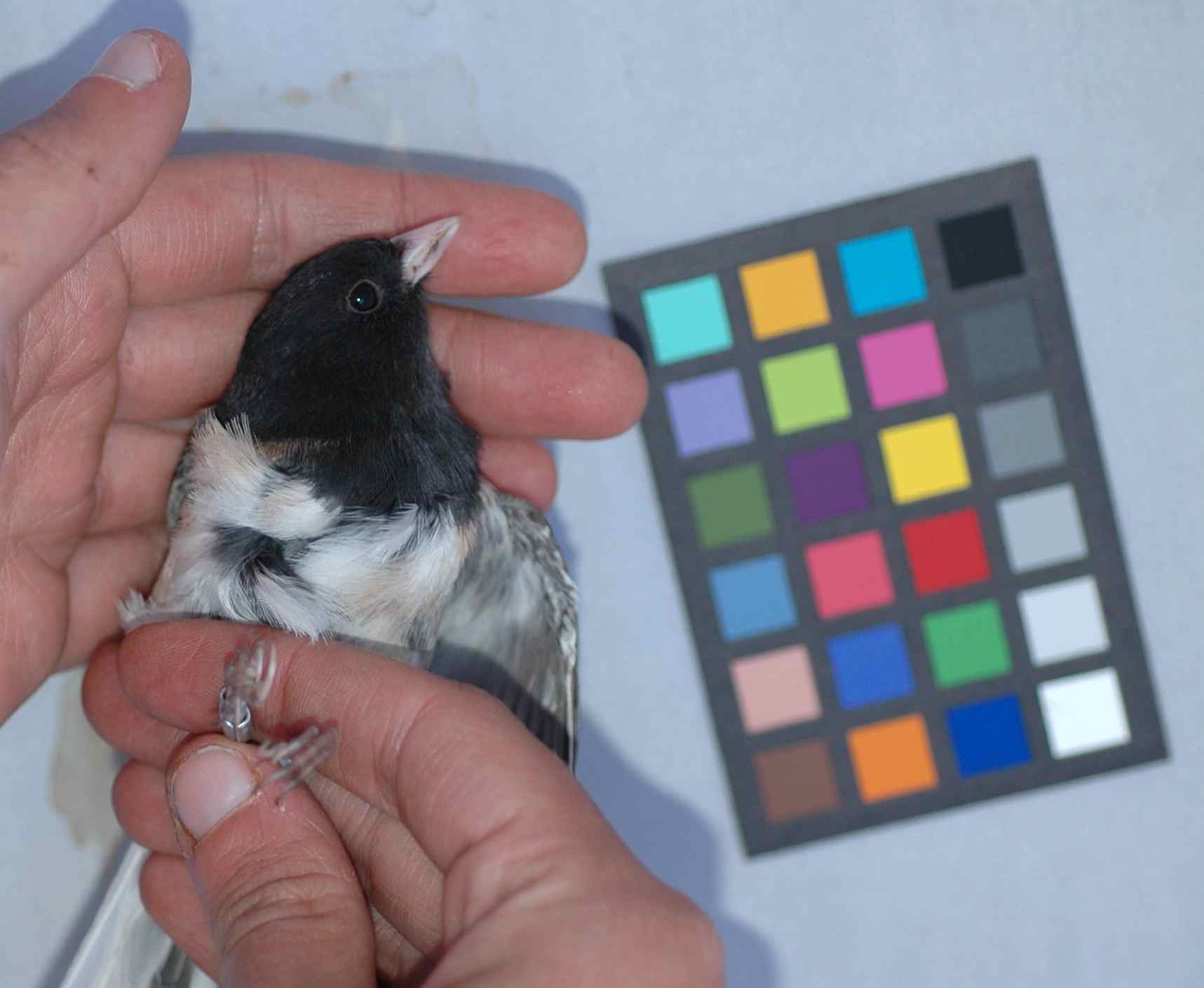
After mentioning my local mutant junco here several times, I figured I owed you a photo, so I went stalking him today. In searching for him I also found lots of normal-looking juncos. I did eventually find my white-splashed bird, so read on to see this unusual junco – after first admiring the regular juncos, because every junco is awesome.
Three specimens
In the course of my junco specimen bill measuring – I’ve measured 561 so far – I’ve handled ratty specimens and fine ones, old and not-quite-so-old. (Most of the specimens are from before 1950, so they’re all fairly old.) It’s fun to see how much variation there is even among individuals from the same subspecies and the same state. Here are my three favorite specimens:
The other juncos
As I mentioned before, I don’t get to be out in the field interacting with the juncos right now. I am, however, making use of the other juncos: the ones that don’t fly away, don’t stress out when I handle them, and are always there when I go to look for them. The ones that live about twenty feet from my office.
I work in a museum, remember?
Junco withdrawal
I miss the juncos. I see juncos around campus, but it’s not the same: they have no bands, so I don’t know who they are. (Except for the weird white-splattered junco, who doesn’t need bands to be distinctive. I was delighted to see him last week.)
I miss those warm, fragile bodies in my hand. I miss going back and finding them again and again.
Think like a scientist: correlation
Correlation does not equal causation. Done!
Just kidding. It isn’t enough simply to state that classic phrase because in the real world, we’re often still stuck with using correlations. If you want to know how lifelong exercise habits affect lifespan, you can’t take two groups of people and force one group to exercise and the other not to (“GET BACK IN THAT CHAIR! That is TOO MUCH walking to the corner store for one day!”), while keeping everything else exactly the same between the groups (“I don’t care if you’re not hungry, everyone eats one cupcake on Tuesdays!”), for their entire lives. Even if you didn’t mind knowing that you, too, would be dead before the study was over, it would be completely unethical. Instead, you study people’s natural exercise habits, and try to correlate them with lifespan. Continue reading
One-eye ROYA, pirate mom
[Wrote this back in August and forgot to post it—oops.]
ROYA weighs just 16.1 grams, and her right eye is bloodshot and kept mostly closed.
That’s bad, but ROYA is one tough little bird. You would never know that she is one-eyed from watching her: she flies, she forages, and she feeds her chick—who is in his young-fledgling, über-needy stage—nonstop. If she can keep it up for another week, he’ll be able to fend for himself, and she will have successfully raised a brand new junco.
I really wanted to band her fledgling, but while he seemed dopy (he cheeped nonstop, letting us know exactly where he was, and let us get maddeningly almost within arms’ reach of him), he knew when to fly, and he never flew into the net either. ROYA is doing a good job.
October in the mountains
The field season is mostly over. My field assistants are back in classes; my mist nets are packed away. (Many thanks to the people who kept us fed and equipped by donating a total of $1450 to this field season!) It’s grant-writing, lab work, and data analysis season now.
Well, almost. I really want to know what the juncos do when summer ends. Our working assumption is that they migrate down the mountains to escape the worst of the winter weather, but we don’t know how far they go, or when, or, really, if they do that at all. So this week I went back to look for them.
Molting mania
You know it’s the end of the breeding season when everyone starts molting.
Last chick of the season
If you get too close to a nest or a young fledgling, the parent juncos will often give a repeated, angry chip call. I don’t understand how this could possibly be adaptive—I would understand a snake-like hiss, or a tiger roar, but no one’s scared of “chip”—but as silly as it is for the parents to broadcast, effectively, “My nest is here, don’t come find it!” I do appreciate the help.
On our last trip we noticed SNAE and his unbanded mate chipping insistently.