I’m going to show you some pictures. They will be cute. Ready?

Deer mouse in nestbox
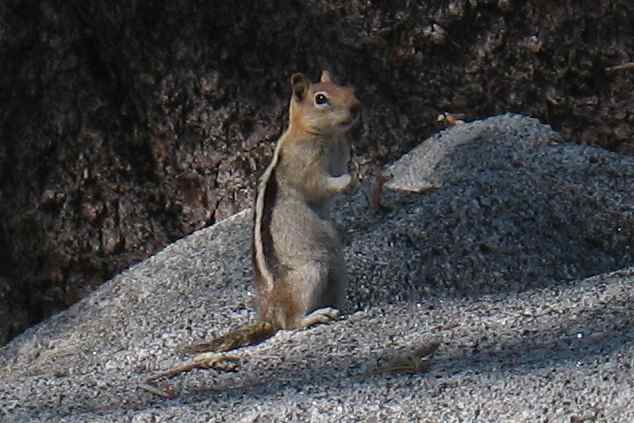
Chipmunk
How do these adorable critters relate to my bird research?
I’m going to show you some pictures. They will be cute. Ready?
Deer mouse in nestbox
Chipmunk
How do these adorable critters relate to my bird research?
I’m in field-work-prep mode now, getting ready for the rapidly approaching field season. That means finding field assistants, getting them approved by the university, buying equipment, planning out food… We’ll be camping for much of the field work, so food is a nontrivial issue. It has to be compact enough that you can fit it in a bear barrel or bear locker (to keep the bears from eating it), it has to keep without refrigeration, it has to be cookable over a camp stove, and it has to give you the energy to do field work all day. It also has to be tasty enough that my field assistants don’t mutiny.

I want to eat your food but people are scary so I'm going to wait in this tree for you to go away
The plan is to start field work in the beginning of May—maybe. To do the kind of research where you capture and handle birds, you need permits. At a minimum, you need a federal permit and a state permit; you may also need a permit for the specific location you’re working in. I have my federal permit, but am still waiting on the state permit. Everyone think speedy thoughts at the state permitting people!
(If I don’t get the permit by May, I will go out and nondisruptively observe the heck out of the juncos until I do get the permit. But I would prefer to be able to begin banding them right away.)
Science! I will discuss scientific topics and describe the day-to-day process of science in unprofessional comprehensible language. If you’re interested in what a field biologist does, or if you want to think about animal behavior and evolution, stick around.
Suspense! These days everything on TV or in the movies has been spoilered all over the internet months in advance. This blog will not be spoilered. This will be a real-time chronicle of my research, so without time travel, spoilering is impossible. I might make the cover of Science! One of my field assistants might get eaten by a bear! No one knows.
Sex! Of course, this is science, so I’ll be using terms like “copulation,” “extra-pair paternity,” and “genetic introgression.” But you’ll know what I’m really talking about.
This is the blog for my research. There will probably also be thoughts on related things, such as: ornithology; behavioral ecology; animal communication; the process of research; the wilds of academia; and animals being awesome.
Who am I? I am Katie LaBarbera, a second-year graduate student in the Museum of Vertebrate Zoology at the University of California – Berkeley. Before I came here, I did research on House Wrens as an undergraduate at Cornell University. Now, I’m working on a research project on Dark-eyed Juncos in the mountains near Yosemite: specifically, how they respond to variability in their habitat, changes in the weather, and climate change.

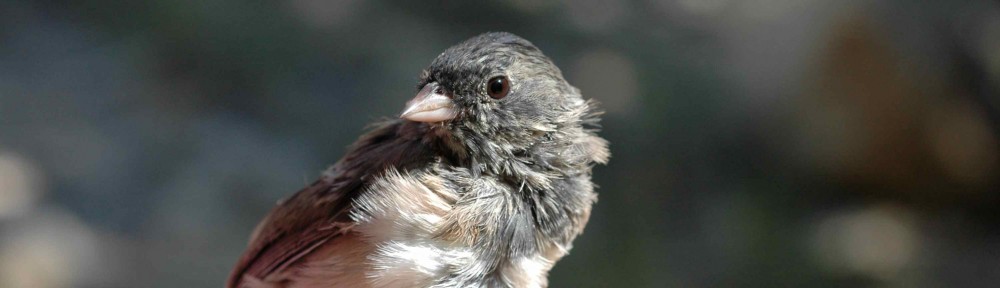
What I study - the Oregon form of the Dark-eyed Junco
In a few weeks I’ll have a page up on RocketHub as part of the SciFund Challenge, and I hope you’ll check it out. There will be baby birds in the video!
 Tough Little Birds