Adventure of a freelance science mouse

Two of my labmates study chipmunks. Recently they have been working with an engineer to develop a small tag that they can attach to a chipmunk to record the chipmunk’s movements. This, if it works, will let them “see” what the chipmunk is doing without actually watching–and bothering–the chipmunk, which would be great: one of the difficulties of behavioral ecology is that, for animals as for subatomic particles, observing the thing often affects the very nature of that thing.

Part of developing this tag is being able to check how well it works. Unfortunately, our lab doesn’t have any chipmunks just hanging around on which to test the tag. So instead, for an unofficial, exploratory test run, we recruited one of my domestic mice.

Oreo the freelance science mouse

Continue reading

Rituals

Ritual is everywhere in the natural world. From braving flight over expansive, stormy seas, to the tenuous, exhausting work of rearing chicks, to squabbling for social rank on the wintering grounds, birds tread and hop and fly recognizable annual patterns.

And so do field biology graduate students.

Our most obvious ritual is the field season. Our study subjects follow an annual pattern and so must we: the ornithologists out May through August, give-or-take; my labmates the high-elevation chipmunk researchers waiting impatiently in June for the snow on Tioga Pass to melt; those studying South American fauna gone in our winter for the Southern Hemisphere summer. Only the tropical biologists are unpredictable.

Continue reading

Scary birds

In honor of Halloween: some birds you would not want to meet in a dark alley at night. (Warning: first two sections contain photos of predation.)

Shrikes

Loggerhead Shrike. Photo by Jeff Jones.

Shrikes are medium-sized birds—the Northern Shrike is slightly smaller than an American Robin—and, upon first glance, fairly unassuming. Perhaps you notice the somewhat raptor-like bill; perhaps the extra notch on that bill, the tomial tooth; perhaps not. But it is only because you are much, much bigger than a shrike that you can afford to be so careless of this fearsome predator.

Continue reading

Blood secrets

Sometimes doing science feels like doing magic. Take a fantastical witch brewing eye of toad and nightshade flower in a cauldron, substitute a 1.5 ml tube for the cauldron, AW1 Buffer for the nightshade flower, and blood of junco for the eye of toad, and that’s me.

(And that “eye of ___” thing happens in science too: a few of my herpetologist colleagues have been talking lately about what you can learn from preserved lizard eyes.)

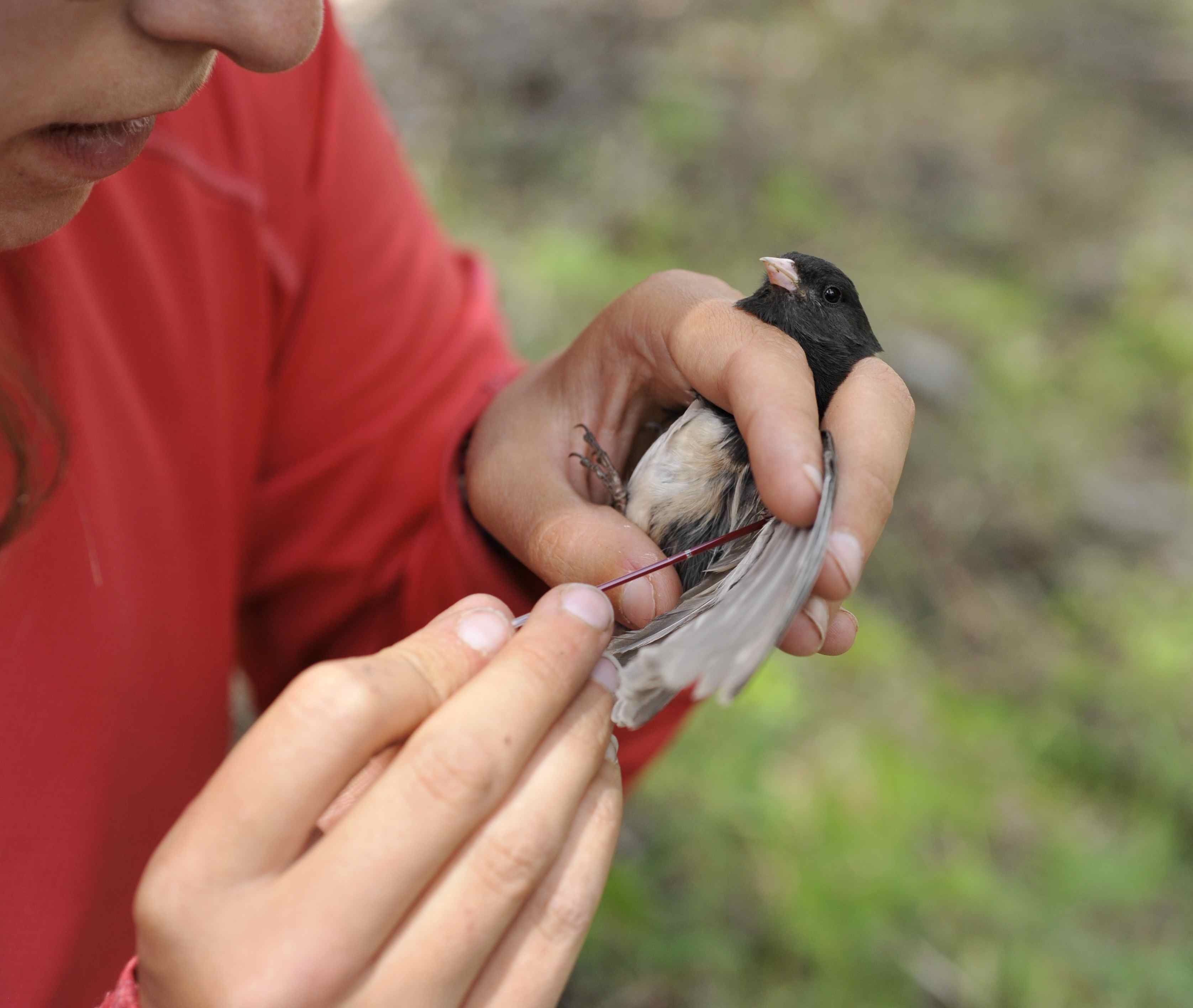
One of the things I do when I capture a junco is to collect a blood sample. I use a sterile needle, collect very little blood, and don’t let the bird go until I’m sure the bleeding has stopped. The birds usually don’t even flinch. They act much more upset when I blow on their chests to look for brood patches (I think it feels cold to them) than they do when I take blood.

Me collecting blood from GRAY. The blood moves up the tiny capillary tube on its own. Photo by M. LaBarbera.

Continue reading

Non-birds of the field II: mammals

All photos in this post are by M. LaBarbera.

Belding’s ground squirrel

Stand at one of our high-elevation sites, and at any given moment, you will be under surveillance by at least two Belding’s ground squirrels.

You might not see them, but down in the grass and the flowers, they are watching.

Continue reading

Non-birds of the field I: invertebrates

From most of the pictures on this blog, you might think that the only animals we saw this summer were the ones that flew into our nets. Not so!

Big red fuzzy moth

Of course, whether I can identify these non-birds is a different matter entirely. If you see anything you recognize, please comment and let me know what these exoskeleton-clad creatures are.

Continue reading

What the chickadees are saying behind your back

Black-capped Chickadees may be the easiest birds to identify by ear. Chick-a-dee-dee-dee, they sing, telling you exactly who they are. (I’ve heard that towhees do this too, but the towhees I’ve heard always seem to be saying twee or taree, from which I would not be able to get “towhee” unassisted.)

Don’t you know who I am? I’m Chick-a-dee-dee!
[A Mountain Chickadee, not a black-cap, but I don’t have any photos of black-caps.]

Of course, the chick-a-dee sounds like a vocal nametag to us only because someone had the good sense to name chickadees after their call. But it serves as an identifier among the chickadees too. The “chick-a-dee call complex” consists of four note types (the A, B, C, and D notes in a row might be transcribed as chick-k-ka-dee) that can be given in various combinations. Each note type itself can vary in frequency and duration. The chickadees thus have a lot of potential variation to work with, and they do. The D (dee) notes alone indicate both the identity of the individual bird calling, and the flock it belongs too—rather the same way that an Englishman saying “Hello, my name is George,” might indicate to compatriots both his own identity (George) and, in his accent, the region he is affiliated with. When captive chickadees are put into new flocks, the calls of the new flock members change, converging on each other, to indicate their new flock membership.

Continue reading

White gloves, strange rooms

One of the things I like about what I do is the strangeness of my everyday situations. There’s more of the boring old Sitting At A Computer Situation than I would like, but the Measuring Baby Birds On A Mountaintop Situation helps make up for that.

Now that field work is (mostly) over for the season, my situations are different, but not really less strange.

Strange Room #1

In order to look at the genetics of the juncos, I’ve been doing lab work in the Museum’s Evolutionary Genetics Lab. Lab work was my introduction to ornithology as an undergrad, and I’ve always liked it, despite the bleach and the potentially-toxic chemicals and the way my nose always itches and I can’t scratch it because I’ve got latex gloves on. The colors, noises, and vocabulary of lab work are specialized and surreal: the stacks of plastic racks in bright red, yellow, blue; the whirr of centrifuges starting up, like tiny revving plane engines; aliquot, vortex, elution buffer. I like the contrariness of refrigerators and microwaves with NO FOOD scolded across them. The concentration required to pipette the right amounts of the right reagents into the right tubes again and again and again makes it a kind of meditation.

Continue reading