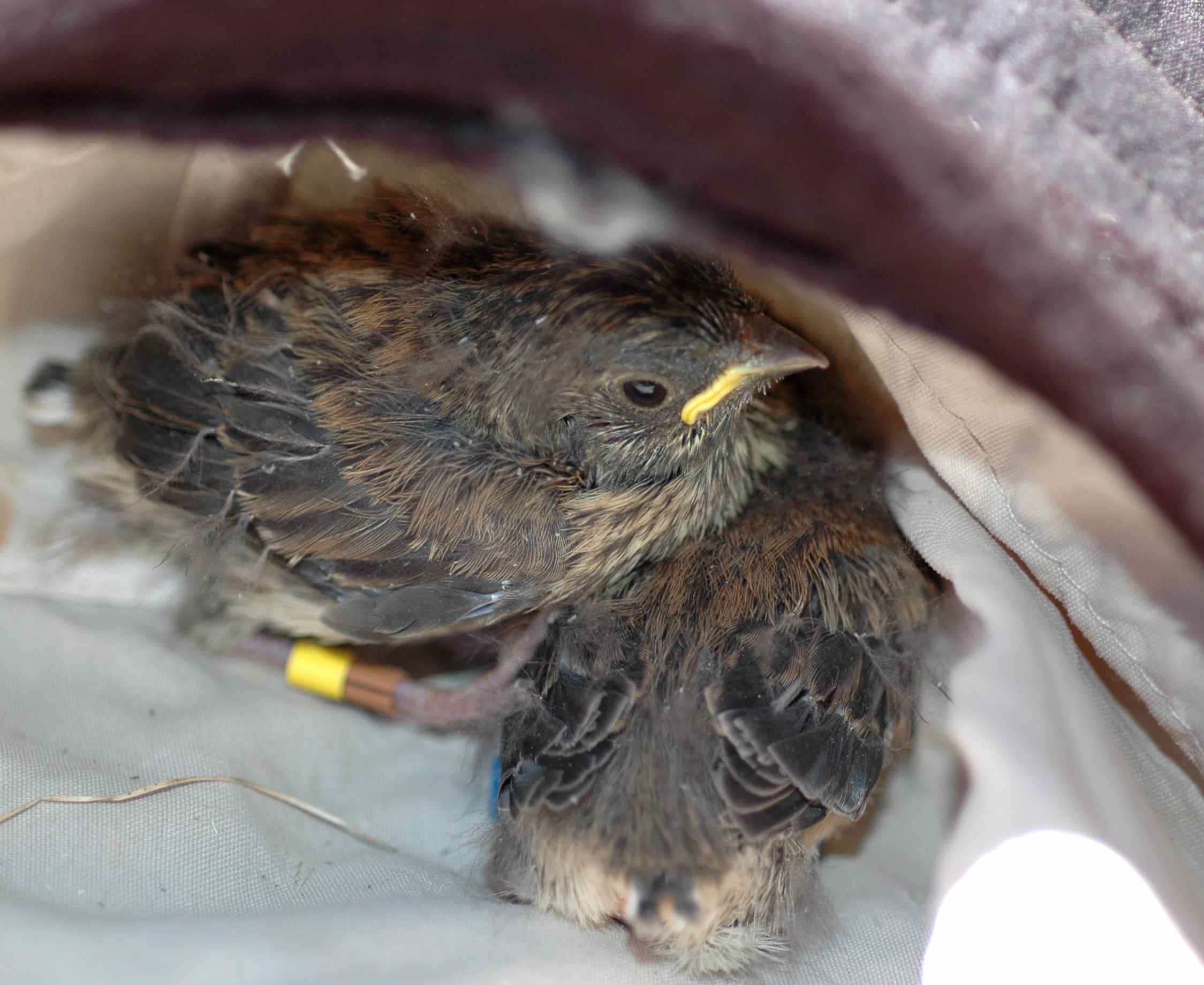
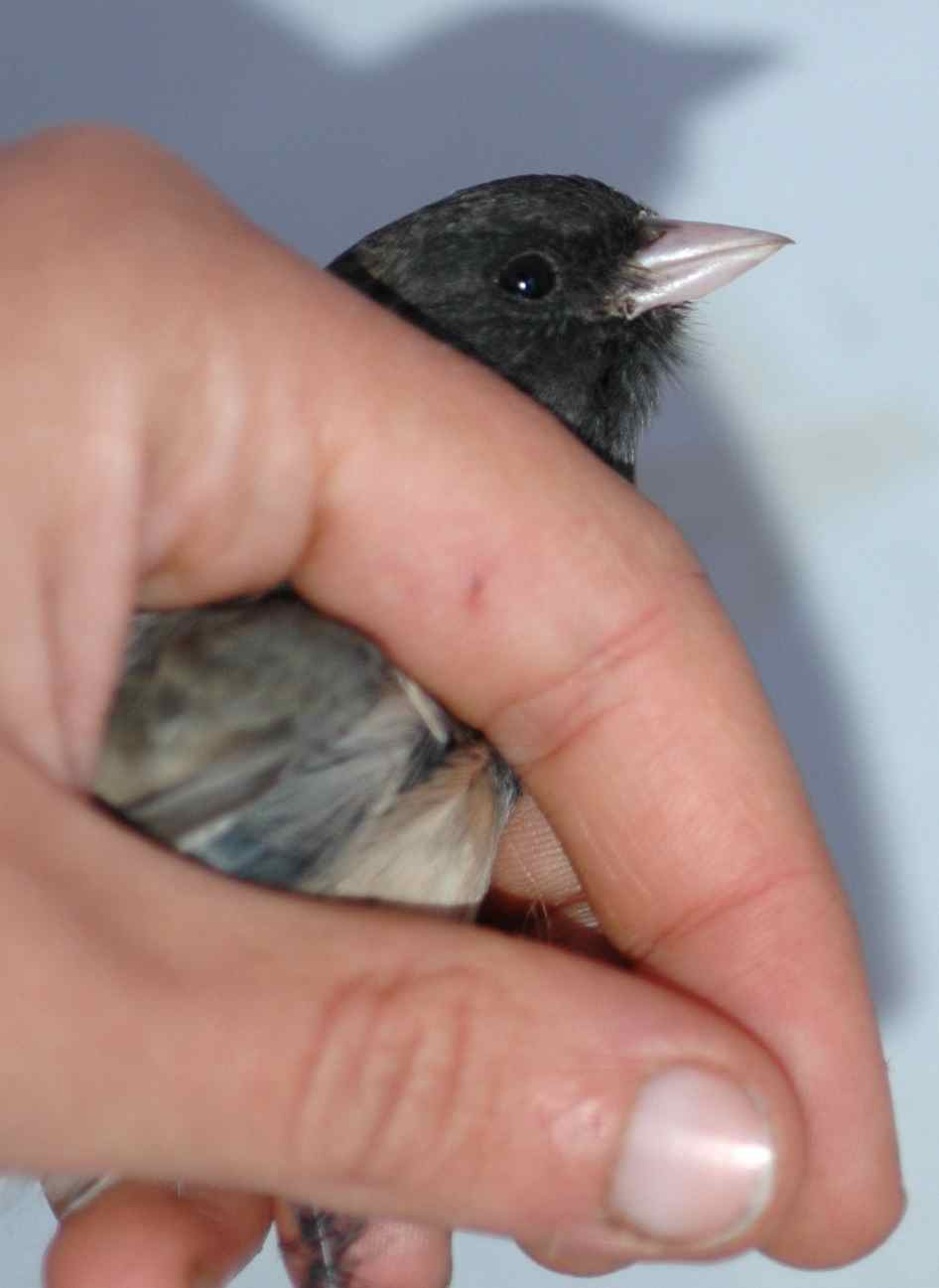
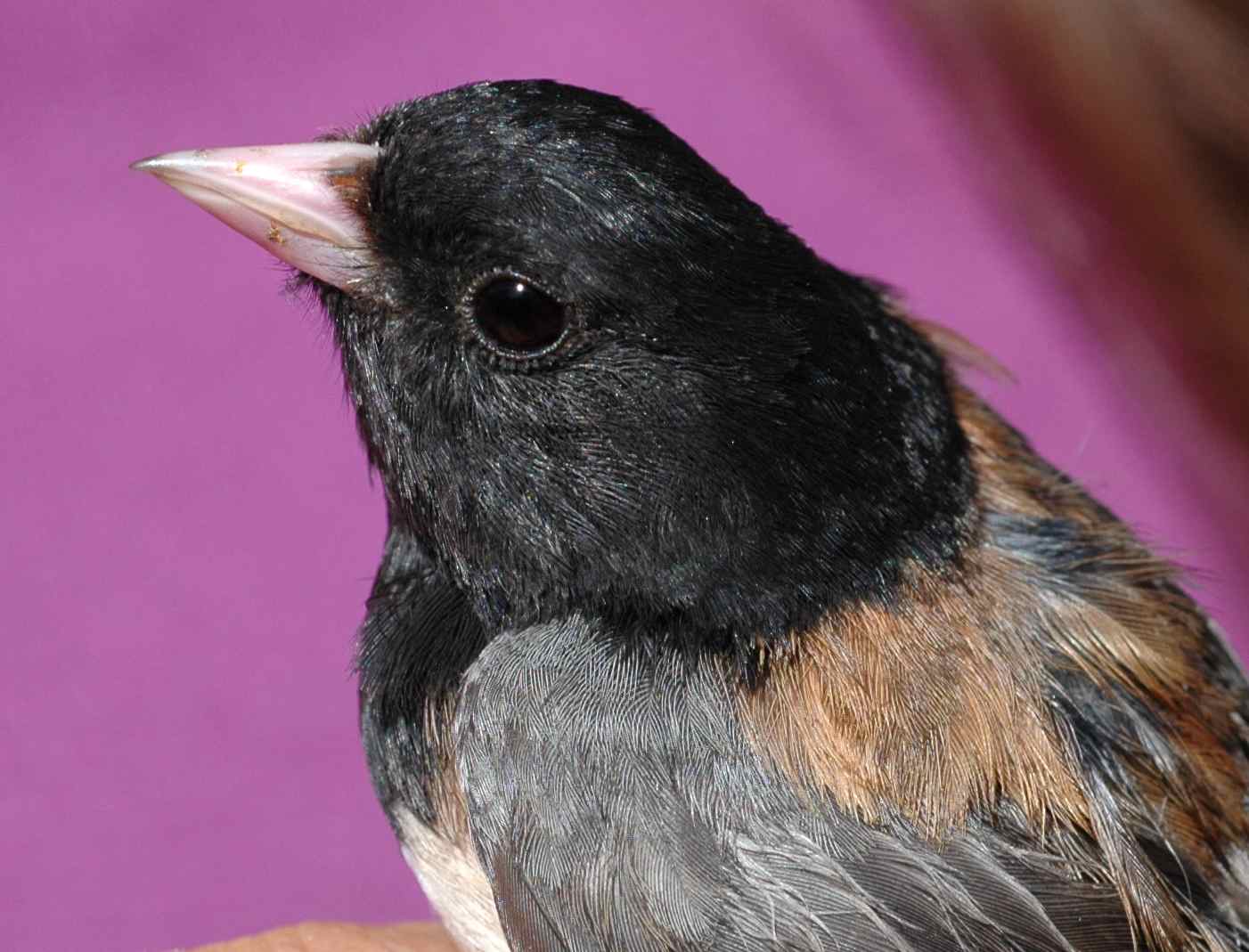
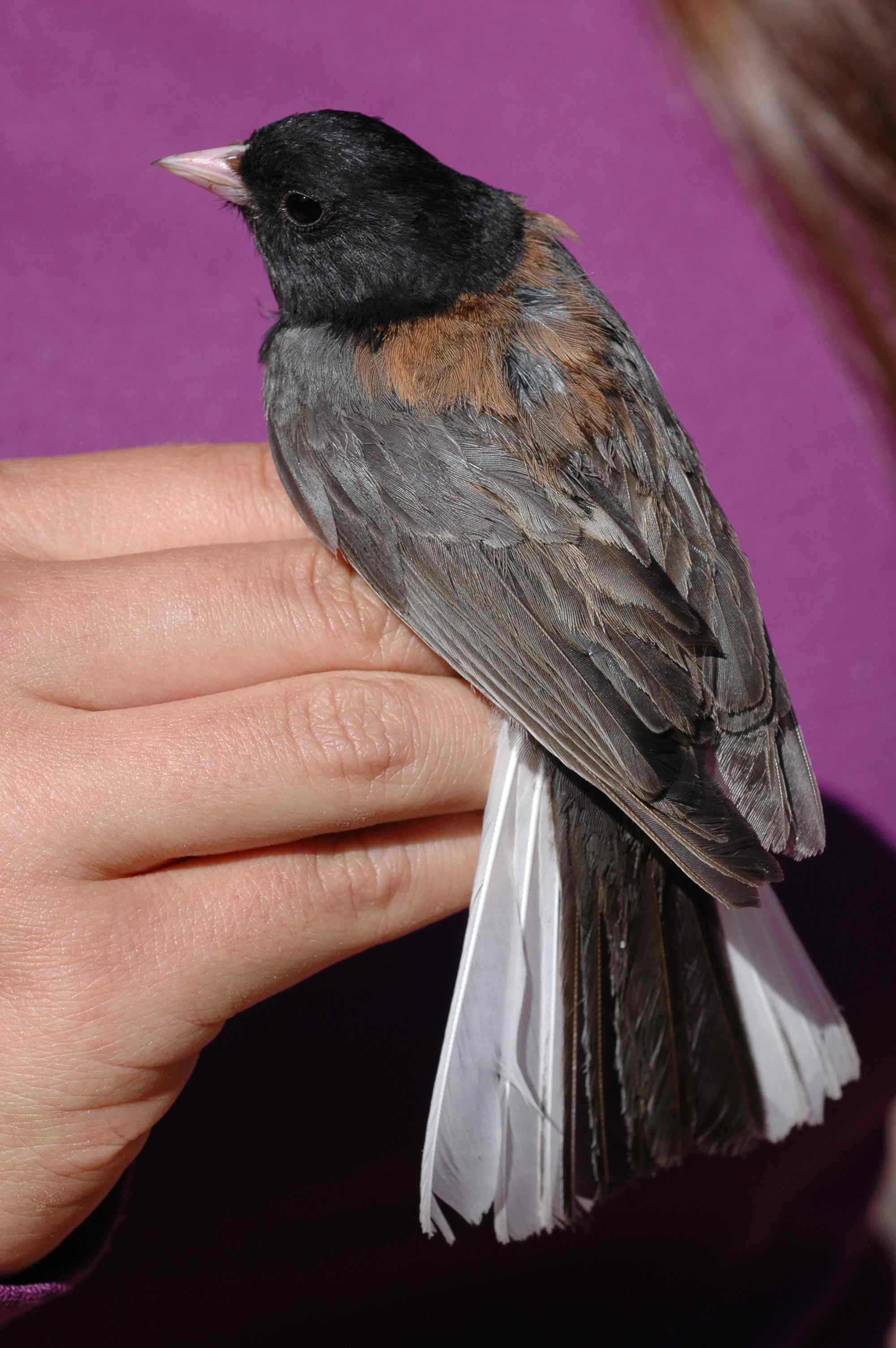
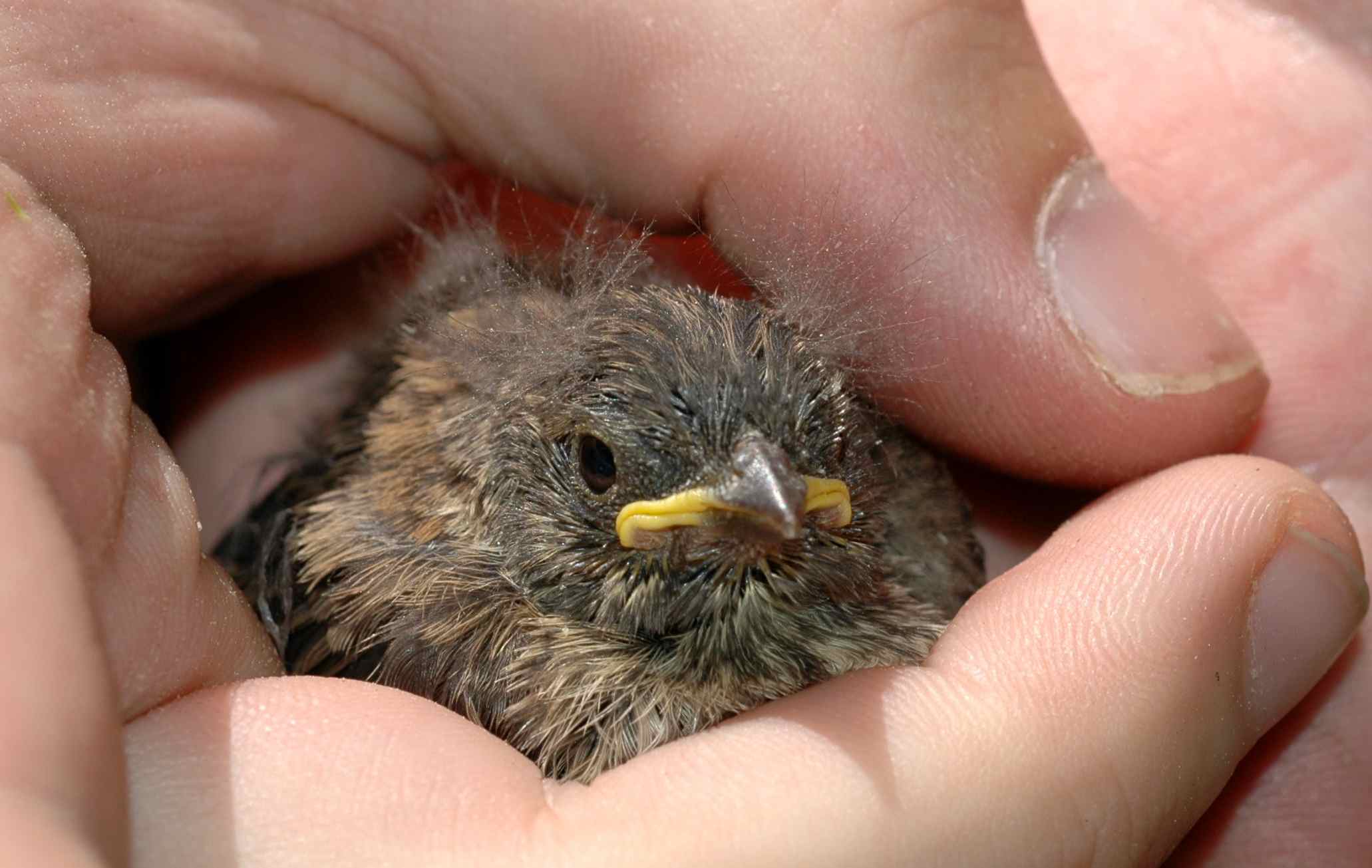
I stayed away from OLLA’s nest for several days, as I promised, so as not to scare the chicks into fledging early; but finally I just had to know if they had fledged yet. As I approached the nest both OLLA and ALGE scolded me—but the nest was empty. I looked around to see why they were angry at me and caught sight of a fledgling in a nearby tree: BABY! I didn’t see BABY’s siblings, but there were lots of trees around, and fledglings can be cryptic if they stay still. BABY was the smallest of the three so if she is fledged and okay, it’s very likely that YAYN and MAYO are doing well too.
Category Archives: notable juncos
The happy couple– er, trio
A few days ago, we had a very good day: we caught two females! This brings our total banded females up to… five. Females are elusive.
The two females we caught aren’t interesting only for their sex, however.
Nest update: OLLA’s chicks!
Remember how OLLA and ALGE had three eggs? They’re not eggs any more!
SOMA, MANI, & NOLA: funny-colored juncos
Color abnormalities don’t seem to be very unusual in juncos. There is a junco who sings outside my work building who has white splotches all over him! None of the juncos we’ve caught have been that extreme, but we have found a few with unusual spots of color on them.
SOMA has a white spot above his right eye:
Nests and eggs!
We found nests! And they have eggs in them!
The first nest we found belongs to OLLA (female) and ALGE (male). Or, we assume it belongs to ALGE too, since he and OLLA are mates; only genetic testing can tell us if the eventual chicks are really his.
LOLA
Meet LOLA (Lime – Orange – Lime – Aluminum). She is one of only two juncos we have caught so far that I feel completely confident is female.
LAGG
Meet LAGG (Lime – Aluminum – Green – Green).
He lives a good 30-minute walk from a campground off Highway 120, far from any other junco territory, as seems to be the rule in our low-elevation sites. We did not see a mate with him—which is strange, to me, because from my subjective human perspective I think he is the handsomest male junco we have caught so far. His head is stark black, no brown feather edges; his back is a rusty red-brown; his tail feathers have lots of white. But of course, there’s no reason to think that female juncos have the same taste in male juncos that I do—and that’s one of the things I’m hoping to find out: what aspects of junco appearance matter to female juncos?
SNAG
Meet SNAG (his leg bands are Sky blue – browN – Aluminum – Green). He lives at approx. 3100 ft above sea level, in a campground along Highway 120 in Stanislaus National Forest. He seems to be doing well: he has a mate, and when I say he lives in a campground, well… actually his territory appears to encompass the entire campground!
His mass is about normal for what we’ve been seeing – 17.6 grams – and he has no visible subcutaneous fat, like most of the juncos we’ve caught. So he’s probably fine, but he could stand to eat more. And he’s working on it: when we caught him he had prey in his bill! They look like aphids to me, but I haven’t really tried to identify them yet.