I always thought of puffins as fairly dignified birds. They look sleek and posed in the photos you usually see, like statues of themselves. Recently, however, I discovered that to get that sleek, clean look, puffins take on some poses that would be quite hard to capture in a statue.
Why do pigeons court all the time?
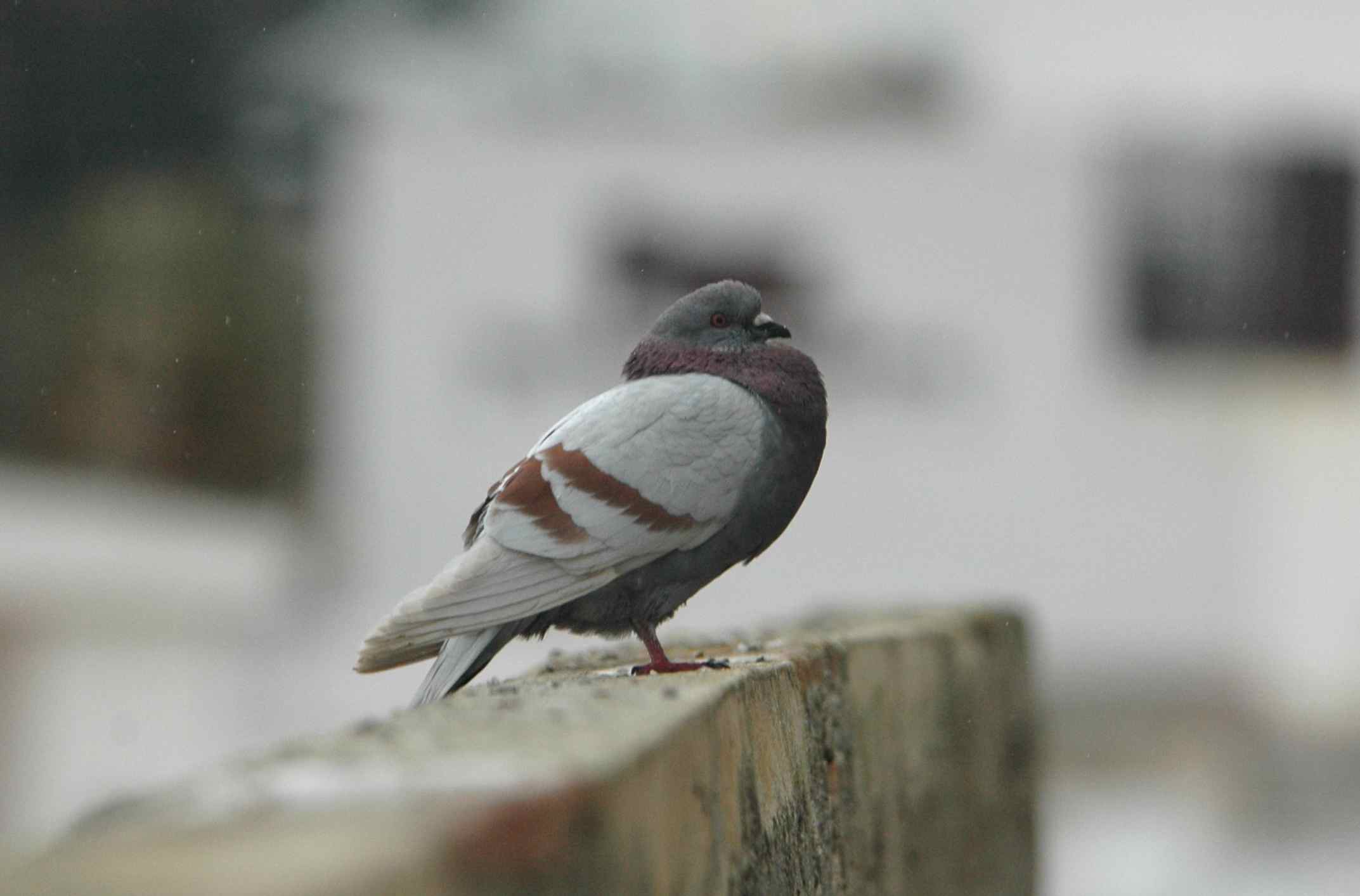
Most of our familiar birds court potential mates only at specific times of year. This is why spring is such a melodious season in many places: the male songbirds are all singing for their mates. Male pigeons, however, seem to court all the time. It’s below freezing and snowing? Why, what a great time to puff up and bow and coo at the ladies!
This seems strange because we expect courting birds to breed soon after a successful courtship. Yet pigeons court in weather that seems like it would be terrible for breeding. What are these pigeons up to? Are the males really trying to convince the females to lay eggs in mid-winter?
The temperatures of field work, made visible
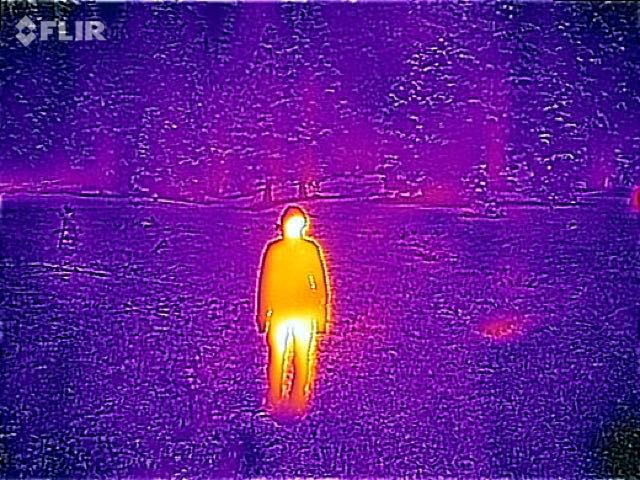
In the field, I become especially attentive to temperature. Is it too cold to catch birds? Are my hands warm enough to not chill a bird when I hold it? Recently, a friend very kindly let me take his FLIR ONE to the field: this is a device that fits over your phone and lets you take photos of heat. (Normal photos are of visible light.) Warmer objects show up as yellows and whites; colder objects are blue and black. The photos it takes aren’t of absolute temperature—that is, 40 degrees F isn’t always the exact same color—but rather of relative temperature: within the same photo, you can use the colors to compare temperatures, but you can’t compare across photos.
This was a lot of fun to use in the field, especially since the weather so generously gave us lots of temperatures to observe by snowing on us. Did you know that snow is cold, and humans are warmer than snow?
First trip of the final junco field season
As endless as PhDs may seem to those in the thick of them, they do end. I am now almost exactly one year out from my planned graduation date, which means that I need to transition from collecting my data to analyzing and disseminating my results. Practically, this means that I can’t spend the whole summer out in the mountains tracking juncos, like the last three years. I need to also spend the summer running analyses, writing, and presenting at conferences.
Of course, I can go out to the mountains sometimes. Just to see what the juncos are up to. They would probably miss me otherwise, right? I’ll just collect a little more data…
Biology with third graders
In the past month I have been occasionally visiting local third-grade classes with some colleagues to deliver a lesson on adaptive variation. It isn’t as dry as that makes it sound—there are puzzles and tiny spoons and squishy fishing lures. We are fun scientists. Science is fun! Science is fun but if you don’t put the fishing lures back in the bins and pay attention, we won’t get to start, okay, I know they’re gross, please don’t throw them, thank you, as I was saying, science is fun!
It has been interesting to see how much difference there is between classes. One class squirmed and giggled whenever we suggested that animals might need to find, as we put it, “boyfriends and girlfriends.” Another class was completely unfazed. “Yes,” one student in that class clarified, “they need to find mates.” Every class so far has known about camouflage and what hummingbirds eat.
Find the nest 3
This is the strangest nest placement I have seen from my juncos so far. The setting is a meadow with scattered corn lilies, an area favored by the cattle that sometimes graze in my field sites. The holes you see in the dirt are footprints left by cow hooves in the soft ground.
Who let me have a smartphone?
I held off getting a smartphone for a long time. I frustrated friends who tried to text my ancient flip phone internet links and baffled people by actually getting lost and having to phone for directions. (Who gets lost these days? Everyone has Google Maps in their back pocket now.)
But I’m going to two conferences in unfamiliar places this summer, and I don’t particularly want to get lost in Alaska or Brazil. So I got a smartphone. And now I have a camera in my back pocket all the time.
Not surprisingly, in my hands this has mostly yielded pictures of birds.
Double rain
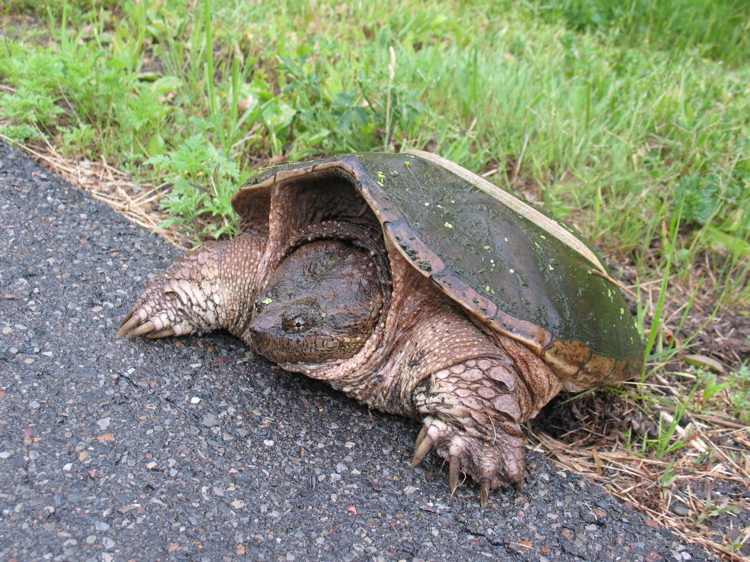
Before I studied juncos in California, I studied House Wrens in New York. Most days in the spring and summer I biked from my basement apartment to my field site, which had the no-nonsense label Unit One. The bike ride was an adventure in itself: I prepped for the field season by relearning how to stay on a bike, which I hadn’t done since childhood. (Contrary to the popular saying, it appears I can forget how to ride a bike.) On my way to Unit One I often came upon large snapping turtles stumping deliberately across the road, on the turtle-slow prowl for places to lay their eggs.
Unit One was primarily a field site for studying Tree Swallows. The front half of it was short grass broken up by regular rectangular ponds, over which the swallows stooped and swirled. House Wren territory lay past the manicured domain of the swallows, in forest dense with brush and mosquitoes. At the start of the field season I feared getting lost in it: the paths were overgrown, and I have a poor natural sense of direction.
Is that a friendly (woolly, stingy) face I see?
Humans see faces everywhere. We see a face in the craters of the moon, in wall sockets, sideways in punctuation :-) and just about anywhere else two dots and a line are arranged in even approximately the same positions as two eyes and a mouth.
Once we recognize something as a face, we process it differently from other visual stimuli. Certain parts of the brains are triggered preferentially by faces. We are especially good at perceiving faces: we can pick out matching faces faster than matching abstract patterns, and distinguish non-matching faces more easily than other images. This only works, however, when our brains recognize the faces as faces: if you flip faces upside-down, they no longer trigger the “face” switch for us, and we become much worse at distinguishing them. The same thing happens if you digitally scramble facial features, so that there’s an ear in the middle and an eye on the chin and a mouth slanting across the forehead, or any other mix-up that makes the face no longer be arranged like a face. Our brains are specialized to perceive face-shaped patterns much better than other patterns.
Find the nest 2
This well-hidden nest took us a long time to find, even after we knew approximately where it should be. While we were searching, a man came to set up for a bike race and moved a port-o-potty right into the area where we thought the nest was, despite my protests. We worried that the parents of the nest would be too disturbed by the looming port-o-potty and the crowd of cyclists to feed the chicks, but fortunately that was not the case: the chicks grew up and fledged successfully.