Answering two questions posed by James:
| 1. Why do birds make such a racket in the morning when waking up?
2. How do they sleep at night without falling out of the trees? |
Answering two questions posed by James:
| 1. Why do birds make such a racket in the morning when waking up?
2. How do they sleep at night without falling out of the trees? |

You put your left foot in, you put your left foot out,

you put your right foot in… wait, is that right?
Cattle Egret isn’t sure how to do the dance but he says thank you Adrienne Jensen-Thomas for supporting bird research!
Round Two of the SciFund Challenge, an experiment in crowdfunding science, is up and running at RocketHub. The SciFund Challenge is a neat idea because it isn’t just asking for money (which we do all the time, although we call it “grant writing” to make ourselves feel better)—it’s about reaching out to the public and talking about our research to non-scientists. Too, it gives everyone a little bit of say in what they think is interesting, worthy research. The vast majority of research is funded by committees made up of veterans in that particular field, and there is a lot that is great about that; but it can make fields rather insular, and promote grant writing skills over outreach skills. Adding crowdfunding into the mix changes that.
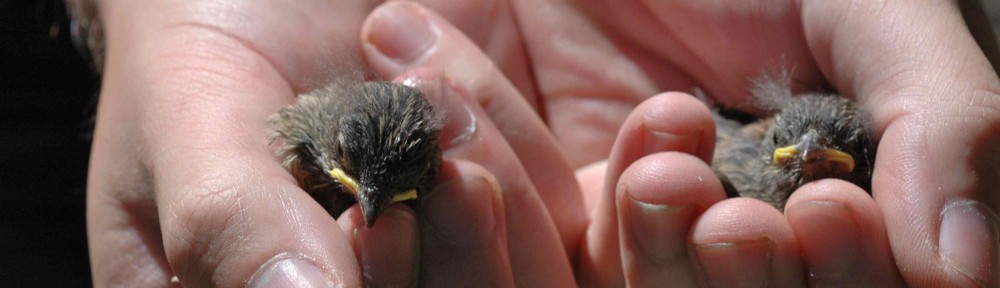
So check out my project, if only to see all the footage of juncos, including chicks and a fledgling! And take a look at some of the others; there are a huge variety of projects up, on everything from crabs to parasites to saving the world, and some of them are really cool.
And thanks to Dr24hours for being my first funder!
Not the game—real angry birds. You may not always notice angry birds, but they are all around you. Birds mob other (usually larger, threatening) birds, flying at them and even hitting them. Imagine if mice got together to run headfirst into cats…
(Actually, I know some cats that might be scared of those mice. You might call them scaredy-cats… Don’t hurt yourself laughing at my witticisms.)
Birds also fight others of their own species. Physical fights are pretty rare: birds usually try to work their fights out using “words not fists”—or rather, song not violence. Birds will usually start with songs and calls, then escalate to threatening postures and movement, and only if none of that resolves the issue will they fight. Recently, I watched a Snowy Egret face what I think must have been an intruder on his territory. First he called. When the intruder didn’t leave, he raised the crest on his head high and flew at the intruder, chasing him away. Continue reading
First, that’s what my research project is about: little birds (Dark-eyed Juncos weigh about 20 g; that’s the same as about eight bite-size Frosted Mini-Wheats biscuits, or 1/4 of a single package of ramen) that are tough. They are tough because they can breed at sea level or high on a mountain—that’s a lot of variation to adapt to! The high-elevation ones are especially tough, since on the tops of mountains there is snow, often into June, and the juncos have a very short window in which to raise their chicks before it gets cold and harsh all over again in the fall. They are also tough, or will need to be, because of climate change. Patterns of temperature and precipitation are shifting, and species are shifting too, but not all at once and not in the same ways, which means that habitats are changing. Juncos will need to be tough to handle that.
Second, the title reflects one of the reasons I am passionate about birds: they are little, or if they aren’t little they are fragile in other ways* (hollow bones, long thin legs, etc.), and yet they constantly astound me with their toughness. They live in deserts or on ice sheets or they stay aloft over the open ocean for months at a time. Tiny birds will migrate across whole continents, twice a year. Hummingbirds are so delicate that they sometimes have to slow down their metabolisms overnight to keep from starving to death before morning—and yet hummingbirds are very successful, and can live more than ten years. Birds are awesomely tough.
*Exception: ostriches. They do not look fragile to me at all. Ostriches, this blog is not about you.
Science! I will discuss scientific topics and describe the day-to-day process of science in unprofessional comprehensible language. If you’re interested in what a field biologist does, or if you want to think about animal behavior and evolution, stick around.
Suspense! These days everything on TV or in the movies has been spoilered all over the internet months in advance. This blog will not be spoilered. This will be a real-time chronicle of my research, so without time travel, spoilering is impossible. I might make the cover of Science! One of my field assistants might get eaten by a bear! No one knows.
Sex! Of course, this is science, so I’ll be using terms like “copulation,” “extra-pair paternity,” and “genetic introgression.” But you’ll know what I’m really talking about.
This is the blog for my research. There will probably also be thoughts on related things, such as: ornithology; behavioral ecology; animal communication; the process of research; the wilds of academia; and animals being awesome.
Who am I? I am Katie LaBarbera, a second-year graduate student in the Museum of Vertebrate Zoology at the University of California – Berkeley. Before I came here, I did research on House Wrens as an undergraduate at Cornell University. Now, I’m working on a research project on Dark-eyed Juncos in the mountains near Yosemite: specifically, how they respond to variability in their habitat, changes in the weather, and climate change.

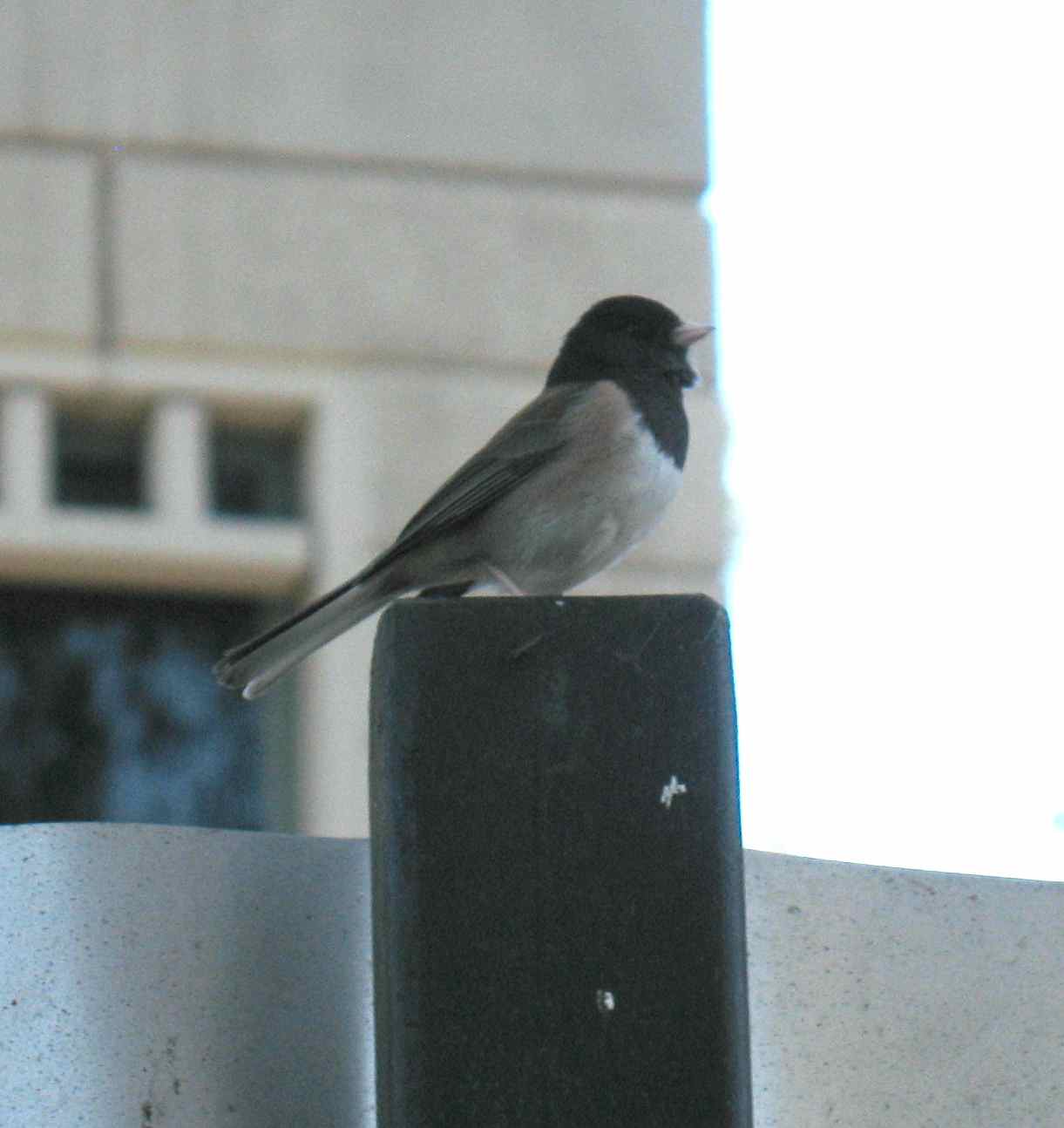
What I study - the Oregon form of the Dark-eyed Junco
In a few weeks I’ll have a page up on RocketHub as part of the SciFund Challenge, and I hope you’ll check it out. There will be baby birds in the video!
 Tough Little Birds